1929 · CLOSE READING
Confessions of Aleister Crowley
Confessions of Aleister Crowley (1929), PDF p. 394
Original page
Enlarge ↗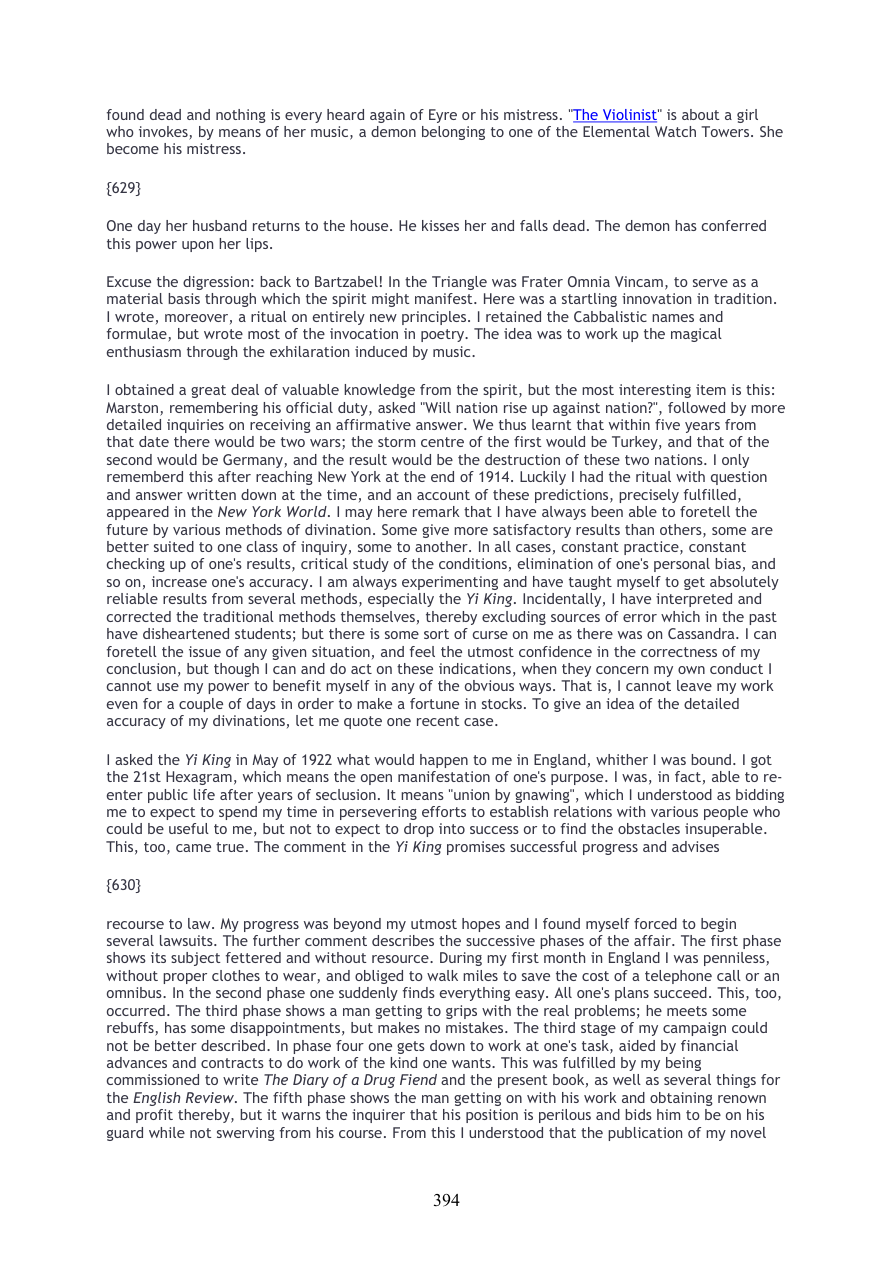
Highlights use the original PDF text layer. OCR-only matches may not be visible on the scan.
Transcription
Download text ↓raw extractionoriginal embedded textReview: unreviewed
394
found dead and nothing is every heard again of Eyre or his mistress. "The Violinist" is about a girl
who invokes, by means of her music, a demon belonging to one of the Elemental Watch Towers. She
become his mistress.
{629}
One day her husband returns to the house. He kisses her and falls dead. The demon has conferred
this power upon her lips.
Excuse the digression: back to Bartzabel! In the Triangle was Frater Omnia Vincam, to serve as a
material basis through which the spirit might manifest. Here was a startling innovation in tradition.
I wrote, moreover, a ritual on entirely new principles. I retained the Cabbalistic names and
formulae, but wrote most of the invocation in poetry. The idea was to work up the magical
enthusiasm through the exhilaration induced by music.
I obtained a great deal of valuable knowledge from the spirit, but the most interesting item is this:
Marston, remembering his official duty, asked "Will nation rise up against nation?", followed by more
detailed inquiries on receiving an affirmative answer. We thus learnt that within five years from
that date there would be two wars; the storm centre of the first would be Turkey, and that of the
second would be Germany, and the result would be the destruction of these two nations. I only
rememberd this after reaching New York at the end of 1914. Luckily I had the ritual with question
and answer written down at the time, and an account of these predictions, precisely fulfilled,
appeared in the New York World. I may here remark that I have always been able to foretell the
future by various methods of divination. Some give more satisfactory results than others, some are
better suited to one class of inquiry, some to another. In all cases, constant practice, constant
checking up of one's results, critical study of the conditions, elimination of one's personal bias, and
so on, increase one's accuracy. I am always experimenting and have taught myself to get absolutely
reliable results from several methods, especially the Yi King. Incidentally, I have interpreted and
corrected the traditional methods themselves, thereby excluding sources of error which in the past
have disheartened students; but there is some sort of curse on me as there was on Cassandra. I can
foretell the issue of any given situation, and feel the utmost confidence in the correctness of my
conclusion, but though I can and do act on these indications, when they concern my own conduct I
cannot use my power to benefit myself in any of the obvious ways. That is, I cannot leave my work
even for a couple of days in order to make a fortune in stocks. To give an idea of the detailed
accuracy of my divinations, let me quote one recent case.
I asked the Yi King in May of 1922 what would happen to me in England, whither I was bound. I got
the 21st Hexagram, which means the open manifestation of one's purpose. I was, in fact, able to re-
enter public life after years of seclusion. It means "union by gnawing", which I understood as bidding
me to expect to spend my time in persevering efforts to establish relations with various people who
could be useful to me, but not to expect to drop into success or to find the obstacles insuperable.
This, too, came true. The comment in the Yi King promises successful progress and advises
{630}
recourse to law. My progress was beyond my utmost hopes and I found myself forced to begin
several lawsuits. The further comment describes the successive phases of the affair. The first phase
shows its subject fettered and without resource. During my first month in England I was penniless,
without proper clothes to wear, and obliged to walk miles to save the cost of a telephone call or an
omnibus. In the second phase one suddenly finds everything easy. All one's plans succeed. This, too,
occurred. The third phase shows a man getting to grips with the real problems; he meets some
rebuffs, has some disappointments, but makes no mistakes. The third stage of my campaign could
not be better described. In phase four one gets down to work at one's task, aided by financial
advances and contracts to do work of the kind one wants. This was fulfilled by my being
commissioned to write The Diary of a Drug Fiend and the present book, as well as several things for
the English Review. The fifth phase shows the man getting on with his work and obtaining renown
and profit thereby, but it warns the inquirer that his position is perilous and bids him to be on his
guard while not swerving from his course. From this I understood that the publication of my novel
Page provenance & review flags
Stable page ID: 5ef44b98d8f9c4af5f6f86e1:p00394
Line breaks are preserved. Reading order and OCR accuracy may need review.
Printed page label has not been verified.
- No automated review flags. This does not establish transcription accuracy.