1929 · CLOSE READING
Confessions of Aleister Crowley
Confessions of Aleister Crowley (1929), PDF p. 398
Original page
Enlarge ↗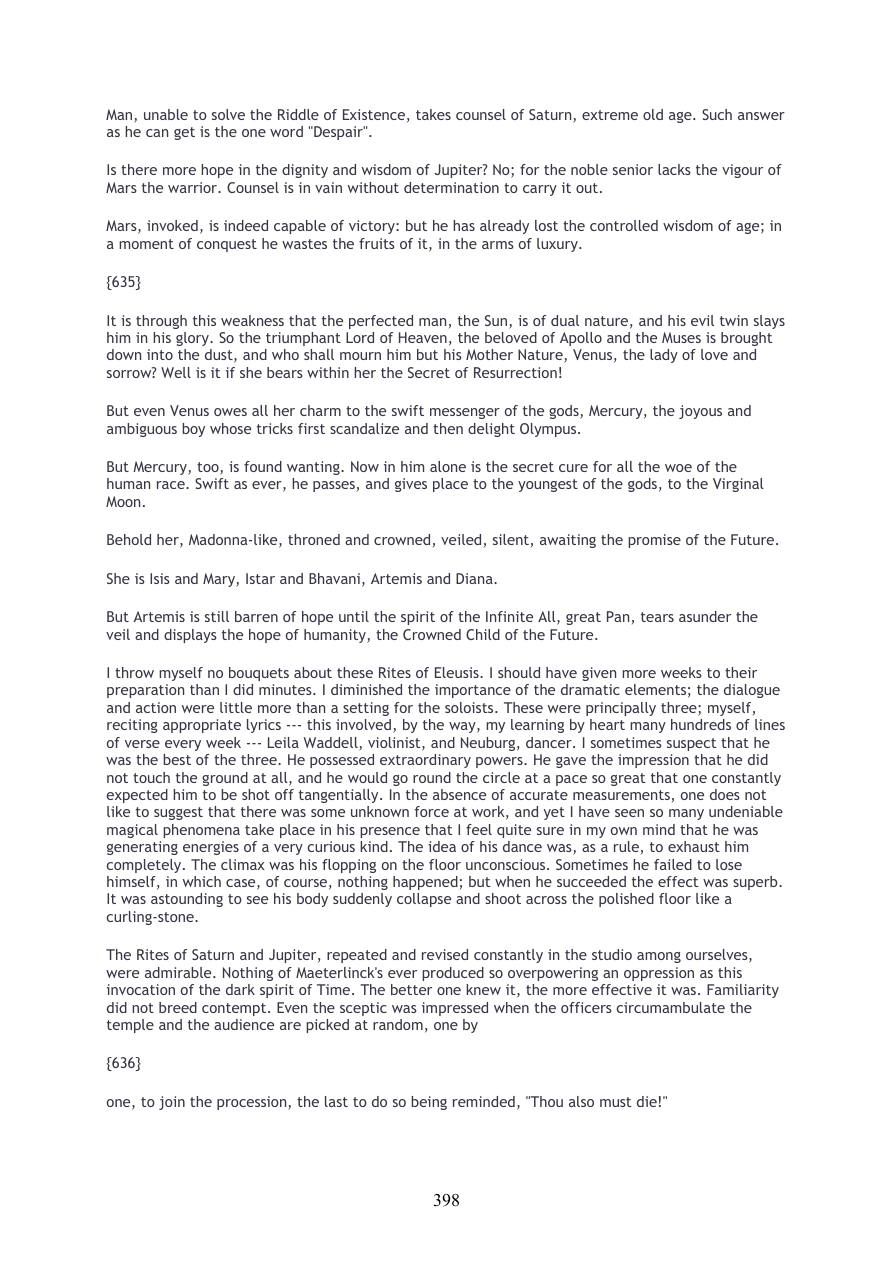
Highlights use the original PDF text layer. OCR-only matches may not be visible on the scan.
Transcription
Download text ↓raw extractionoriginal embedded textReview: unreviewed
398
Man, unable to solve the Riddle of Existence, takes counsel of Saturn, extreme old age. Such answer
as he can get is the one word "Despair".
Is there more hope in the dignity and wisdom of Jupiter? No; for the noble senior lacks the vigour of
Mars the warrior. Counsel is in vain without determination to carry it out.
Mars, invoked, is indeed capable of victory: but he has already lost the controlled wisdom of age; in
a moment of conquest he wastes the fruits of it, in the arms of luxury.
{635}
It is through this weakness that the perfected man, the Sun, is of dual nature, and his evil twin slays
him in his glory. So the triumphant Lord of Heaven, the beloved of Apollo and the Muses is brought
down into the dust, and who shall mourn him but his Mother Nature, Venus, the lady of love and
sorrow? Well is it if she bears within her the Secret of Resurrection!
But even Venus owes all her charm to the swift messenger of the gods, Mercury, the joyous and
ambiguous boy whose tricks first scandalize and then delight Olympus.
But Mercury, too, is found wanting. Now in him alone is the secret cure for all the woe of the
human race. Swift as ever, he passes, and gives place to the youngest of the gods, to the Virginal
Moon.
Behold her, Madonna-like, throned and crowned, veiled, silent, awaiting the promise of the Future.
She is Isis and Mary, Istar and Bhavani, Artemis and Diana.
But Artemis is still barren of hope until the spirit of the Infinite All, great Pan, tears asunder the
veil and displays the hope of humanity, the Crowned Child of the Future.
I throw myself no bouquets about these Rites of Eleusis. I should have given more weeks to their
preparation than I did minutes. I diminished the importance of the dramatic elements; the dialogue
and action were little more than a setting for the soloists. These were principally three; myself,
reciting appropriate lyrics --- this involved, by the way, my learning by heart many hundreds of lines
of verse every week --- Leila Waddell, violinist, and Neuburg, dancer. I sometimes suspect that he
was the best of the three. He possessed extraordinary powers. He gave the impression that he did
not touch the ground at all, and he would go round the circle at a pace so great that one constantly
expected him to be shot off tangentially. In the absence of accurate measurements, one does not
like to suggest that there was some unknown force at work, and yet I have seen so many undeniable
magical phenomena take place in his presence that I feel quite sure in my own mind that he was
generating energies of a very curious kind. The idea of his dance was, as a rule, to exhaust him
completely. The climax was his flopping on the floor unconscious. Sometimes he failed to lose
himself, in which case, of course, nothing happened; but when he succeeded the effect was superb.
It was astounding to see his body suddenly collapse and shoot across the polished floor like a
curling-stone.
The Rites of Saturn and Jupiter, repeated and revised constantly in the studio among ourselves,
were admirable. Nothing of Maeterlinck's ever produced so overpowering an oppression as this
invocation of the dark spirit of Time. The better one knew it, the more effective it was. Familiarity
did not breed contempt. Even the sceptic was impressed when the officers circumambulate the
temple and the audience are picked at random, one by
{636}
one, to join the procession, the last to do so being reminded, "Thou also must die!"
Page provenance & review flags
Stable page ID: 5ef44b98d8f9c4af5f6f86e1:p00398
Line breaks are preserved. Reading order and OCR accuracy may need review.
Printed page label has not been verified.
- No automated review flags. This does not establish transcription accuracy.