1929 · CLOSE READING
Confessions of Aleister Crowley
Confessions of Aleister Crowley (1929), PDF p. 400
Original page
Enlarge ↗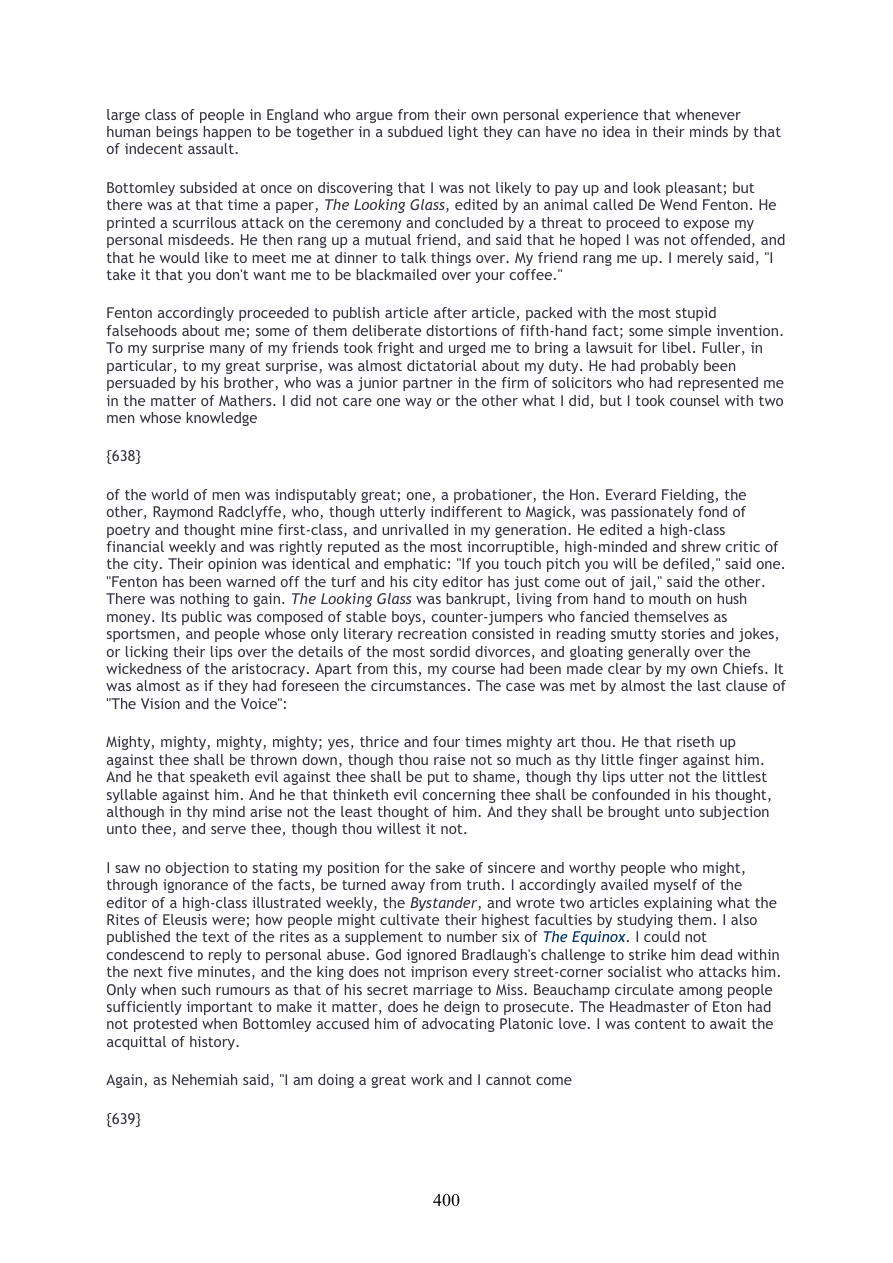
Highlights use the original PDF text layer. OCR-only matches may not be visible on the scan.
Transcription
Download text ↓raw extractionoriginal embedded textReview: unreviewed
400
large class of people in England who argue from their own personal experience that whenever
human beings happen to be together in a subdued light they can have no idea in their minds by that
of indecent assault.
Bottomley subsided at once on discovering that I was not likely to pay up and look pleasant; but
there was at that time a paper, The Looking Glass, edited by an animal called De Wend Fenton. He
printed a scurrilous attack on the ceremony and concluded by a threat to proceed to expose my
personal misdeeds. He then rang up a mutual friend, and said that he hoped I was not offended, and
that he would like to meet me at dinner to talk things over. My friend rang me up. I merely said, "I
take it that you don't want me to be blackmailed over your coffee."
Fenton accordingly proceeded to publish article after article, packed with the most stupid
falsehoods about me; some of them deliberate distortions of fifth-hand fact; some simple invention.
To my surprise many of my friends took fright and urged me to bring a lawsuit for libel. Fuller, in
particular, to my great surprise, was almost dictatorial about my duty. He had probably been
persuaded by his brother, who was a junior partner in the firm of solicitors who had represented me
in the matter of Mathers. I did not care one way or the other what I did, but I took counsel with two
men whose knowledge
{638}
of the world of men was indisputably great; one, a probationer, the Hon. Everard Fielding, the
other, Raymond Radclyffe, who, though utterly indifferent to Magick, was passionately fond of
poetry and thought mine first-class, and unrivalled in my generation. He edited a high-class
financial weekly and was rightly reputed as the most incorruptible, high-minded and shrew critic of
the city. Their opinion was identical and emphatic: "If you touch pitch you will be defiled," said one.
"Fenton has been warned off the turf and his city editor has just come out of jail," said the other.
There was nothing to gain. The Looking Glass was bankrupt, living from hand to mouth on hush
money. Its public was composed of stable boys, counter-jumpers who fancied themselves as
sportsmen, and people whose only literary recreation consisted in reading smutty stories and jokes,
or licking their lips over the details of the most sordid divorces, and gloating generally over the
wickedness of the aristocracy. Apart from this, my course had been made clear by my own Chiefs. It
was almost as if they had foreseen the circumstances. The case was met by almost the last clause of
"The Vision and the Voice":
Mighty, mighty, mighty, mighty; yes, thrice and four times mighty art thou. He that riseth up
against thee shall be thrown down, though thou raise not so much as thy little finger against him.
And he that speaketh evil against thee shall be put to shame, though thy lips utter not the littlest
syllable against him. And he that thinketh evil concerning thee shall be confounded in his thought,
although in thy mind arise not the least thought of him. And they shall be brought unto subjection
unto thee, and serve thee, though thou willest it not.
I saw no objection to stating my position for the sake of sincere and worthy people who might,
through ignorance of the facts, be turned away from truth. I accordingly availed myself of the
editor of a high-class illustrated weekly, the Bystander, and wrote two articles explaining what the
Rites of Eleusis were; how people might cultivate their highest faculties by studying them. I also
published the text of the rites as a supplement to number six of The Equinox. I could not
condescend to reply to personal abuse. God ignored Bradlaugh's challenge to strike him dead within
the next five minutes, and the king does not imprison every street-corner socialist who attacks him.
Only when such rumours as that of his secret marriage to Miss. Beauchamp circulate among people
sufficiently important to make it matter, does he deign to prosecute. The Headmaster of Eton had
not protested when Bottomley accused him of advocating Platonic love. I was content to await the
acquittal of history.
Again, as Nehemiah said, "I am doing a great work and I cannot come
{639}
Page provenance & review flags
Stable page ID: 5ef44b98d8f9c4af5f6f86e1:p00400
Line breaks are preserved. Reading order and OCR accuracy may need review.
Printed page label has not been verified.
- No automated review flags. This does not establish transcription accuracy.