1929 · CLOSE READING
Confessions of Aleister Crowley
Confessions of Aleister Crowley (1929), PDF p. 403
Original page
Enlarge ↗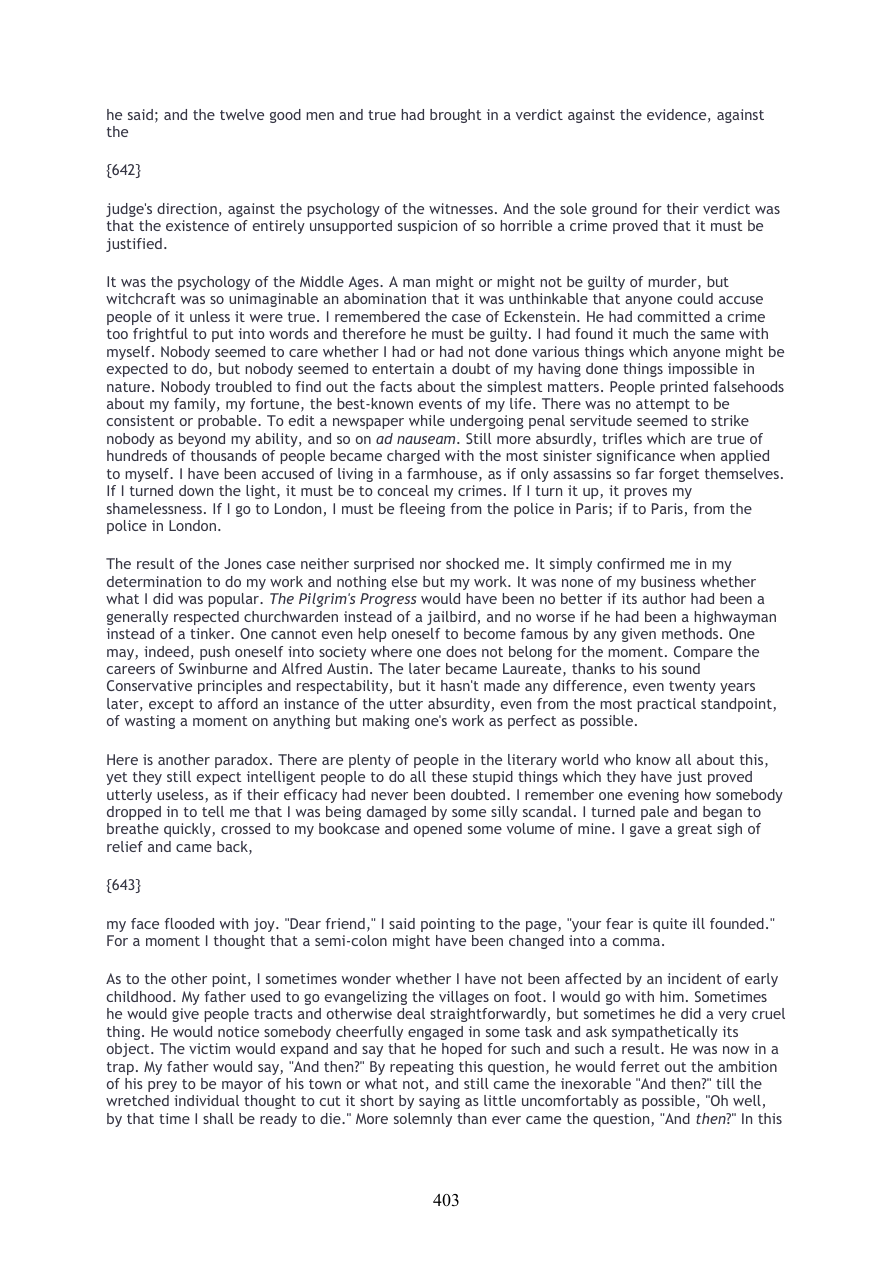
Highlights use the original PDF text layer. OCR-only matches may not be visible on the scan.
Transcription
Download text ↓raw extractionoriginal embedded textReview: unreviewed
403
he said; and the twelve good men and true had brought in a verdict against the evidence, against
the
{642}
judge's direction, against the psychology of the witnesses. And the sole ground for their verdict was
that the existence of entirely unsupported suspicion of so horrible a crime proved that it must be
justified.
It was the psychology of the Middle Ages. A man might or might not be guilty of murder, but
witchcraft was so unimaginable an abomination that it was unthinkable that anyone could accuse
people of it unless it were true. I remembered the case of Eckenstein. He had committed a crime
too frightful to put into words and therefore he must be guilty. I had found it much the same with
myself. Nobody seemed to care whether I had or had not done various things which anyone might be
expected to do, but nobody seemed to entertain a doubt of my having done things impossible in
nature. Nobody troubled to find out the facts about the simplest matters. People printed falsehoods
about my family, my fortune, the best-known events of my life. There was no attempt to be
consistent or probable. To edit a newspaper while undergoing penal servitude seemed to strike
nobody as beyond my ability, and so on ad nauseam. Still more absurdly, trifles which are true of
hundreds of thousands of people became charged with the most sinister significance when applied
to myself. I have been accused of living in a farmhouse, as if only assassins so far forget themselves.
If I turned down the light, it must be to conceal my crimes. If I turn it up, it proves my
shamelessness. If I go to London, I must be fleeing from the police in Paris; if to Paris, from the
police in London.
The result of the Jones case neither surprised nor shocked me. It simply confirmed me in my
determination to do my work and nothing else but my work. It was none of my business whether
what I did was popular. The Pilgrim's Progress would have been no better if its author had been a
generally respected churchwarden instead of a jailbird, and no worse if he had been a highwayman
instead of a tinker. One cannot even help oneself to become famous by any given methods. One
may, indeed, push oneself into society where one does not belong for the moment. Compare the
careers of Swinburne and Alfred Austin. The later became Laureate, thanks to his sound
Conservative principles and respectability, but it hasn't made any difference, even twenty years
later, except to afford an instance of the utter absurdity, even from the most practical standpoint,
of wasting a moment on anything but making one's work as perfect as possible.
Here is another paradox. There are plenty of people in the literary world who know all about this,
yet they still expect intelligent people to do all these stupid things which they have just proved
utterly useless, as if their efficacy had never been doubted. I remember one evening how somebody
dropped in to tell me that I was being damaged by some silly scandal. I turned pale and began to
breathe quickly, crossed to my bookcase and opened some volume of mine. I gave a great sigh of
relief and came back,
{643}
my face flooded with joy. "Dear friend," I said pointing to the page, "your fear is quite ill founded."
For a moment I thought that a semi-colon might have been changed into a comma.
As to the other point, I sometimes wonder whether I have not been affected by an incident of early
childhood. My father used to go evangelizing the villages on foot. I would go with him. Sometimes
he would give people tracts and otherwise deal straightforwardly, but sometimes he did a very cruel
thing. He would notice somebody cheerfully engaged in some task and ask sympathetically its
object. The victim would expand and say that he hoped for such and such a result. He was now in a
trap. My father would say, "And then?" By repeating this question, he would ferret out the ambition
of his prey to be mayor of his town or what not, and still came the inexorable "And then?" till the
wretched individual thought to cut it short by saying as little uncomfortably as possible, "Oh well,
by that time I shall be ready to die." More solemnly than ever came the question, "And then?" In this
Page provenance & review flags
Stable page ID: 5ef44b98d8f9c4af5f6f86e1:p00403
Line breaks are preserved. Reading order and OCR accuracy may need review.
Printed page label has not been verified.
- No automated review flags. This does not establish transcription accuracy.