1929 · CLOSE READING
Confessions of Aleister Crowley
Confessions of Aleister Crowley (1929), PDF p. 405
Original page
Enlarge ↗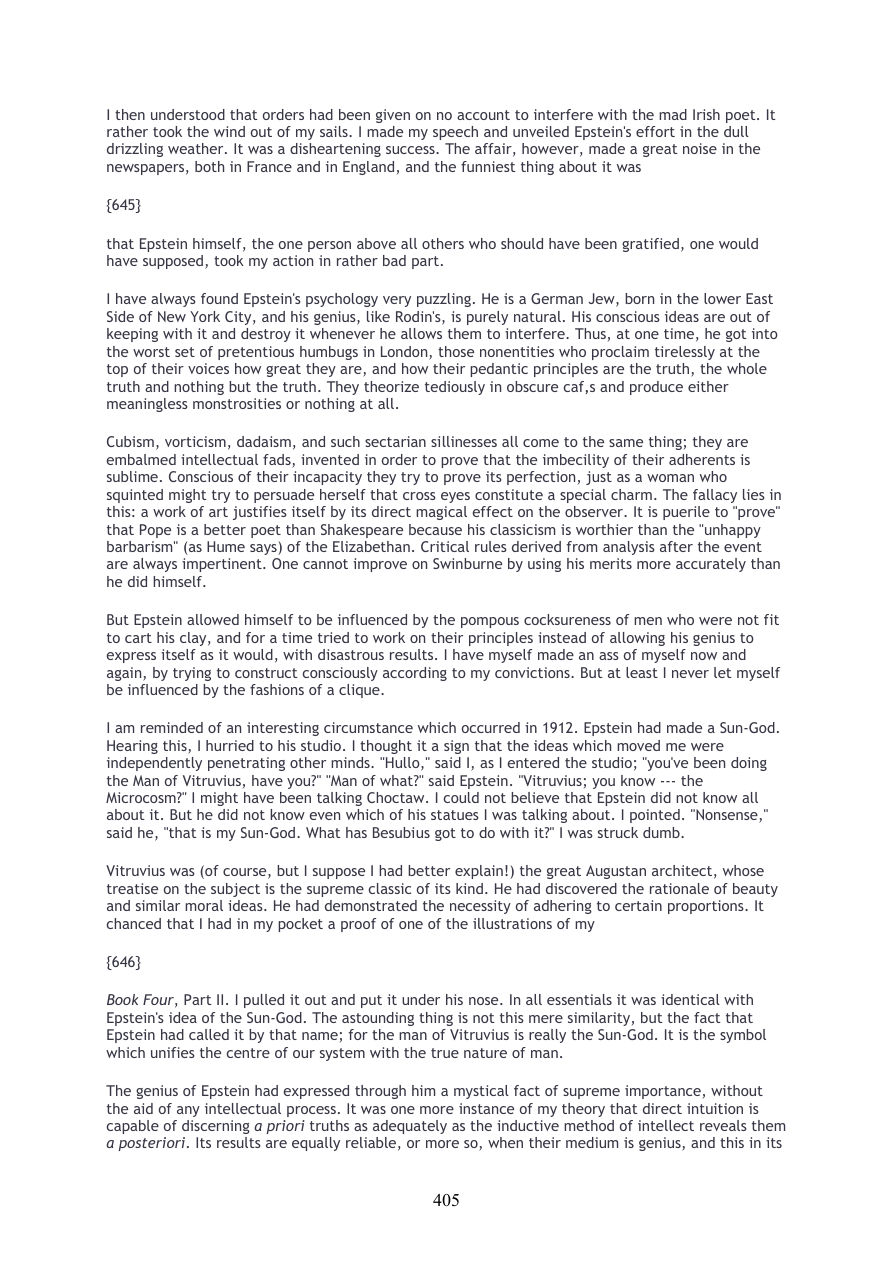
Highlights use the original PDF text layer. OCR-only matches may not be visible on the scan.
Transcription
Download text ↓raw extractionoriginal embedded textReview: unreviewed
405
I then understood that orders had been given on no account to interfere with the mad Irish poet. It
rather took the wind out of my sails. I made my speech and unveiled Epstein's effort in the dull
drizzling weather. It was a disheartening success. The affair, however, made a great noise in the
newspapers, both in France and in England, and the funniest thing about it was
{645}
that Epstein himself, the one person above all others who should have been gratified, one would
have supposed, took my action in rather bad part.
I have always found Epstein's psychology very puzzling. He is a German Jew, born in the lower East
Side of New York City, and his genius, like Rodin's, is purely natural. His conscious ideas are out of
keeping with it and destroy it whenever he allows them to interfere. Thus, at one time, he got into
the worst set of pretentious humbugs in London, those nonentities who proclaim tirelessly at the
top of their voices how great they are, and how their pedantic principles are the truth, the whole
truth and nothing but the truth. They theorize tediously in obscure cafs and produce either
meaningless monstrosities or nothing at all.
Cubism, vorticism, dadaism, and such sectarian sillinesses all come to the same thing; they are
embalmed intellectual fads, invented in order to prove that the imbecility of their adherents is
sublime. Conscious of their incapacity they try to prove its perfection, just as a woman who
squinted might try to persuade herself that cross eyes constitute a special charm. The fallacy lies in
this: a work of art justifies itself by its direct magical effect on the observer. It is puerile to "prove"
that Pope is a better poet than Shakespeare because his classicism is worthier than the "unhappy
barbarism" (as Hume says) of the Elizabethan. Critical rules derived from analysis after the event
are always impertinent. One cannot improve on Swinburne by using his merits more accurately than
he did himself.
But Epstein allowed himself to be influenced by the pompous cocksureness of men who were not fit
to cart his clay, and for a time tried to work on their principles instead of allowing his genius to
express itself as it would, with disastrous results. I have myself made an ass of myself now and
again, by trying to construct consciously according to my convictions. But at least I never let myself
be influenced by the fashions of a clique.
I am reminded of an interesting circumstance which occurred in 1912. Epstein had made a Sun-God.
Hearing this, I hurried to his studio. I thought it a sign that the ideas which moved me were
independently penetrating other minds. "Hullo," said I, as I entered the studio; "you've been doing
the Man of Vitruvius, have you?" "Man of what?" said Epstein. "Vitruvius; you know --- the
Microcosm?" I might have been talking Choctaw. I could not believe that Epstein did not know all
about it. But he did not know even which of his statues I was talking about. I pointed. "Nonsense,"
said he, "that is my Sun-God. What has Besubius got to do with it?" I was struck dumb.
Vitruvius was (of course, but I suppose I had better explain!) the great Augustan architect, whose
treatise on the subject is the supreme classic of its kind. He had discovered the rationale of beauty
and similar moral ideas. He had demonstrated the necessity of adhering to certain proportions. It
chanced that I had in my pocket a proof of one of the illustrations of my
{646}
Book Four, Part II. I pulled it out and put it under his nose. In all essentials it was identical with
Epstein's idea of the Sun-God. The astounding thing is not this mere similarity, but the fact that
Epstein had called it by that name; for the man of Vitruvius is really the Sun-God. It is the symbol
which unifies the centre of our system with the true nature of man.
The genius of Epstein had expressed through him a mystical fact of supreme importance, without
the aid of any intellectual process. It was one more instance of my theory that direct intuition is
capable of discerning a priori truths as adequately as the inductive method of intellect reveals them
a posteriori. Its results are equally reliable, or more so, when their medium is genius, and this in its
Page provenance & review flags
Stable page ID: 5ef44b98d8f9c4af5f6f86e1:p00405
Line breaks are preserved. Reading order and OCR accuracy may need review.
Printed page label has not been verified.
- No automated review flags. This does not establish transcription accuracy.