1929 · CLOSE READING
Confessions of Aleister Crowley
Confessions of Aleister Crowley (1929), PDF p. 418
Original page
Enlarge ↗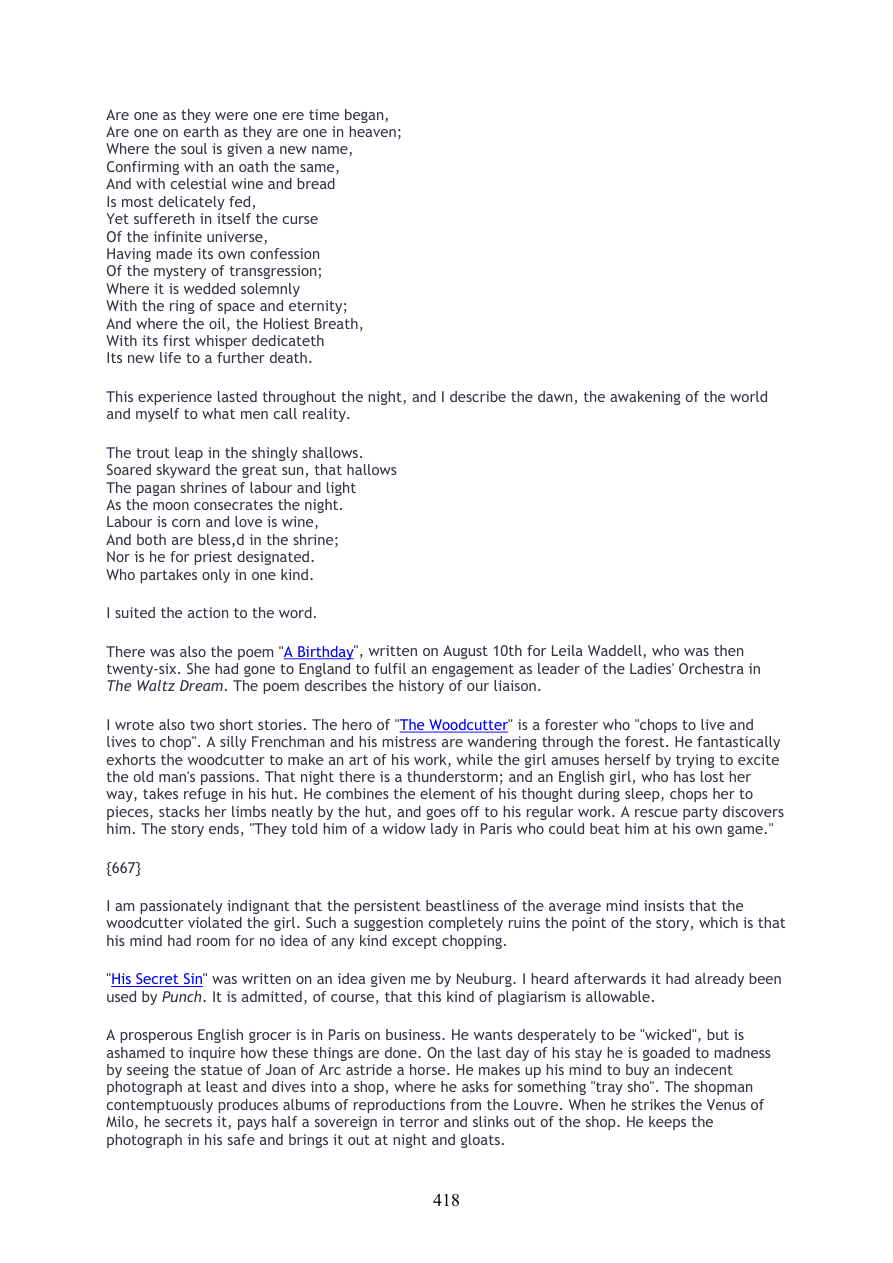
Highlights use the original PDF text layer. OCR-only matches may not be visible on the scan.
Transcription
Download text ↓raw extractionoriginal embedded textReview: unreviewed
418
Are one as they were one ere time began,
Are one on earth as they are one in heaven;
Where the soul is given a new name,
Confirming with an oath the same,
And with celestial wine and bread
Is most delicately fed,
Yet suffereth in itself the curse
Of the infinite universe,
Having made its own confession
Of the mystery of transgression;
Where it is wedded solemnly
With the ring of space and eternity;
And where the oil, the Holiest Breath,
With its first whisper dedicateth
Its new life to a further death.
This experience lasted throughout the night, and I describe the dawn, the awakening of the world
and myself to what men call reality.
The trout leap in the shingly shallows.
Soared skyward the great sun, that hallows
The pagan shrines of labour and light
As the moon consecrates the night.
Labour is corn and love is wine,
And both are blessd in the shrine;
Nor is he for priest designated.
Who partakes only in one kind.
I suited the action to the word.
There was also the poem "A Birthday", written on August 10th for Leila Waddell, who was then
twenty-six. She had gone to England to fulfil an engagement as leader of the Ladies' Orchestra in
The Waltz Dream. The poem describes the history of our liaison.
I wrote also two short stories. The hero of "The Woodcutter" is a forester who "chops to live and
lives to chop". A silly Frenchman and his mistress are wandering through the forest. He fantastically
exhorts the woodcutter to make an art of his work, while the girl amuses herself by trying to excite
the old man's passions. That night there is a thunderstorm; and an English girl, who has lost her
way, takes refuge in his hut. He combines the element of his thought during sleep, chops her to
pieces, stacks her limbs neatly by the hut, and goes off to his regular work. A rescue party discovers
him. The story ends, "They told him of a widow lady in Paris who could beat him at his own game."
{667}
I am passionately indignant that the persistent beastliness of the average mind insists that the
woodcutter violated the girl. Such a suggestion completely ruins the point of the story, which is that
his mind had room for no idea of any kind except chopping.
"His Secret Sin" was written on an idea given me by Neuburg. I heard afterwards it had already been
used by Punch. It is admitted, of course, that this kind of plagiarism is allowable.
A prosperous English grocer is in Paris on business. He wants desperately to be "wicked", but is
ashamed to inquire how these things are done. On the last day of his stay he is goaded to madness
by seeing the statue of Joan of Arc astride a horse. He makes up his mind to buy an indecent
photograph at least and dives into a shop, where he asks for something "tray sho". The shopman
contemptuously produces albums of reproductions from the Louvre. When he strikes the Venus of
Milo, he secrets it, pays half a sovereign in terror and slinks out of the shop. He keeps the
photograph in his safe and brings it out at night and gloats.
Page provenance & review flags
Stable page ID: 5ef44b98d8f9c4af5f6f86e1:p00418
Line breaks are preserved. Reading order and OCR accuracy may need review.
Printed page label has not been verified.
- No automated review flags. This does not establish transcription accuracy.