1929 · CLOSE READING
Confessions of Aleister Crowley
Confessions of Aleister Crowley (1929), PDF p. 421
Original page
Enlarge ↗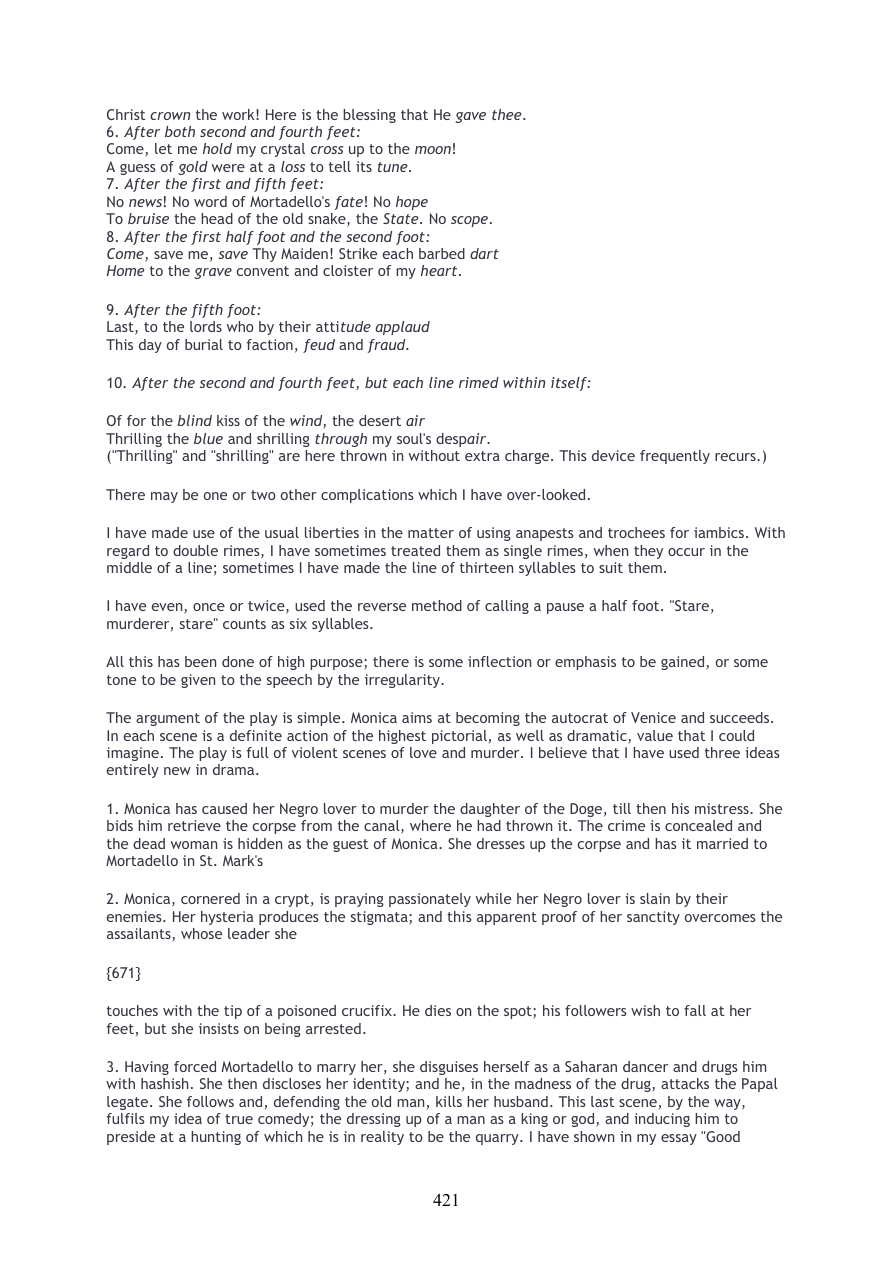
Highlights use the original PDF text layer. OCR-only matches may not be visible on the scan.
Transcription
Download text ↓raw extractionoriginal embedded textReview: unreviewed
421
Christ crown the work! Here is the blessing that He gave thee.
6. After both second and fourth feet:
Come, let me hold my crystal cross up to the moon!
A guess of gold were at a loss to tell its tune.
7. After the first and fifth feet:
No news! No word of Mortadello's fate! No hope
To bruise the head of the old snake, the State. No scope.
8. After the first half foot and the second foot:
Come, save me, save Thy Maiden! Strike each barbed dart
Home to the grave convent and cloister of my heart.
9. After the fifth foot:
Last, to the lords who by their attitude applaud
This day of burial to faction, feud and fraud.
10. After the second and fourth feet, but each line rimed within itself:
Of for the blind kiss of the wind, the desert air
Thrilling the blue and shrilling through my soul's despair.
("Thrilling" and "shrilling" are here thrown in without extra charge. This device frequently recurs.)
There may be one or two other complications which I have over-looked.
I have made use of the usual liberties in the matter of using anapests and trochees for iambics. With
regard to double rimes, I have sometimes treated them as single rimes, when they occur in the
middle of a line; sometimes I have made the line of thirteen syllables to suit them.
I have even, once or twice, used the reverse method of calling a pause a half foot. "Stare,
murderer, stare" counts as six syllables.
All this has been done of high purpose; there is some inflection or emphasis to be gained, or some
tone to be given to the speech by the irregularity.
The argument of the play is simple. Monica aims at becoming the autocrat of Venice and succeeds.
In each scene is a definite action of the highest pictorial, as well as dramatic, value that I could
imagine. The play is full of violent scenes of love and murder. I believe that I have used three ideas
entirely new in drama.
1. Monica has caused her Negro lover to murder the daughter of the Doge, till then his mistress. She
bids him retrieve the corpse from the canal, where he had thrown it. The crime is concealed and
the dead woman is hidden as the guest of Monica. She dresses up the corpse and has it married to
Mortadello in St. Mark's
2. Monica, cornered in a crypt, is praying passionately while her Negro lover is slain by their
enemies. Her hysteria produces the stigmata; and this apparent proof of her sanctity overcomes the
assailants, whose leader she
{671}
touches with the tip of a poisoned crucifix. He dies on the spot; his followers wish to fall at her
feet, but she insists on being arrested.
3. Having forced Mortadello to marry her, she disguises herself as a Saharan dancer and drugs him
with hashish. She then discloses her identity; and he, in the madness of the drug, attacks the Papal
legate. She follows and, defending the old man, kills her husband. This last scene, by the way,
fulfils my idea of true comedy; the dressing up of a man as a king or god, and inducing him to
preside at a hunting of which he is in reality to be the quarry. I have shown in my essay "Good
Page provenance & review flags
Stable page ID: 5ef44b98d8f9c4af5f6f86e1:p00421
Line breaks are preserved. Reading order and OCR accuracy may need review.
Printed page label has not been verified.
- No automated review flags. This does not establish transcription accuracy.