1929 · CLOSE READING
Confessions of Aleister Crowley
Confessions of Aleister Crowley (1929), PDF p. 44
Original page
Enlarge ↗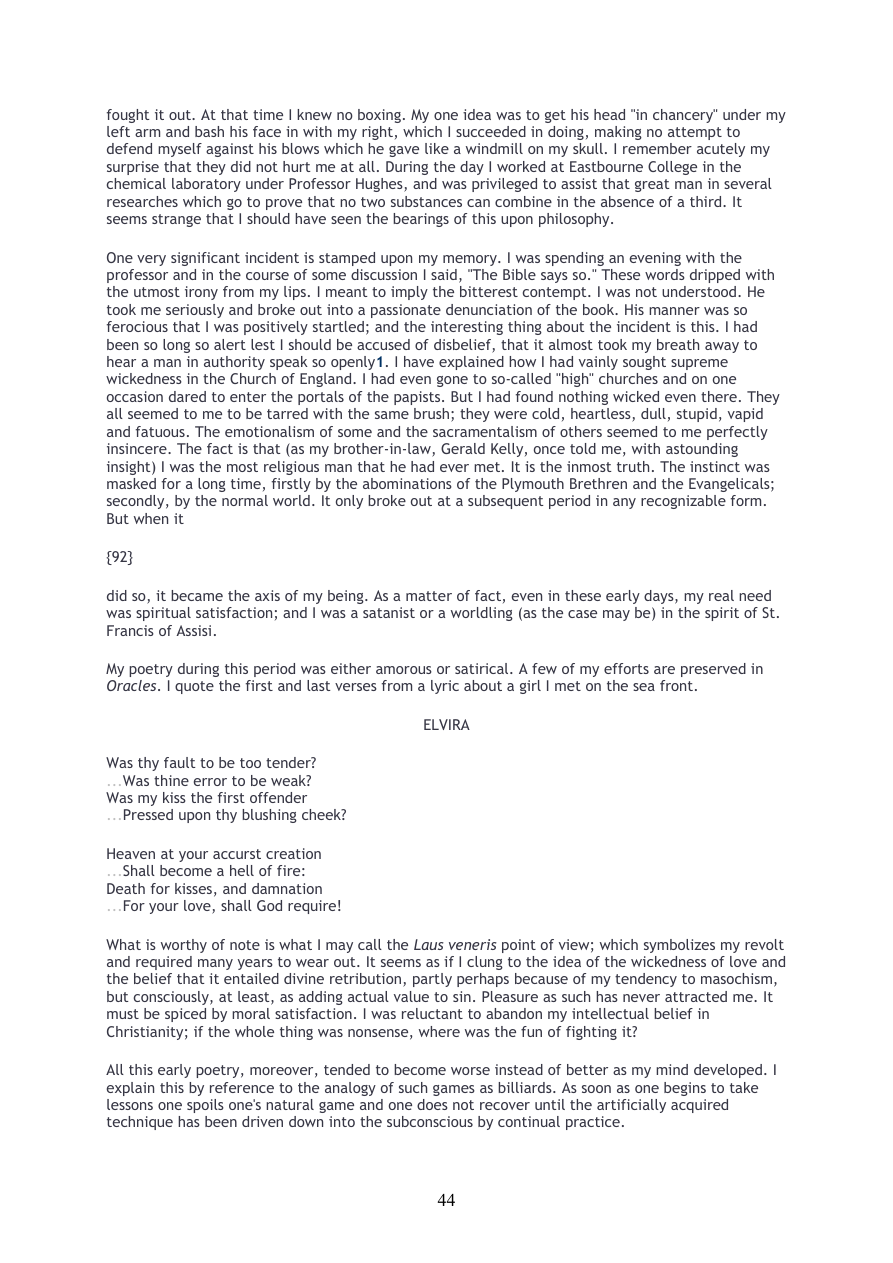
Highlights use the original PDF text layer. OCR-only matches may not be visible on the scan.
Transcription
Download text ↓raw extractionoriginal embedded textReview: unreviewed
44
fought it out. At that time I knew no boxing. My one idea was to get his head "in chancery" under my
left arm and bash his face in with my right, which I succeeded in doing, making no attempt to
defend myself against his blows which he gave like a windmill on my skull. I remember acutely my
surprise that they did not hurt me at all. During the day I worked at Eastbourne College in the
chemical laboratory under Professor Hughes, and was privileged to assist that great man in several
researches which go to prove that no two substances can combine in the absence of a third. It
seems strange that I should have seen the bearings of this upon philosophy.
One very significant incident is stamped upon my memory. I was spending an evening with the
professor and in the course of some discussion I said, "The Bible says so." These words dripped with
the utmost irony from my lips. I meant to imply the bitterest contempt. I was not understood. He
took me seriously and broke out into a passionate denunciation of the book. His manner was so
ferocious that I was positively startled; and the interesting thing about the incident is this. I had
been so long so alert lest I should be accused of disbelief, that it almost took my breath away to
hear a man in authority speak so openly1. I have explained how I had vainly sought supreme
wickedness in the Church of England. I had even gone to so-called "high" churches and on one
occasion dared to enter the portals of the papists. But I had found nothing wicked even there. They
all seemed to me to be tarred with the same brush; they were cold, heartless, dull, stupid, vapid
and fatuous. The emotionalism of some and the sacramentalism of others seemed to me perfectly
insincere. The fact is that (as my brother-in-law, Gerald Kelly, once told me, with astounding
insight) I was the most religious man that he had ever met. It is the inmost truth. The instinct was
masked for a long time, firstly by the abominations of the Plymouth Brethren and the Evangelicals;
secondly, by the normal world. It only broke out at a subsequent period in any recognizable form.
But when it
{92}
did so, it became the axis of my being. As a matter of fact, even in these early days, my real need
was spiritual satisfaction; and I was a satanist or a worldling (as the case may be) in the spirit of St.
Francis of Assisi.
My poetry during this period was either amorous or satirical. A few of my efforts are preserved in
Oracles. I quote the first and last verses from a lyric about a girl I met on the sea front.
ELVIRA
Was thy fault to be too tender?
...Was thine error to be weak?
Was my kiss the first offender
...Pressed upon thy blushing cheek?
Heaven at your accurst creation
...Shall become a hell of fire:
Death for kisses, and damnation
...For your love, shall God require!
What is worthy of note is what I may call the Laus veneris point of view; which symbolizes my revolt
and required many years to wear out. It seems as if I clung to the idea of the wickedness of love and
the belief that it entailed divine retribution, partly perhaps because of my tendency to masochism,
but consciously, at least, as adding actual value to sin. Pleasure as such has never attracted me. It
must be spiced by moral satisfaction. I was reluctant to abandon my intellectual belief in
Christianity; if the whole thing was nonsense, where was the fun of fighting it?
All this early poetry, moreover, tended to become worse instead of better as my mind developed. I
explain this by reference to the analogy of such games as billiards. As soon as one begins to take
lessons one spoils one's natural game and one does not recover until the artificially acquired
technique has been driven down into the subconscious by continual practice.
Page provenance & review flags
Stable page ID: 5ef44b98d8f9c4af5f6f86e1:p00044
Line breaks are preserved. Reading order and OCR accuracy may need review.
Printed page label has not been verified.
- No automated review flags. This does not establish transcription accuracy.