1929 · CLOSE READING
Confessions of Aleister Crowley
Confessions of Aleister Crowley (1929), PDF p. 448
Original page
Enlarge ↗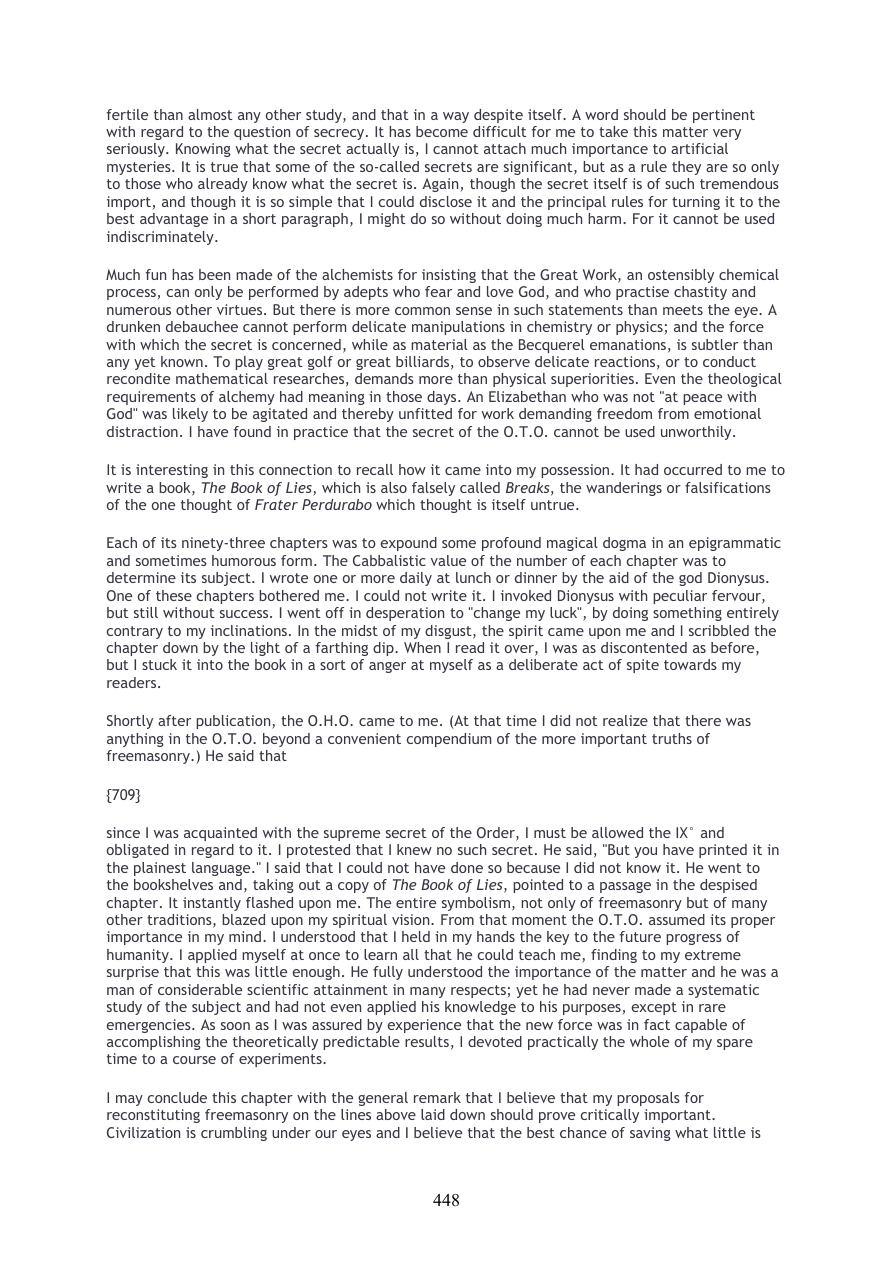
Highlights use the original PDF text layer. OCR-only matches may not be visible on the scan.
Transcription
Download text ↓raw extractionoriginal embedded textReview: unreviewed
448
fertile than almost any other study, and that in a way despite itself. A word should be pertinent
with regard to the question of secrecy. It has become difficult for me to take this matter very
seriously. Knowing what the secret actually is, I cannot attach much importance to artificial
mysteries. It is true that some of the so-called secrets are significant, but as a rule they are so only
to those who already know what the secret is. Again, though the secret itself is of such tremendous
import, and though it is so simple that I could disclose it and the principal rules for turning it to the
best advantage in a short paragraph, I might do so without doing much harm. For it cannot be used
indiscriminately.
Much fun has been made of the alchemists for insisting that the Great Work, an ostensibly chemical
process, can only be performed by adepts who fear and love God, and who practise chastity and
numerous other virtues. But there is more common sense in such statements than meets the eye. A
drunken debauchee cannot perform delicate manipulations in chemistry or physics; and the force
with which the secret is concerned, while as material as the Becquerel emanations, is subtler than
any yet known. To play great golf or great billiards, to observe delicate reactions, or to conduct
recondite mathematical researches, demands more than physical superiorities. Even the theological
requirements of alchemy had meaning in those days. An Elizabethan who was not "at peace with
God" was likely to be agitated and thereby unfitted for work demanding freedom from emotional
distraction. I have found in practice that the secret of the O.T.O. cannot be used unworthily.
It is interesting in this connection to recall how it came into my possession. It had occurred to me to
write a book, The Book of Lies, which is also falsely called Breaks, the wanderings or falsifications
of the one thought of Frater Perdurabo which thought is itself untrue.
Each of its ninety-three chapters was to expound some profound magical dogma in an epigrammatic
and sometimes humorous form. The Cabbalistic value of the number of each chapter was to
determine its subject. I wrote one or more daily at lunch or dinner by the aid of the god Dionysus.
One of these chapters bothered me. I could not write it. I invoked Dionysus with peculiar fervour,
but still without success. I went off in desperation to "change my luck", by doing something entirely
contrary to my inclinations. In the midst of my disgust, the spirit came upon me and I scribbled the
chapter down by the light of a farthing dip. When I read it over, I was as discontented as before,
but I stuck it into the book in a sort of anger at myself as a deliberate act of spite towards my
readers.
Shortly after publication, the O.H.O. came to me. (At that time I did not realize that there was
anything in the O.T.O. beyond a convenient compendium of the more important truths of
freemasonry.) He said that
{709}
since I was acquainted with the supreme secret of the Order, I must be allowed the IX° and
obligated in regard to it. I protested that I knew no such secret. He said, "But you have printed it in
the plainest language." I said that I could not have done so because I did not know it. He went to
the bookshelves and, taking out a copy of The Book of Lies, pointed to a passage in the despised
chapter. It instantly flashed upon me. The entire symbolism, not only of freemasonry but of many
other traditions, blazed upon my spiritual vision. From that moment the O.T.O. assumed its proper
importance in my mind. I understood that I held in my hands the key to the future progress of
humanity. I applied myself at once to learn all that he could teach me, finding to my extreme
surprise that this was little enough. He fully understood the importance of the matter and he was a
man of considerable scientific attainment in many respects; yet he had never made a systematic
study of the subject and had not even applied his knowledge to his purposes, except in rare
emergencies. As soon as I was assured by experience that the new force was in fact capable of
accomplishing the theoretically predictable results, I devoted practically the whole of my spare
time to a course of experiments.
I may conclude this chapter with the general remark that I believe that my proposals for
reconstituting freemasonry on the lines above laid down should prove critically important.
Civilization is crumbling under our eyes and I believe that the best chance of saving what little is
Page provenance & review flags
Stable page ID: 5ef44b98d8f9c4af5f6f86e1:p00448
Line breaks are preserved. Reading order and OCR accuracy may need review.
Printed page label has not been verified.
- No automated review flags. This does not establish transcription accuracy.