1929 · CLOSE READING
Confessions of Aleister Crowley
Confessions of Aleister Crowley (1929), PDF p. 450
Original page
Enlarge ↗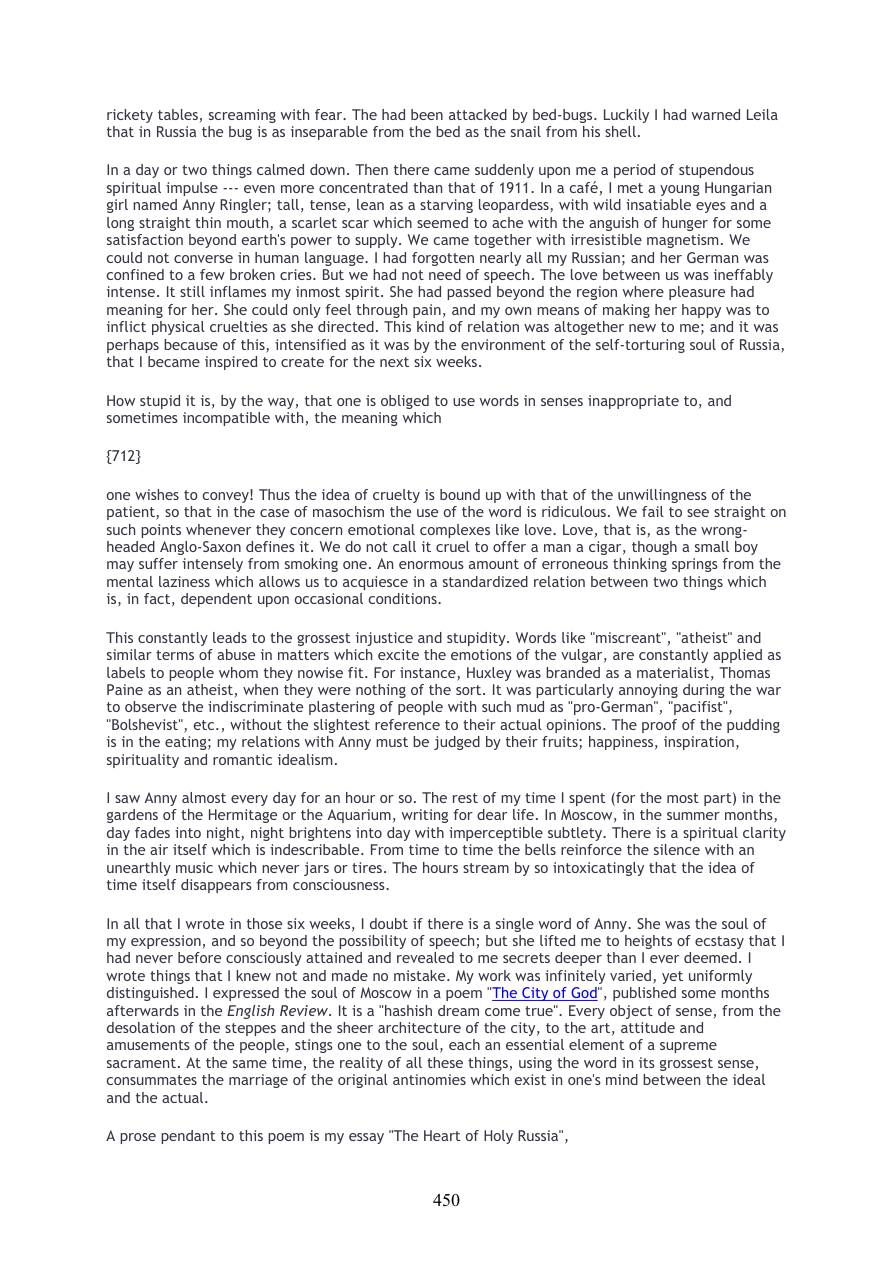
Highlights use the original PDF text layer. OCR-only matches may not be visible on the scan.
Transcription
Download text ↓raw extractionoriginal embedded textReview: unreviewed
450
rickety tables, screaming with fear. The had been attacked by bed-bugs. Luckily I had warned Leila
that in Russia the bug is as inseparable from the bed as the snail from his shell.
In a day or two things calmed down. Then there came suddenly upon me a period of stupendous
spiritual impulse --- even more concentrated than that of 1911. In a café, I met a young Hungarian
girl named Anny Ringler; tall, tense, lean as a starving leopardess, with wild insatiable eyes and a
long straight thin mouth, a scarlet scar which seemed to ache with the anguish of hunger for some
satisfaction beyond earth's power to supply. We came together with irresistible magnetism. We
could not converse in human language. I had forgotten nearly all my Russian; and her German was
confined to a few broken cries. But we had not need of speech. The love between us was ineffably
intense. It still inflames my inmost spirit. She had passed beyond the region where pleasure had
meaning for her. She could only feel through pain, and my own means of making her happy was to
inflict physical cruelties as she directed. This kind of relation was altogether new to me; and it was
perhaps because of this, intensified as it was by the environment of the self-torturing soul of Russia,
that I became inspired to create for the next six weeks.
How stupid it is, by the way, that one is obliged to use words in senses inappropriate to, and
sometimes incompatible with, the meaning which
{712}
one wishes to convey! Thus the idea of cruelty is bound up with that of the unwillingness of the
patient, so that in the case of masochism the use of the word is ridiculous. We fail to see straight on
such points whenever they concern emotional complexes like love. Love, that is, as the wrong-
headed Anglo-Saxon defines it. We do not call it cruel to offer a man a cigar, though a small boy
may suffer intensely from smoking one. An enormous amount of erroneous thinking springs from the
mental laziness which allows us to acquiesce in a standardized relation between two things which
is, in fact, dependent upon occasional conditions.
This constantly leads to the grossest injustice and stupidity. Words like "miscreant", "atheist" and
similar terms of abuse in matters which excite the emotions of the vulgar, are constantly applied as
labels to people whom they nowise fit. For instance, Huxley was branded as a materialist, Thomas
Paine as an atheist, when they were nothing of the sort. It was particularly annoying during the war
to observe the indiscriminate plastering of people with such mud as "pro-German", "pacifist",
"Bolshevist", etc., without the slightest reference to their actual opinions. The proof of the pudding
is in the eating; my relations with Anny must be judged by their fruits; happiness, inspiration,
spirituality and romantic idealism.
I saw Anny almost every day for an hour or so. The rest of my time I spent (for the most part) in the
gardens of the Hermitage or the Aquarium, writing for dear life. In Moscow, in the summer months,
day fades into night, night brightens into day with imperceptible subtlety. There is a spiritual clarity
in the air itself which is indescribable. From time to time the bells reinforce the silence with an
unearthly music which never jars or tires. The hours stream by so intoxicatingly that the idea of
time itself disappears from consciousness.
In all that I wrote in those six weeks, I doubt if there is a single word of Anny. She was the soul of
my expression, and so beyond the possibility of speech; but she lifted me to heights of ecstasy that I
had never before consciously attained and revealed to me secrets deeper than I ever deemed. I
wrote things that I knew not and made no mistake. My work was infinitely varied, yet uniformly
distinguished. I expressed the soul of Moscow in a poem "The City of God", published some months
afterwards in the English Review. It is a "hashish dream come true". Every object of sense, from the
desolation of the steppes and the sheer architecture of the city, to the art, attitude and
amusements of the people, stings one to the soul, each an essential element of a supreme
sacrament. At the same time, the reality of all these things, using the word in its grossest sense,
consummates the marriage of the original antinomies which exist in one's mind between the ideal
and the actual.
A prose pendant to this poem is my essay "The Heart of Holy Russia",
Page provenance & review flags
Stable page ID: 5ef44b98d8f9c4af5f6f86e1:p00450
Line breaks are preserved. Reading order and OCR accuracy may need review.
Printed page label has not been verified.
- No automated review flags. This does not establish transcription accuracy.