1929 · CLOSE READING
Confessions of Aleister Crowley
Confessions of Aleister Crowley (1929), PDF p. 460
Original page
Enlarge ↗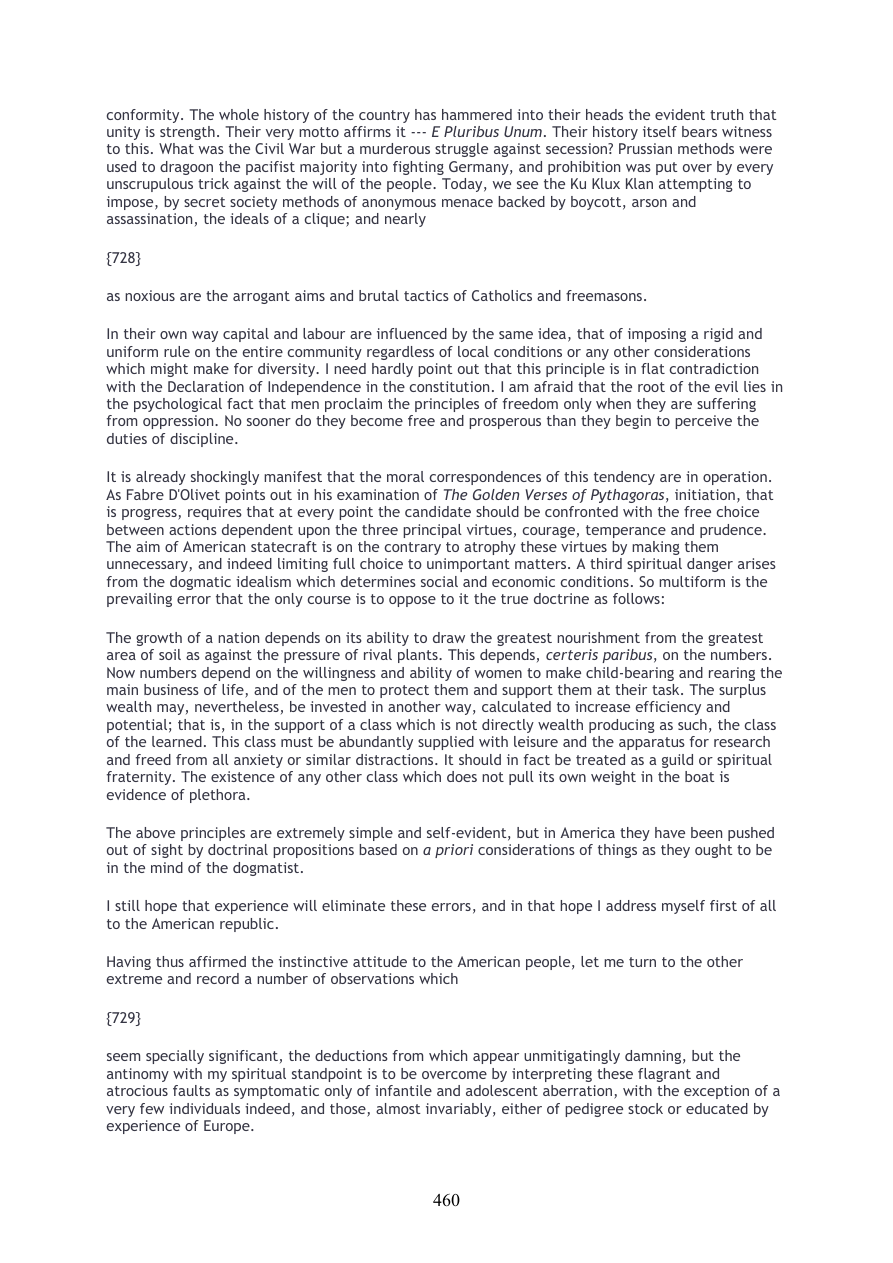
Highlights use the original PDF text layer. OCR-only matches may not be visible on the scan.
Transcription
Download text ↓raw extractionoriginal embedded textReview: unreviewed
460
conformity. The whole history of the country has hammered into their heads the evident truth that
unity is strength. Their very motto affirms it --- E Pluribus Unum. Their history itself bears witness
to this. What was the Civil War but a murderous struggle against secession? Prussian methods were
used to dragoon the pacifist majority into fighting Germany, and prohibition was put over by every
unscrupulous trick against the will of the people. Today, we see the Ku Klux Klan attempting to
impose, by secret society methods of anonymous menace backed by boycott, arson and
assassination, the ideals of a clique; and nearly
{728}
as noxious are the arrogant aims and brutal tactics of Catholics and freemasons.
In their own way capital and labour are influenced by the same idea, that of imposing a rigid and
uniform rule on the entire community regardless of local conditions or any other considerations
which might make for diversity. I need hardly point out that this principle is in flat contradiction
with the Declaration of Independence in the constitution. I am afraid that the root of the evil lies in
the psychological fact that men proclaim the principles of freedom only when they are suffering
from oppression. No sooner do they become free and prosperous than they begin to perceive the
duties of discipline.
It is already shockingly manifest that the moral correspondences of this tendency are in operation.
As Fabre D'Olivet points out in his examination of The Golden Verses of Pythagoras, initiation, that
is progress, requires that at every point the candidate should be confronted with the free choice
between actions dependent upon the three principal virtues, courage, temperance and prudence.
The aim of American statecraft is on the contrary to atrophy these virtues by making them
unnecessary, and indeed limiting full choice to unimportant matters. A third spiritual danger arises
from the dogmatic idealism which determines social and economic conditions. So multiform is the
prevailing error that the only course is to oppose to it the true doctrine as follows:
The growth of a nation depends on its ability to draw the greatest nourishment from the greatest
area of soil as against the pressure of rival plants. This depends, certeris paribus, on the numbers.
Now numbers depend on the willingness and ability of women to make child-bearing and rearing the
main business of life, and of the men to protect them and support them at their task. The surplus
wealth may, nevertheless, be invested in another way, calculated to increase efficiency and
potential; that is, in the support of a class which is not directly wealth producing as such, the class
of the learned. This class must be abundantly supplied with leisure and the apparatus for research
and freed from all anxiety or similar distractions. It should in fact be treated as a guild or spiritual
fraternity. The existence of any other class which does not pull its own weight in the boat is
evidence of plethora.
The above principles are extremely simple and self-evident, but in America they have been pushed
out of sight by doctrinal propositions based on a priori considerations of things as they ought to be
in the mind of the dogmatist.
I still hope that experience will eliminate these errors, and in that hope I address myself first of all
to the American republic.
Having thus affirmed the instinctive attitude to the American people, let me turn to the other
extreme and record a number of observations which
{729}
seem specially significant, the deductions from which appear unmitigatingly damning, but the
antinomy with my spiritual standpoint is to be overcome by interpreting these flagrant and
atrocious faults as symptomatic only of infantile and adolescent aberration, with the exception of a
very few individuals indeed, and those, almost invariably, either of pedigree stock or educated by
experience of Europe.
Page provenance & review flags
Stable page ID: 5ef44b98d8f9c4af5f6f86e1:p00460
Line breaks are preserved. Reading order and OCR accuracy may need review.
Printed page label has not been verified.
- No automated review flags. This does not establish transcription accuracy.