1929 · CLOSE READING
Confessions of Aleister Crowley
Confessions of Aleister Crowley (1929), PDF p. 465
Original page
Enlarge ↗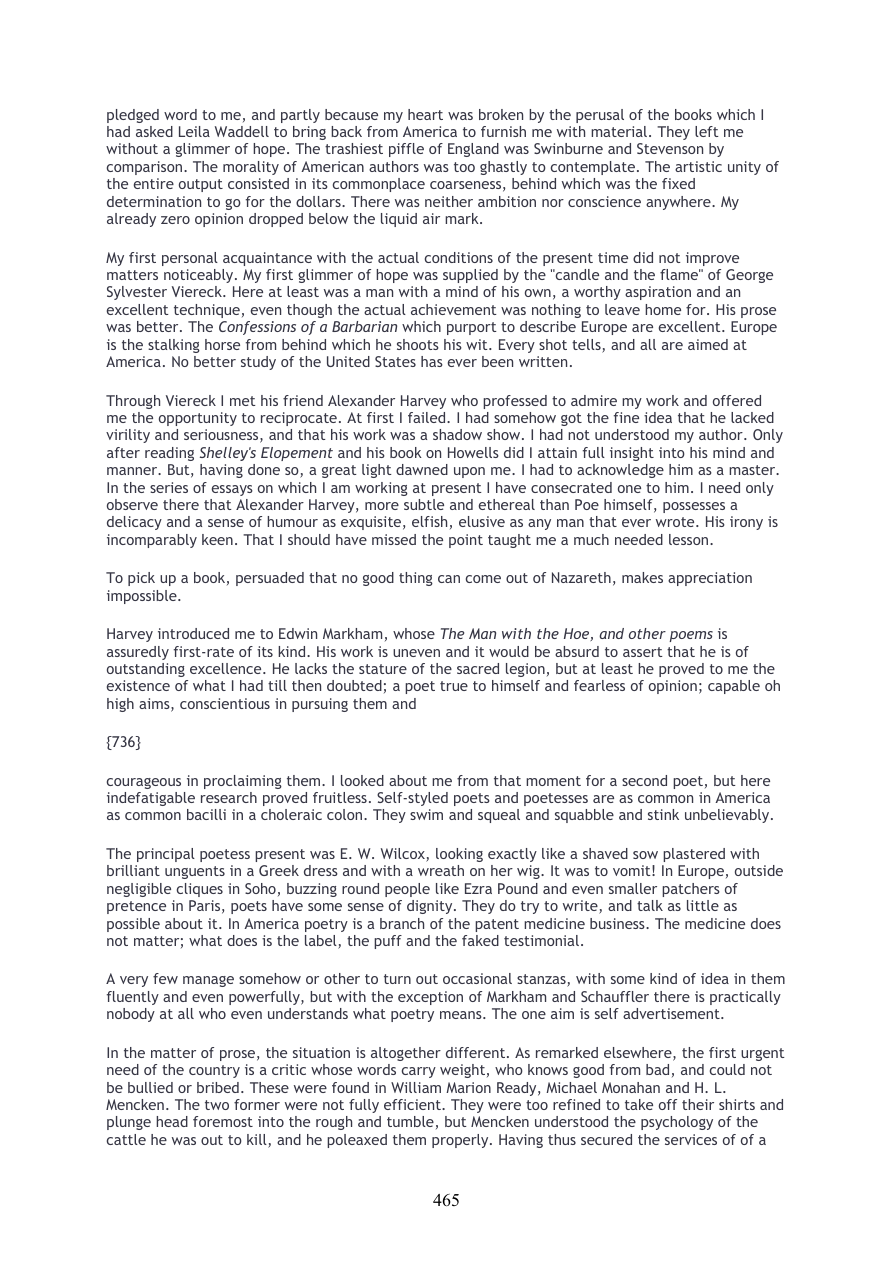
Highlights use the original PDF text layer. OCR-only matches may not be visible on the scan.
Transcription
Download text ↓raw extractionoriginal embedded textReview: unreviewed
465
pledged word to me, and partly because my heart was broken by the perusal of the books which I
had asked Leila Waddell to bring back from America to furnish me with material. They left me
without a glimmer of hope. The trashiest piffle of England was Swinburne and Stevenson by
comparison. The morality of American authors was too ghastly to contemplate. The artistic unity of
the entire output consisted in its commonplace coarseness, behind which was the fixed
determination to go for the dollars. There was neither ambition nor conscience anywhere. My
already zero opinion dropped below the liquid air mark.
My first personal acquaintance with the actual conditions of the present time did not improve
matters noticeably. My first glimmer of hope was supplied by the "candle and the flame" of George
Sylvester Viereck. Here at least was a man with a mind of his own, a worthy aspiration and an
excellent technique, even though the actual achievement was nothing to leave home for. His prose
was better. The Confessions of a Barbarian which purport to describe Europe are excellent. Europe
is the stalking horse from behind which he shoots his wit. Every shot tells, and all are aimed at
America. No better study of the United States has ever been written.
Through Viereck I met his friend Alexander Harvey who professed to admire my work and offered
me the opportunity to reciprocate. At first I failed. I had somehow got the fine idea that he lacked
virility and seriousness, and that his work was a shadow show. I had not understood my author. Only
after reading Shelley's Elopement and his book on Howells did I attain full insight into his mind and
manner. But, having done so, a great light dawned upon me. I had to acknowledge him as a master.
In the series of essays on which I am working at present I have consecrated one to him. I need only
observe there that Alexander Harvey, more subtle and ethereal than Poe himself, possesses a
delicacy and a sense of humour as exquisite, elfish, elusive as any man that ever wrote. His irony is
incomparably keen. That I should have missed the point taught me a much needed lesson.
To pick up a book, persuaded that no good thing can come out of Nazareth, makes appreciation
impossible.
Harvey introduced me to Edwin Markham, whose The Man with the Hoe, and other poems is
assuredly first-rate of its kind. His work is uneven and it would be absurd to assert that he is of
outstanding excellence. He lacks the stature of the sacred legion, but at least he proved to me the
existence of what I had till then doubted; a poet true to himself and fearless of opinion; capable oh
high aims, conscientious in pursuing them and
{736}
courageous in proclaiming them. I looked about me from that moment for a second poet, but here
indefatigable research proved fruitless. Self-styled poets and poetesses are as common in America
as common bacilli in a choleraic colon. They swim and squeal and squabble and stink unbelievably.
The principal poetess present was E. W. Wilcox, looking exactly like a shaved sow plastered with
brilliant unguents in a Greek dress and with a wreath on her wig. It was to vomit! In Europe, outside
negligible cliques in Soho, buzzing round people like Ezra Pound and even smaller patchers of
pretence in Paris, poets have some sense of dignity. They do try to write, and talk as little as
possible about it. In America poetry is a branch of the patent medicine business. The medicine does
not matter; what does is the label, the puff and the faked testimonial.
A very few manage somehow or other to turn out occasional stanzas, with some kind of idea in them
fluently and even powerfully, but with the exception of Markham and Schauffler there is practically
nobody at all who even understands what poetry means. The one aim is self advertisement.
In the matter of prose, the situation is altogether different. As remarked elsewhere, the first urgent
need of the country is a critic whose words carry weight, who knows good from bad, and could not
be bullied or bribed. These were found in William Marion Ready, Michael Monahan and H. L.
Mencken. The two former were not fully efficient. They were too refined to take off their shirts and
plunge head foremost into the rough and tumble, but Mencken understood the psychology of the
cattle he was out to kill, and he poleaxed them properly. Having thus secured the services of of a
Page provenance & review flags
Stable page ID: 5ef44b98d8f9c4af5f6f86e1:p00465
Line breaks are preserved. Reading order and OCR accuracy may need review.
Printed page label has not been verified.
- No automated review flags. This does not establish transcription accuracy.