1929 · CLOSE READING
Confessions of Aleister Crowley
Confessions of Aleister Crowley (1929), PDF p. 466
Original page
Enlarge ↗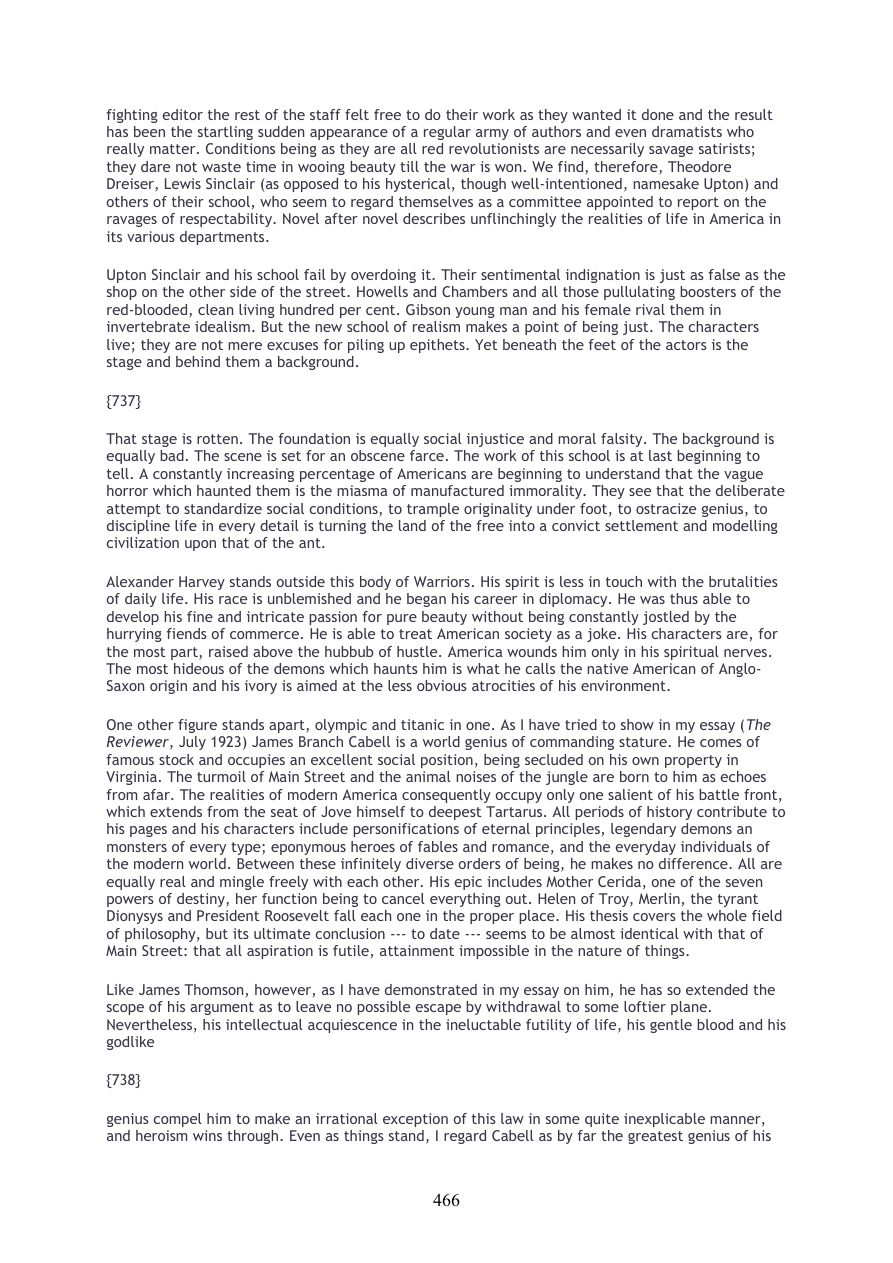
Highlights use the original PDF text layer. OCR-only matches may not be visible on the scan.
Transcription
Download text ↓raw extractionoriginal embedded textReview: unreviewed
466
fighting editor the rest of the staff felt free to do their work as they wanted it done and the result
has been the startling sudden appearance of a regular army of authors and even dramatists who
really matter. Conditions being as they are all red revolutionists are necessarily savage satirists;
they dare not waste time in wooing beauty till the war is won. We find, therefore, Theodore
Dreiser, Lewis Sinclair (as opposed to his hysterical, though well-intentioned, namesake Upton) and
others of their school, who seem to regard themselves as a committee appointed to report on the
ravages of respectability. Novel after novel describes unflinchingly the realities of life in America in
its various departments.
Upton Sinclair and his school fail by overdoing it. Their sentimental indignation is just as false as the
shop on the other side of the street. Howells and Chambers and all those pullulating boosters of the
red-blooded, clean living hundred per cent. Gibson young man and his female rival them in
invertebrate idealism. But the new school of realism makes a point of being just. The characters
live; they are not mere excuses for piling up epithets. Yet beneath the feet of the actors is the
stage and behind them a background.
{737}
That stage is rotten. The foundation is equally social injustice and moral falsity. The background is
equally bad. The scene is set for an obscene farce. The work of this school is at last beginning to
tell. A constantly increasing percentage of Americans are beginning to understand that the vague
horror which haunted them is the miasma of manufactured immorality. They see that the deliberate
attempt to standardize social conditions, to trample originality under foot, to ostracize genius, to
discipline life in every detail is turning the land of the free into a convict settlement and modelling
civilization upon that of the ant.
Alexander Harvey stands outside this body of Warriors. His spirit is less in touch with the brutalities
of daily life. His race is unblemished and he began his career in diplomacy. He was thus able to
develop his fine and intricate passion for pure beauty without being constantly jostled by the
hurrying fiends of commerce. He is able to treat American society as a joke. His characters are, for
the most part, raised above the hubbub of hustle. America wounds him only in his spiritual nerves.
The most hideous of the demons which haunts him is what he calls the native American of Anglo-
Saxon origin and his ivory is aimed at the less obvious atrocities of his environment.
One other figure stands apart, olympic and titanic in one. As I have tried to show in my essay (The
Reviewer, July 1923) James Branch Cabell is a world genius of commanding stature. He comes of
famous stock and occupies an excellent social position, being secluded on his own property in
Virginia. The turmoil of Main Street and the animal noises of the jungle are born to him as echoes
from afar. The realities of modern America consequently occupy only one salient of his battle front,
which extends from the seat of Jove himself to deepest Tartarus. All periods of history contribute to
his pages and his characters include personifications of eternal principles, legendary demons an
monsters of every type; eponymous heroes of fables and romance, and the everyday individuals of
the modern world. Between these infinitely diverse orders of being, he makes no difference. All are
equally real and mingle freely with each other. His epic includes Mother Cerida, one of the seven
powers of destiny, her function being to cancel everything out. Helen of Troy, Merlin, the tyrant
Dionysys and President Roosevelt fall each one in the proper place. His thesis covers the whole field
of philosophy, but its ultimate conclusion --- to date --- seems to be almost identical with that of
Main Street: that all aspiration is futile, attainment impossible in the nature of things.
Like James Thomson, however, as I have demonstrated in my essay on him, he has so extended the
scope of his argument as to leave no possible escape by withdrawal to some loftier plane.
Nevertheless, his intellectual acquiescence in the ineluctable futility of life, his gentle blood and his
godlike
{738}
genius compel him to make an irrational exception of this law in some quite inexplicable manner,
and heroism wins through. Even as things stand, I regard Cabell as by far the greatest genius of his
Page provenance & review flags
Stable page ID: 5ef44b98d8f9c4af5f6f86e1:p00466
Line breaks are preserved. Reading order and OCR accuracy may need review.
Printed page label has not been verified.
- No automated review flags. This does not establish transcription accuracy.