1929 · CLOSE READING
Confessions of Aleister Crowley
Confessions of Aleister Crowley (1929), PDF p. 48
Original page
Enlarge ↗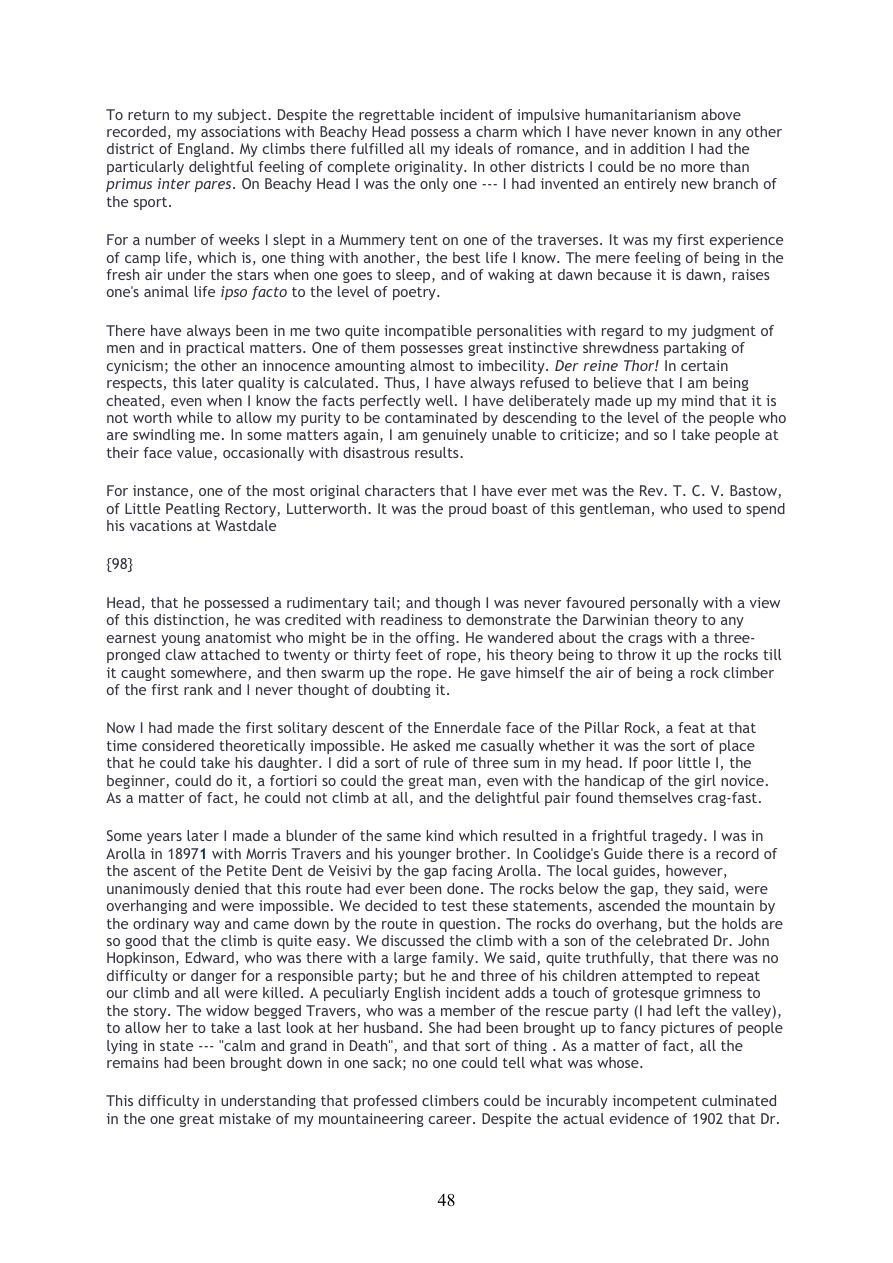
Highlights use the original PDF text layer. OCR-only matches may not be visible on the scan.
Transcription
Download text ↓raw extractionoriginal embedded textReview: unreviewed
48
To return to my subject. Despite the regrettable incident of impulsive humanitarianism above
recorded, my associations with Beachy Head possess a charm which I have never known in any other
district of England. My climbs there fulfilled all my ideals of romance, and in addition I had the
particularly delightful feeling of complete originality. In other districts I could be no more than
primus inter pares. On Beachy Head I was the only one --- I had invented an entirely new branch of
the sport.
For a number of weeks I slept in a Mummery tent on one of the traverses. It was my first experience
of camp life, which is, one thing with another, the best life I know. The mere feeling of being in the
fresh air under the stars when one goes to sleep, and of waking at dawn because it is dawn, raises
one's animal life ipso facto to the level of poetry.
There have always been in me two quite incompatible personalities with regard to my judgment of
men and in practical matters. One of them possesses great instinctive shrewdness partaking of
cynicism; the other an innocence amounting almost to imbecility. Der reine Thor! In certain
respects, this later quality is calculated. Thus, I have always refused to believe that I am being
cheated, even when I know the facts perfectly well. I have deliberately made up my mind that it is
not worth while to allow my purity to be contaminated by descending to the level of the people who
are swindling me. In some matters again, I am genuinely unable to criticize; and so I take people at
their face value, occasionally with disastrous results.
For instance, one of the most original characters that I have ever met was the Rev. T. C. V. Bastow,
of Little Peatling Rectory, Lutterworth. It was the proud boast of this gentleman, who used to spend
his vacations at Wastdale
{98}
Head, that he possessed a rudimentary tail; and though I was never favoured personally with a view
of this distinction, he was credited with readiness to demonstrate the Darwinian theory to any
earnest young anatomist who might be in the offing. He wandered about the crags with a three-
pronged claw attached to twenty or thirty feet of rope, his theory being to throw it up the rocks till
it caught somewhere, and then swarm up the rope. He gave himself the air of being a rock climber
of the first rank and I never thought of doubting it.
Now I had made the first solitary descent of the Ennerdale face of the Pillar Rock, a feat at that
time considered theoretically impossible. He asked me casually whether it was the sort of place
that he could take his daughter. I did a sort of rule of three sum in my head. If poor little I, the
beginner, could do it, a fortiori so could the great man, even with the handicap of the girl novice.
As a matter of fact, he could not climb at all, and the delightful pair found themselves crag-fast.
Some years later I made a blunder of the same kind which resulted in a frightful tragedy. I was in
Arolla in 18971 with Morris Travers and his younger brother. In Coolidge's Guide there is a record of
the ascent of the Petite Dent de Veisivi by the gap facing Arolla. The local guides, however,
unanimously denied that this route had ever been done. The rocks below the gap, they said, were
overhanging and were impossible. We decided to test these statements, ascended the mountain by
the ordinary way and came down by the route in question. The rocks do overhang, but the holds are
so good that the climb is quite easy. We discussed the climb with a son of the celebrated Dr. John
Hopkinson, Edward, who was there with a large family. We said, quite truthfully, that there was no
difficulty or danger for a responsible party; but he and three of his children attempted to repeat
our climb and all were killed. A peculiarly English incident adds a touch of grotesque grimness to
the story. The widow begged Travers, who was a member of the rescue party (I had left the valley),
to allow her to take a last look at her husband. She had been brought up to fancy pictures of people
lying in state --- "calm and grand in Death", and that sort of thing . As a matter of fact, all the
remains had been brought down in one sack; no one could tell what was whose.
This difficulty in understanding that professed climbers could be incurably incompetent culminated
in the one great mistake of my mountaineering career. Despite the actual evidence of 1902 that Dr.
Page provenance & review flags
Stable page ID: 5ef44b98d8f9c4af5f6f86e1:p00048
Line breaks are preserved. Reading order and OCR accuracy may need review.
Printed page label has not been verified.
- No automated review flags. This does not establish transcription accuracy.