1929 · CLOSE READING
Confessions of Aleister Crowley
Confessions of Aleister Crowley (1929), PDF p. 480
Original page
Enlarge ↗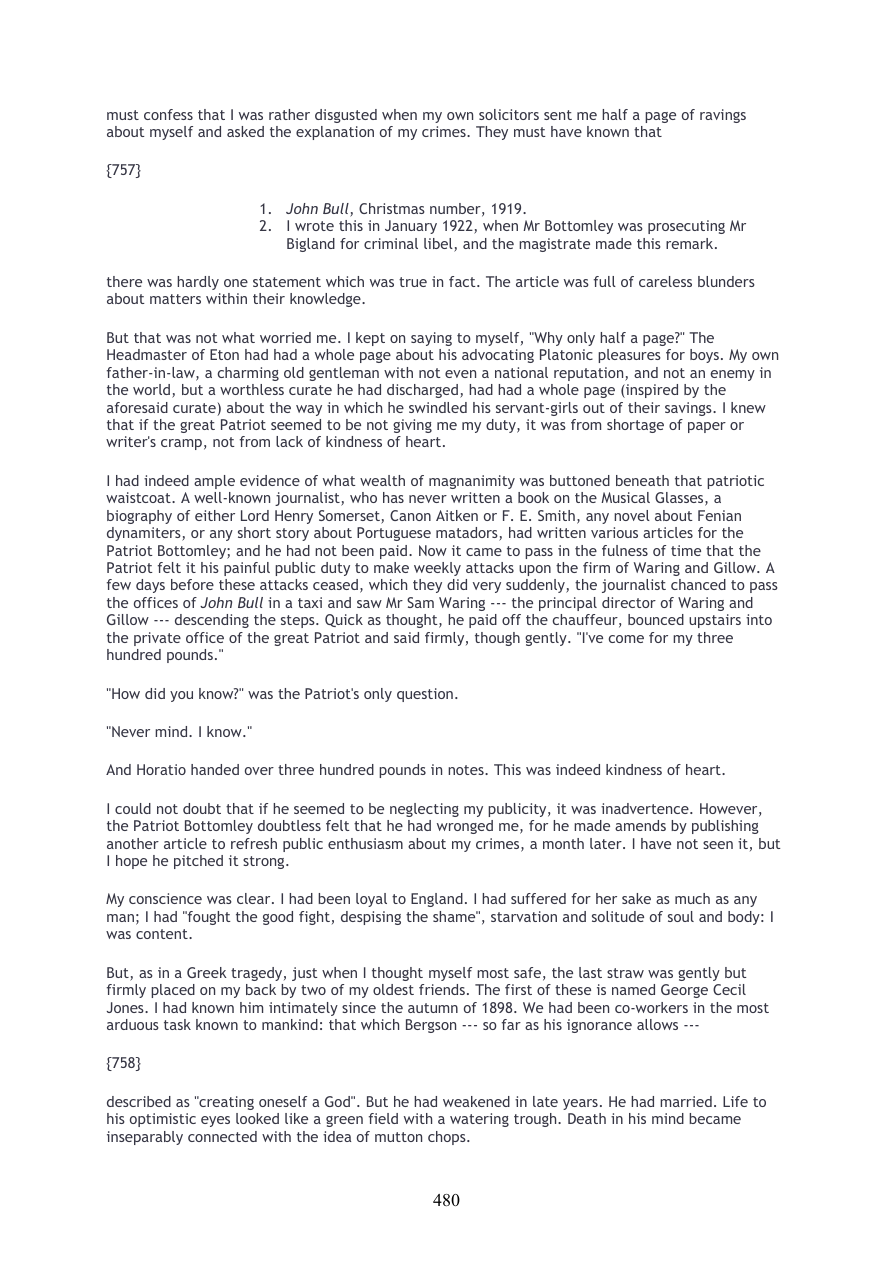
Highlights use the original PDF text layer. OCR-only matches may not be visible on the scan.
Transcription
Download text ↓raw extractionoriginal embedded textReview: unreviewed
480
must confess that I was rather disgusted when my own solicitors sent me half a page of ravings
about myself and asked the explanation of my crimes. They must have known that
{757}
1. John Bull, Christmas number, 1919.
2. I wrote this in January 1922, when Mr Bottomley was prosecuting Mr
Bigland for criminal libel, and the magistrate made this remark.
there was hardly one statement which was true in fact. The article was full of careless blunders
about matters within their knowledge.
But that was not what worried me. I kept on saying to myself, "Why only half a page?" The
Headmaster of Eton had had a whole page about his advocating Platonic pleasures for boys. My own
father-in-law, a charming old gentleman with not even a national reputation, and not an enemy in
the world, but a worthless curate he had discharged, had had a whole page (inspired by the
aforesaid curate) about the way in which he swindled his servant-girls out of their savings. I knew
that if the great Patriot seemed to be not giving me my duty, it was from shortage of paper or
writer's cramp, not from lack of kindness of heart.
I had indeed ample evidence of what wealth of magnanimity was buttoned beneath that patriotic
waistcoat. A well-known journalist, who has never written a book on the Musical Glasses, a
biography of either Lord Henry Somerset, Canon Aitken or F. E. Smith, any novel about Fenian
dynamiters, or any short story about Portuguese matadors, had written various articles for the
Patriot Bottomley; and he had not been paid. Now it came to pass in the fulness of time that the
Patriot felt it his painful public duty to make weekly attacks upon the firm of Waring and Gillow. A
few days before these attacks ceased, which they did very suddenly, the journalist chanced to pass
the offices of John Bull in a taxi and saw Mr Sam Waring --- the principal director of Waring and
Gillow --- descending the steps. Quick as thought, he paid off the chauffeur, bounced upstairs into
the private office of the great Patriot and said firmly, though gently. "I've come for my three
hundred pounds."
"How did you know?" was the Patriot's only question.
"Never mind. I know."
And Horatio handed over three hundred pounds in notes. This was indeed kindness of heart.
I could not doubt that if he seemed to be neglecting my publicity, it was inadvertence. However,
the Patriot Bottomley doubtless felt that he had wronged me, for he made amends by publishing
another article to refresh public enthusiasm about my crimes, a month later. I have not seen it, but
I hope he pitched it strong.
My conscience was clear. I had been loyal to England. I had suffered for her sake as much as any
man; I had "fought the good fight, despising the shame", starvation and solitude of soul and body: I
was content.
But, as in a Greek tragedy, just when I thought myself most safe, the last straw was gently but
firmly placed on my back by two of my oldest friends. The first of these is named George Cecil
Jones. I had known him intimately since the autumn of 1898. We had been co-workers in the most
arduous task known to mankind: that which Bergson --- so far as his ignorance allows ---
{758}
described as "creating oneself a God". But he had weakened in late years. He had married. Life to
his optimistic eyes looked like a green field with a watering trough. Death in his mind became
inseparably connected with the idea of mutton chops.
Page provenance & review flags
Stable page ID: 5ef44b98d8f9c4af5f6f86e1:p00480
Line breaks are preserved. Reading order and OCR accuracy may need review.
Printed page label has not been verified.
- No automated review flags. This does not establish transcription accuracy.