1929 · CLOSE READING
Confessions of Aleister Crowley
Confessions of Aleister Crowley (1929), PDF p. 516
Original page
Enlarge ↗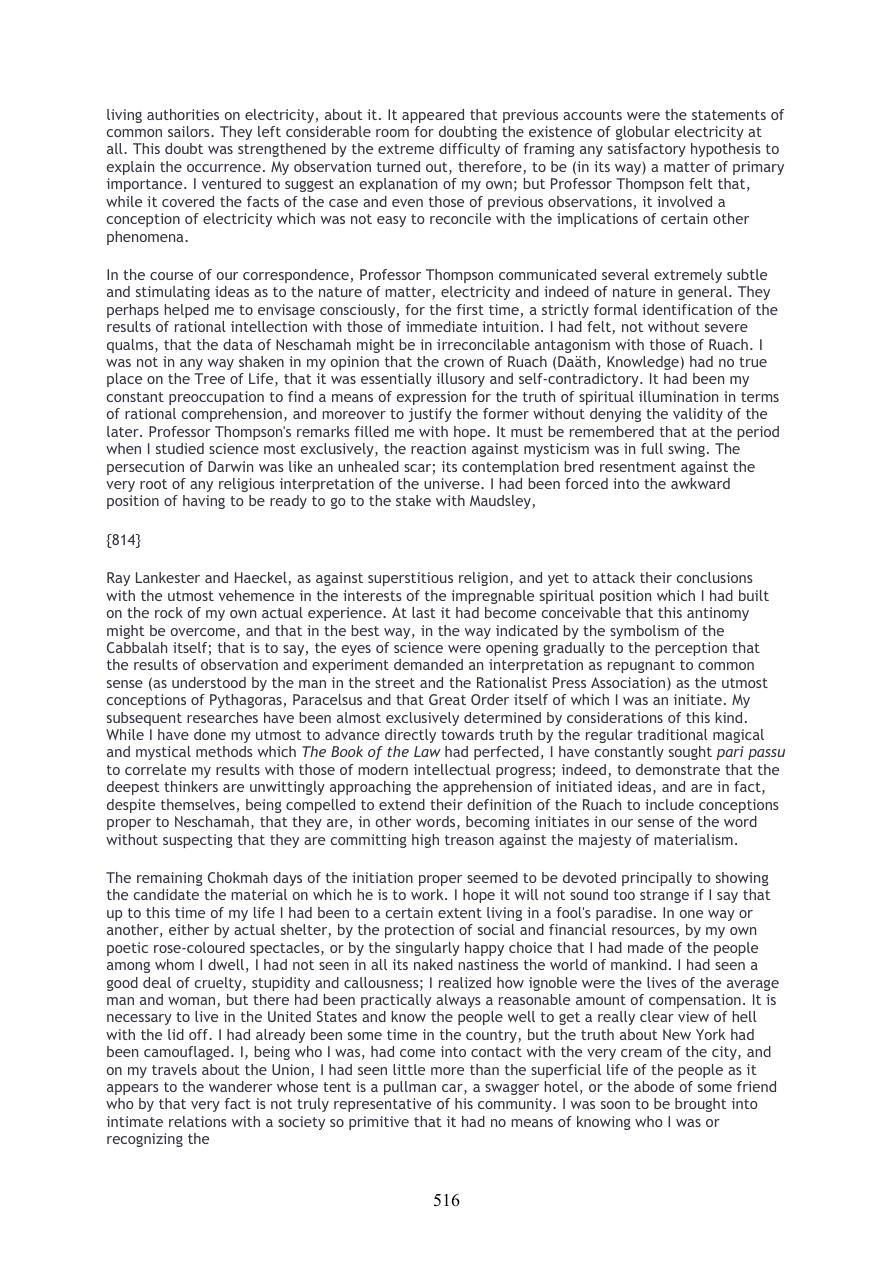
Highlights use the original PDF text layer. OCR-only matches may not be visible on the scan.
Transcription
Download text ↓raw extractionoriginal embedded textReview: unreviewed
516
living authorities on electricity, about it. It appeared that previous accounts were the statements of
common sailors. They left considerable room for doubting the existence of globular electricity at
all. This doubt was strengthened by the extreme difficulty of framing any satisfactory hypothesis to
explain the occurrence. My observation turned out, therefore, to be (in its way) a matter of primary
importance. I ventured to suggest an explanation of my own; but Professor Thompson felt that,
while it covered the facts of the case and even those of previous observations, it involved a
conception of electricity which was not easy to reconcile with the implications of certain other
phenomena.
In the course of our correspondence, Professor Thompson communicated several extremely subtle
and stimulating ideas as to the nature of matter, electricity and indeed of nature in general. They
perhaps helped me to envisage consciously, for the first time, a strictly formal identification of the
results of rational intellection with those of immediate intuition. I had felt, not without severe
qualms, that the data of Neschamah might be in irreconcilable antagonism with those of Ruach. I
was not in any way shaken in my opinion that the crown of Ruach (Daäth, Knowledge) had no true
place on the Tree of Life, that it was essentially illusory and self-contradictory. It had been my
constant preoccupation to find a means of expression for the truth of spiritual illumination in terms
of rational comprehension, and moreover to justify the former without denying the validity of the
later. Professor Thompson's remarks filled me with hope. It must be remembered that at the period
when I studied science most exclusively, the reaction against mysticism was in full swing. The
persecution of Darwin was like an unhealed scar; its contemplation bred resentment against the
very root of any religious interpretation of the universe. I had been forced into the awkward
position of having to be ready to go to the stake with Maudsley,
{814}
Ray Lankester and Haeckel, as against superstitious religion, and yet to attack their conclusions
with the utmost vehemence in the interests of the impregnable spiritual position which I had built
on the rock of my own actual experience. At last it had become conceivable that this antinomy
might be overcome, and that in the best way, in the way indicated by the symbolism of the
Cabbalah itself; that is to say, the eyes of science were opening gradually to the perception that
the results of observation and experiment demanded an interpretation as repugnant to common
sense (as understood by the man in the street and the Rationalist Press Association) as the utmost
conceptions of Pythagoras, Paracelsus and that Great Order itself of which I was an initiate. My
subsequent researches have been almost exclusively determined by considerations of this kind.
While I have done my utmost to advance directly towards truth by the regular traditional magical
and mystical methods which The Book of the Law had perfected, I have constantly sought pari passu
to correlate my results with those of modern intellectual progress; indeed, to demonstrate that the
deepest thinkers are unwittingly approaching the apprehension of initiated ideas, and are in fact,
despite themselves, being compelled to extend their definition of the Ruach to include conceptions
proper to Neschamah, that they are, in other words, becoming initiates in our sense of the word
without suspecting that they are committing high treason against the majesty of materialism.
The remaining Chokmah days of the initiation proper seemed to be devoted principally to showing
the candidate the material on which he is to work. I hope it will not sound too strange if I say that
up to this time of my life I had been to a certain extent living in a fool's paradise. In one way or
another, either by actual shelter, by the protection of social and financial resources, by my own
poetic rose-coloured spectacles, or by the singularly happy choice that I had made of the people
among whom I dwell, I had not seen in all its naked nastiness the world of mankind. I had seen a
good deal of cruelty, stupidity and callousness; I realized how ignoble were the lives of the average
man and woman, but there had been practically always a reasonable amount of compensation. It is
necessary to live in the United States and know the people well to get a really clear view of hell
with the lid off. I had already been some time in the country, but the truth about New York had
been camouflaged. I, being who I was, had come into contact with the very cream of the city, and
on my travels about the Union, I had seen little more than the superficial life of the people as it
appears to the wanderer whose tent is a pullman car, a swagger hotel, or the abode of some friend
who by that very fact is not truly representative of his community. I was soon to be brought into
intimate relations with a society so primitive that it had no means of knowing who I was or
recognizing the
Page provenance & review flags
Stable page ID: 5ef44b98d8f9c4af5f6f86e1:p00516
Line breaks are preserved. Reading order and OCR accuracy may need review.
Printed page label has not been verified.
- No automated review flags. This does not establish transcription accuracy.