1929 · CLOSE READING
Confessions of Aleister Crowley
Confessions of Aleister Crowley (1929), PDF p. 525
Original page
Enlarge ↗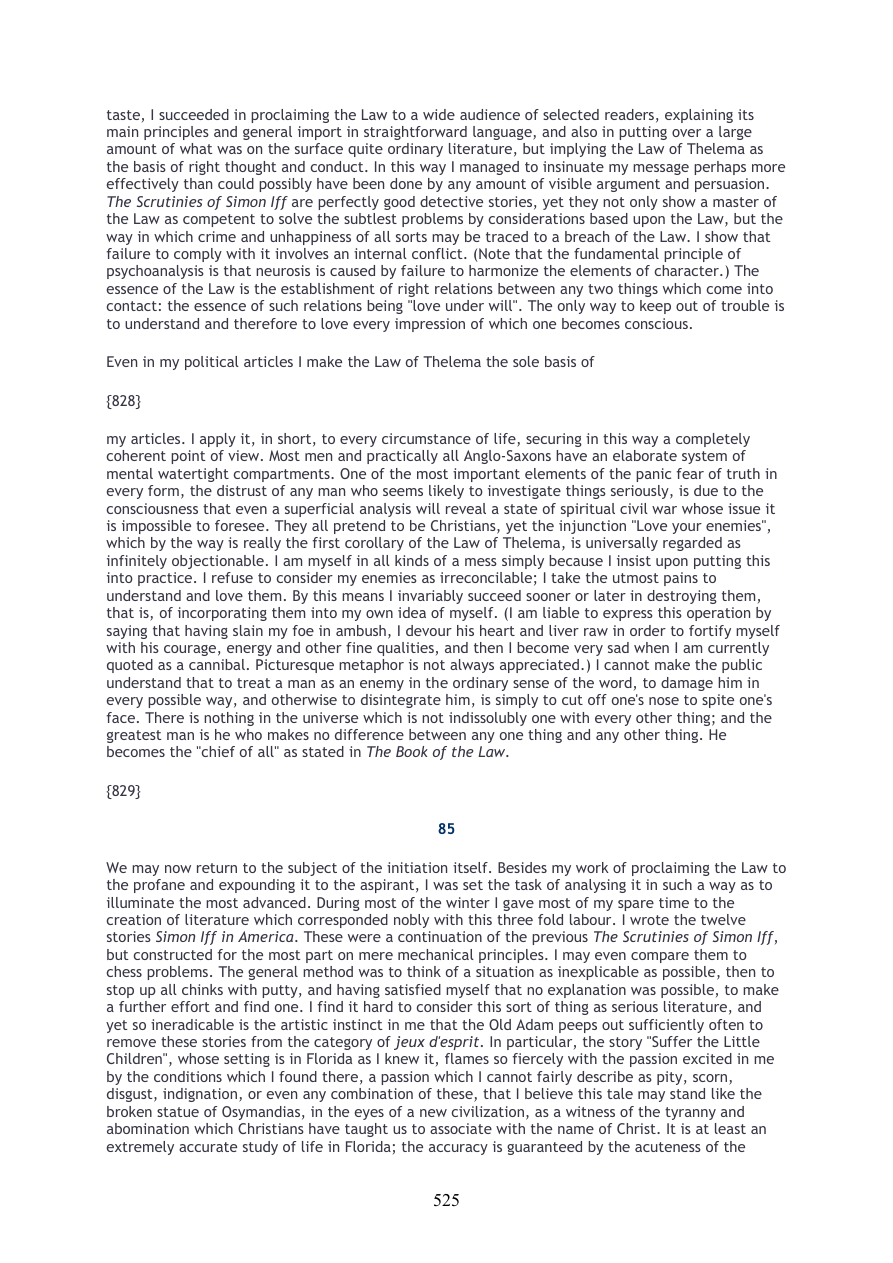
Highlights use the original PDF text layer. OCR-only matches may not be visible on the scan.
Transcription
Download text ↓raw extractionoriginal embedded textReview: unreviewed
525
taste, I succeeded in proclaiming the Law to a wide audience of selected readers, explaining its
main principles and general import in straightforward language, and also in putting over a large
amount of what was on the surface quite ordinary literature, but implying the Law of Thelema as
the basis of right thought and conduct. In this way I managed to insinuate my message perhaps more
effectively than could possibly have been done by any amount of visible argument and persuasion.
The Scrutinies of Simon Iff are perfectly good detective stories, yet they not only show a master of
the Law as competent to solve the subtlest problems by considerations based upon the Law, but the
way in which crime and unhappiness of all sorts may be traced to a breach of the Law. I show that
failure to comply with it involves an internal conflict. (Note that the fundamental principle of
psychoanalysis is that neurosis is caused by failure to harmonize the elements of character.) The
essence of the Law is the establishment of right relations between any two things which come into
contact: the essence of such relations being "love under will". The only way to keep out of trouble is
to understand and therefore to love every impression of which one becomes conscious.
Even in my political articles I make the Law of Thelema the sole basis of
{828}
my articles. I apply it, in short, to every circumstance of life, securing in this way a completely
coherent point of view. Most men and practically all Anglo-Saxons have an elaborate system of
mental watertight compartments. One of the most important elements of the panic fear of truth in
every form, the distrust of any man who seems likely to investigate things seriously, is due to the
consciousness that even a superficial analysis will reveal a state of spiritual civil war whose issue it
is impossible to foresee. They all pretend to be Christians, yet the injunction "Love your enemies",
which by the way is really the first corollary of the Law of Thelema, is universally regarded as
infinitely objectionable. I am myself in all kinds of a mess simply because I insist upon putting this
into practice. I refuse to consider my enemies as irreconcilable; I take the utmost pains to
understand and love them. By this means I invariably succeed sooner or later in destroying them,
that is, of incorporating them into my own idea of myself. (I am liable to express this operation by
saying that having slain my foe in ambush, I devour his heart and liver raw in order to fortify myself
with his courage, energy and other fine qualities, and then I become very sad when I am currently
quoted as a cannibal. Picturesque metaphor is not always appreciated.) I cannot make the public
understand that to treat a man as an enemy in the ordinary sense of the word, to damage him in
every possible way, and otherwise to disintegrate him, is simply to cut off one's nose to spite one's
face. There is nothing in the universe which is not indissolubly one with every other thing; and the
greatest man is he who makes no difference between any one thing and any other thing. He
becomes the "chief of all" as stated in The Book of the Law.
{829}
85
We may now return to the subject of the initiation itself. Besides my work of proclaiming the Law to
the profane and expounding it to the aspirant, I was set the task of analysing it in such a way as to
illuminate the most advanced. During most of the winter I gave most of my spare time to the
creation of literature which corresponded nobly with this three fold labour. I wrote the twelve
stories Simon Iff in America. These were a continuation of the previous The Scrutinies of Simon Iff,
but constructed for the most part on mere mechanical principles. I may even compare them to
chess problems. The general method was to think of a situation as inexplicable as possible, then to
stop up all chinks with putty, and having satisfied myself that no explanation was possible, to make
a further effort and find one. I find it hard to consider this sort of thing as serious literature, and
yet so ineradicable is the artistic instinct in me that the Old Adam peeps out sufficiently often to
remove these stories from the category of jeux d'esprit. In particular, the story "Suffer the Little
Children", whose setting is in Florida as I knew it, flames so fiercely with the passion excited in me
by the conditions which I found there, a passion which I cannot fairly describe as pity, scorn,
disgust, indignation, or even any combination of these, that I believe this tale may stand like the
broken statue of Osymandias, in the eyes of a new civilization, as a witness of the tyranny and
abomination which Christians have taught us to associate with the name of Christ. It is at least an
extremely accurate study of life in Florida; the accuracy is guaranteed by the acuteness of the
Page provenance & review flags
Stable page ID: 5ef44b98d8f9c4af5f6f86e1:p00525
Line breaks are preserved. Reading order and OCR accuracy may need review.
Printed page label has not been verified.
- No automated review flags. This does not establish transcription accuracy.