1929 · CLOSE READING
Confessions of Aleister Crowley
Confessions of Aleister Crowley (1929), PDF p. 54
Original page
Enlarge ↗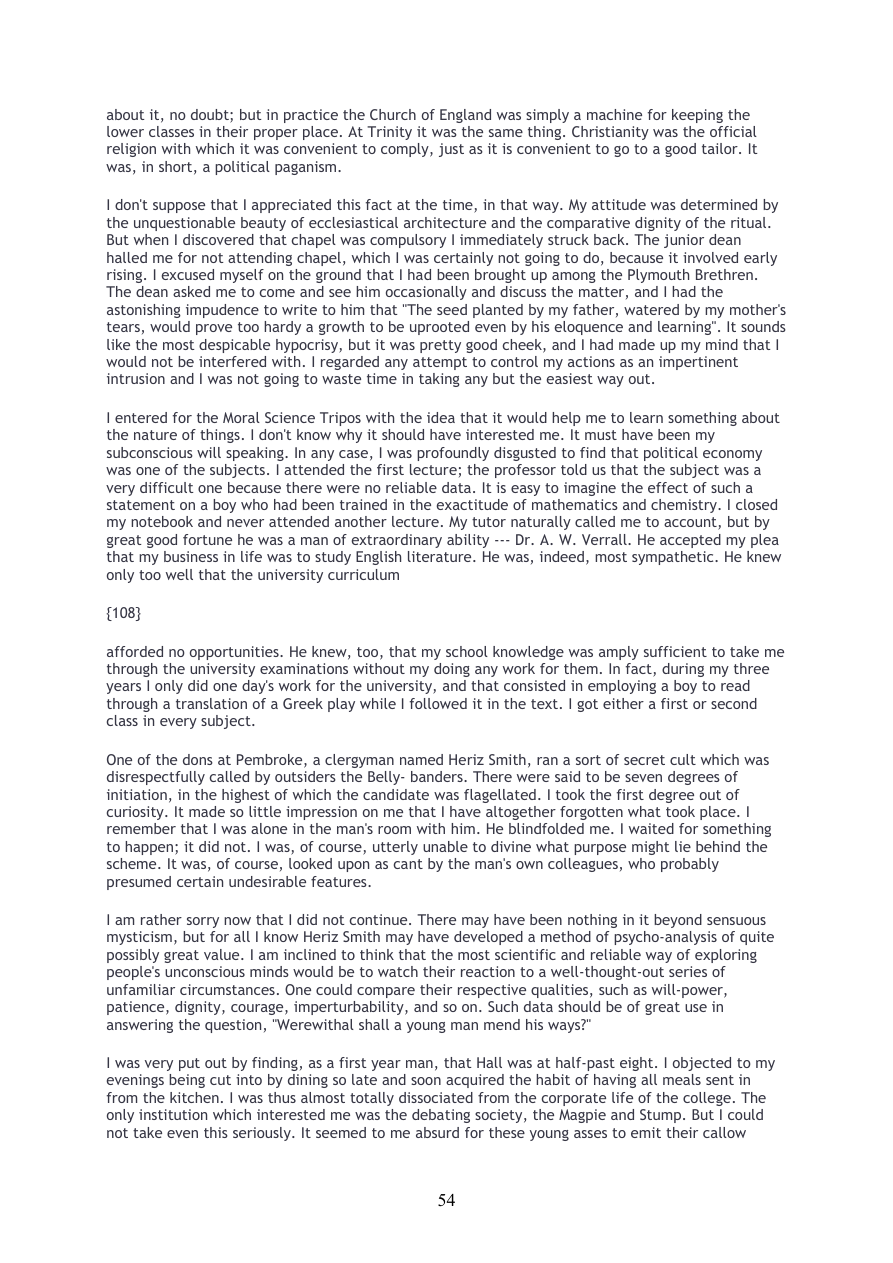
Highlights use the original PDF text layer. OCR-only matches may not be visible on the scan.
Transcription
Download text ↓raw extractionoriginal embedded textReview: unreviewed
54
about it, no doubt; but in practice the Church of England was simply a machine for keeping the
lower classes in their proper place. At Trinity it was the same thing. Christianity was the official
religion with which it was convenient to comply, just as it is convenient to go to a good tailor. It
was, in short, a political paganism.
I don't suppose that I appreciated this fact at the time, in that way. My attitude was determined by
the unquestionable beauty of ecclesiastical architecture and the comparative dignity of the ritual.
But when I discovered that chapel was compulsory I immediately struck back. The junior dean
halled me for not attending chapel, which I was certainly not going to do, because it involved early
rising. I excused myself on the ground that I had been brought up among the Plymouth Brethren.
The dean asked me to come and see him occasionally and discuss the matter, and I had the
astonishing impudence to write to him that "The seed planted by my father, watered by my mother's
tears, would prove too hardy a growth to be uprooted even by his eloquence and learning". It sounds
like the most despicable hypocrisy, but it was pretty good cheek, and I had made up my mind that I
would not be interfered with. I regarded any attempt to control my actions as an impertinent
intrusion and I was not going to waste time in taking any but the easiest way out.
I entered for the Moral Science Tripos with the idea that it would help me to learn something about
the nature of things. I don't know why it should have interested me. It must have been my
subconscious will speaking. In any case, I was profoundly disgusted to find that political economy
was one of the subjects. I attended the first lecture; the professor told us that the subject was a
very difficult one because there were no reliable data. It is easy to imagine the effect of such a
statement on a boy who had been trained in the exactitude of mathematics and chemistry. I closed
my notebook and never attended another lecture. My tutor naturally called me to account, but by
great good fortune he was a man of extraordinary ability --- Dr. A. W. Verrall. He accepted my plea
that my business in life was to study English literature. He was, indeed, most sympathetic. He knew
only too well that the university curriculum
{108}
afforded no opportunities. He knew, too, that my school knowledge was amply sufficient to take me
through the university examinations without my doing any work for them. In fact, during my three
years I only did one day's work for the university, and that consisted in employing a boy to read
through a translation of a Greek play while I followed it in the text. I got either a first or second
class in every subject.
One of the dons at Pembroke, a clergyman named Heriz Smith, ran a sort of secret cult which was
disrespectfully called by outsiders the Belly- banders. There were said to be seven degrees of
initiation, in the highest of which the candidate was flagellated. I took the first degree out of
curiosity. It made so little impression on me that I have altogether forgotten what took place. I
remember that I was alone in the man's room with him. He blindfolded me. I waited for something
to happen; it did not. I was, of course, utterly unable to divine what purpose might lie behind the
scheme. It was, of course, looked upon as cant by the man's own colleagues, who probably
presumed certain undesirable features.
I am rather sorry now that I did not continue. There may have been nothing in it beyond sensuous
mysticism, but for all I know Heriz Smith may have developed a method of psycho-analysis of quite
possibly great value. I am inclined to think that the most scientific and reliable way of exploring
people's unconscious minds would be to watch their reaction to a well-thought-out series of
unfamiliar circumstances. One could compare their respective qualities, such as will-power,
patience, dignity, courage, imperturbability, and so on. Such data should be of great use in
answering the question, "Werewithal shall a young man mend his ways?"
I was very put out by finding, as a first year man, that Hall was at half-past eight. I objected to my
evenings being cut into by dining so late and soon acquired the habit of having all meals sent in
from the kitchen. I was thus almost totally dissociated from the corporate life of the college. The
only institution which interested me was the debating society, the Magpie and Stump. But I could
not take even this seriously. It seemed to me absurd for these young asses to emit their callow
Page provenance & review flags
Stable page ID: 5ef44b98d8f9c4af5f6f86e1:p00054
Line breaks are preserved. Reading order and OCR accuracy may need review.
Printed page label has not been verified.
- No automated review flags. This does not establish transcription accuracy.