1929 · CLOSE READING
Confessions of Aleister Crowley
Confessions of Aleister Crowley (1929), PDF p. 565
Original page
Enlarge ↗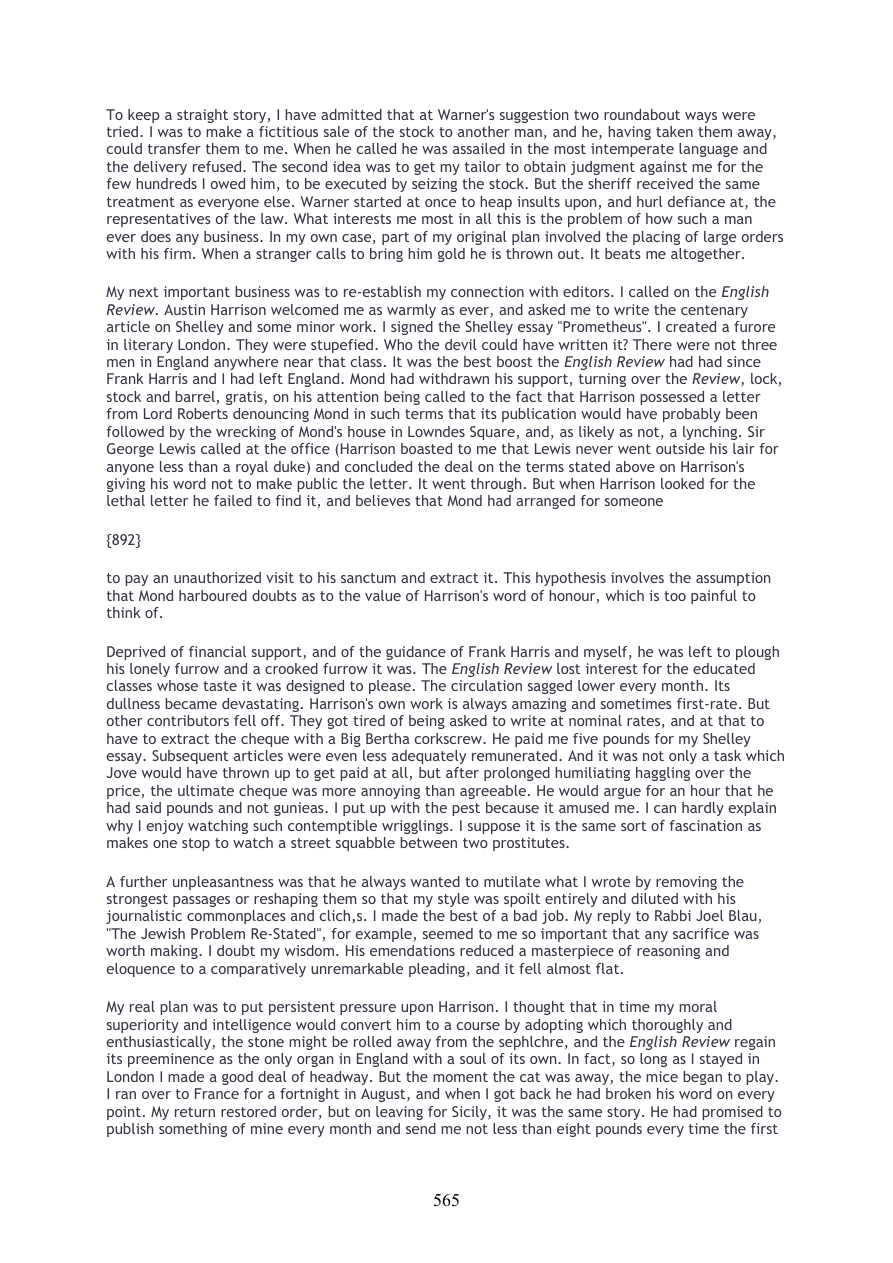
Highlights use the original PDF text layer. OCR-only matches may not be visible on the scan.
Transcription
Download text ↓raw extractionoriginal embedded textReview: unreviewed
565
To keep a straight story, I have admitted that at Warner's suggestion two roundabout ways were
tried. I was to make a fictitious sale of the stock to another man, and he, having taken them away,
could transfer them to me. When he called he was assailed in the most intemperate language and
the delivery refused. The second idea was to get my tailor to obtain judgment against me for the
few hundreds I owed him, to be executed by seizing the stock. But the sheriff received the same
treatment as everyone else. Warner started at once to heap insults upon, and hurl defiance at, the
representatives of the law. What interests me most in all this is the problem of how such a man
ever does any business. In my own case, part of my original plan involved the placing of large orders
with his firm. When a stranger calls to bring him gold he is thrown out. It beats me altogether.
My next important business was to re-establish my connection with editors. I called on the English
Review. Austin Harrison welcomed me as warmly as ever, and asked me to write the centenary
article on Shelley and some minor work. I signed the Shelley essay "Prometheus". I created a furore
in literary London. They were stupefied. Who the devil could have written it? There were not three
men in England anywhere near that class. It was the best boost the English Review had had since
Frank Harris and I had left England. Mond had withdrawn his support, turning over the Review, lock,
stock and barrel, gratis, on his attention being called to the fact that Harrison possessed a letter
from Lord Roberts denouncing Mond in such terms that its publication would have probably been
followed by the wrecking of Mond's house in Lowndes Square, and, as likely as not, a lynching. Sir
George Lewis called at the office (Harrison boasted to me that Lewis never went outside his lair for
anyone less than a royal duke) and concluded the deal on the terms stated above on Harrison's
giving his word not to make public the letter. It went through. But when Harrison looked for the
lethal letter he failed to find it, and believes that Mond had arranged for someone
{892}
to pay an unauthorized visit to his sanctum and extract it. This hypothesis involves the assumption
that Mond harboured doubts as to the value of Harrison's word of honour, which is too painful to
think of.
Deprived of financial support, and of the guidance of Frank Harris and myself, he was left to plough
his lonely furrow and a crooked furrow it was. The English Review lost interest for the educated
classes whose taste it was designed to please. The circulation sagged lower every month. Its
dullness became devastating. Harrison's own work is always amazing and sometimes first-rate. But
other contributors fell off. They got tired of being asked to write at nominal rates, and at that to
have to extract the cheque with a Big Bertha corkscrew. He paid me five pounds for my Shelley
essay. Subsequent articles were even less adequately remunerated. And it was not only a task which
Jove would have thrown up to get paid at all, but after prolonged humiliating haggling over the
price, the ultimate cheque was more annoying than agreeable. He would argue for an hour that he
had said pounds and not gunieas. I put up with the pest because it amused me. I can hardly explain
why I enjoy watching such contemptible wrigglings. I suppose it is the same sort of fascination as
makes one stop to watch a street squabble between two prostitutes.
A further unpleasantness was that he always wanted to mutilate what I wrote by removing the
strongest passages or reshaping them so that my style was spoilt entirely and diluted with his
journalistic commonplaces and clichs. I made the best of a bad job. My reply to Rabbi Joel Blau,
"The Jewish Problem Re-Stated", for example, seemed to me so important that any sacrifice was
worth making. I doubt my wisdom. His emendations reduced a masterpiece of reasoning and
eloquence to a comparatively unremarkable pleading, and it fell almost flat.
My real plan was to put persistent pressure upon Harrison. I thought that in time my moral
superiority and intelligence would convert him to a course by adopting which thoroughly and
enthusiastically, the stone might be rolled away from the sephlchre, and the English Review regain
its preeminence as the only organ in England with a soul of its own. In fact, so long as I stayed in
London I made a good deal of headway. But the moment the cat was away, the mice began to play.
I ran over to France for a fortnight in August, and when I got back he had broken his word on every
point. My return restored order, but on leaving for Sicily, it was the same story. He had promised to
publish something of mine every month and send me not less than eight pounds every time the first
Page provenance & review flags
Stable page ID: 5ef44b98d8f9c4af5f6f86e1:p00565
Line breaks are preserved. Reading order and OCR accuracy may need review.
Printed page label has not been verified.
- No automated review flags. This does not establish transcription accuracy.