1929 · CLOSE READING
Confessions of Aleister Crowley
Confessions of Aleister Crowley (1929), PDF p. 581
Original page
Enlarge ↗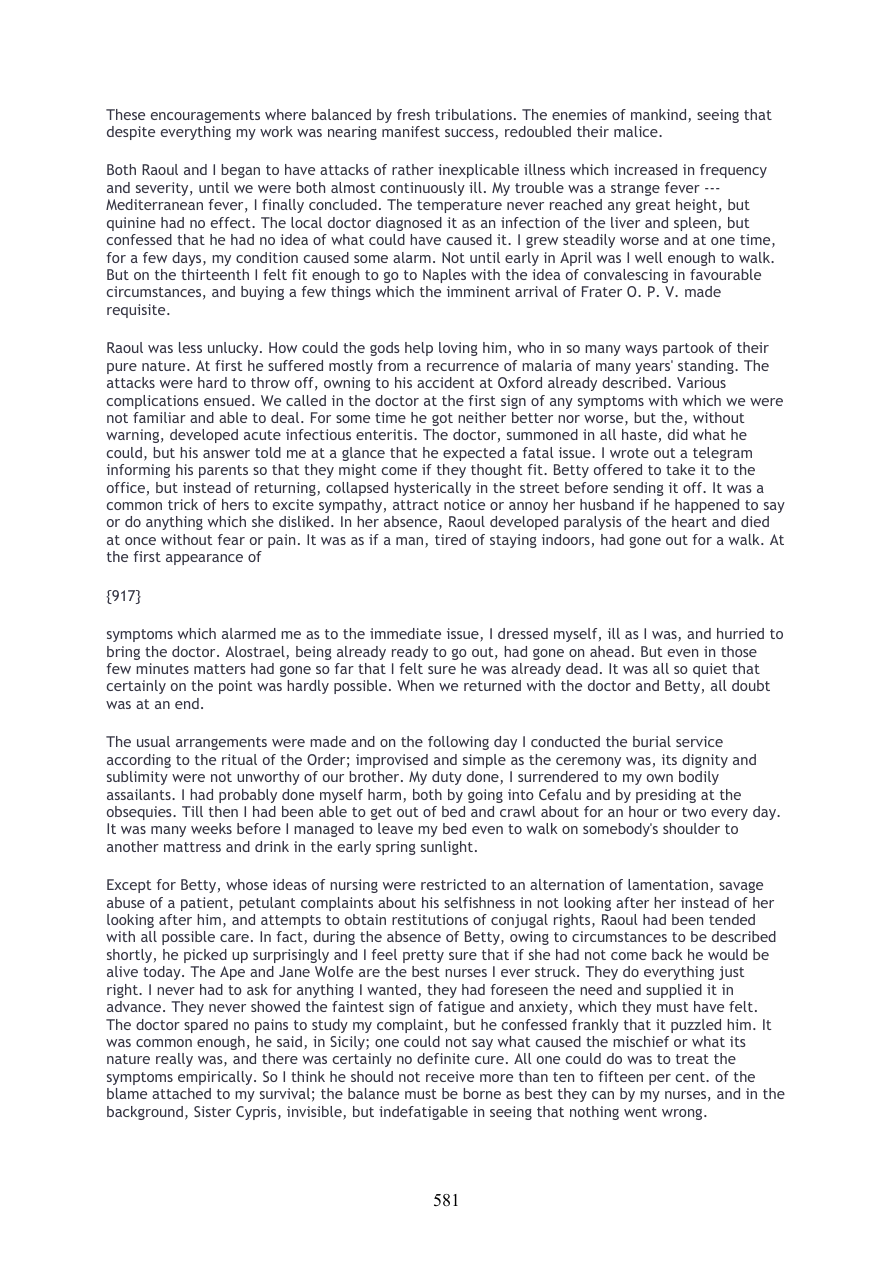
Highlights use the original PDF text layer. OCR-only matches may not be visible on the scan.
Transcription
Download text ↓raw extractionoriginal embedded textReview: unreviewed
581
These encouragements where balanced by fresh tribulations. The enemies of mankind, seeing that
despite everything my work was nearing manifest success, redoubled their malice.
Both Raoul and I began to have attacks of rather inexplicable illness which increased in frequency
and severity, until we were both almost continuously ill. My trouble was a strange fever ---
Mediterranean fever, I finally concluded. The temperature never reached any great height, but
quinine had no effect. The local doctor diagnosed it as an infection of the liver and spleen, but
confessed that he had no idea of what could have caused it. I grew steadily worse and at one time,
for a few days, my condition caused some alarm. Not until early in April was I well enough to walk.
But on the thirteenth I felt fit enough to go to Naples with the idea of convalescing in favourable
circumstances, and buying a few things which the imminent arrival of Frater O. P. V. made
requisite.
Raoul was less unlucky. How could the gods help loving him, who in so many ways partook of their
pure nature. At first he suffered mostly from a recurrence of malaria of many years' standing. The
attacks were hard to throw off, owning to his accident at Oxford already described. Various
complications ensued. We called in the doctor at the first sign of any symptoms with which we were
not familiar and able to deal. For some time he got neither better nor worse, but the, without
warning, developed acute infectious enteritis. The doctor, summoned in all haste, did what he
could, but his answer told me at a glance that he expected a fatal issue. I wrote out a telegram
informing his parents so that they might come if they thought fit. Betty offered to take it to the
office, but instead of returning, collapsed hysterically in the street before sending it off. It was a
common trick of hers to excite sympathy, attract notice or annoy her husband if he happened to say
or do anything which she disliked. In her absence, Raoul developed paralysis of the heart and died
at once without fear or pain. It was as if a man, tired of staying indoors, had gone out for a walk. At
the first appearance of
{917}
symptoms which alarmed me as to the immediate issue, I dressed myself, ill as I was, and hurried to
bring the doctor. Alostrael, being already ready to go out, had gone on ahead. But even in those
few minutes matters had gone so far that I felt sure he was already dead. It was all so quiet that
certainly on the point was hardly possible. When we returned with the doctor and Betty, all doubt
was at an end.
The usual arrangements were made and on the following day I conducted the burial service
according to the ritual of the Order; improvised and simple as the ceremony was, its dignity and
sublimity were not unworthy of our brother. My duty done, I surrendered to my own bodily
assailants. I had probably done myself harm, both by going into Cefalu and by presiding at the
obsequies. Till then I had been able to get out of bed and crawl about for an hour or two every day.
It was many weeks before I managed to leave my bed even to walk on somebody's shoulder to
another mattress and drink in the early spring sunlight.
Except for Betty, whose ideas of nursing were restricted to an alternation of lamentation, savage
abuse of a patient, petulant complaints about his selfishness in not looking after her instead of her
looking after him, and attempts to obtain restitutions of conjugal rights, Raoul had been tended
with all possible care. In fact, during the absence of Betty, owing to circumstances to be described
shortly, he picked up surprisingly and I feel pretty sure that if she had not come back he would be
alive today. The Ape and Jane Wolfe are the best nurses I ever struck. They do everything just
right. I never had to ask for anything I wanted, they had foreseen the need and supplied it in
advance. They never showed the faintest sign of fatigue and anxiety, which they must have felt.
The doctor spared no pains to study my complaint, but he confessed frankly that it puzzled him. It
was common enough, he said, in Sicily; one could not say what caused the mischief or what its
nature really was, and there was certainly no definite cure. All one could do was to treat the
symptoms empirically. So I think he should not receive more than ten to fifteen per cent. of the
blame attached to my survival; the balance must be borne as best they can by my nurses, and in the
background, Sister Cypris, invisible, but indefatigable in seeing that nothing went wrong.
Page provenance & review flags
Stable page ID: 5ef44b98d8f9c4af5f6f86e1:p00581
Line breaks are preserved. Reading order and OCR accuracy may need review.
Printed page label has not been verified.
- No automated review flags. This does not establish transcription accuracy.