1929 · CLOSE READING
Confessions of Aleister Crowley
Confessions of Aleister Crowley (1929), PDF p. 72
Original page
Enlarge ↗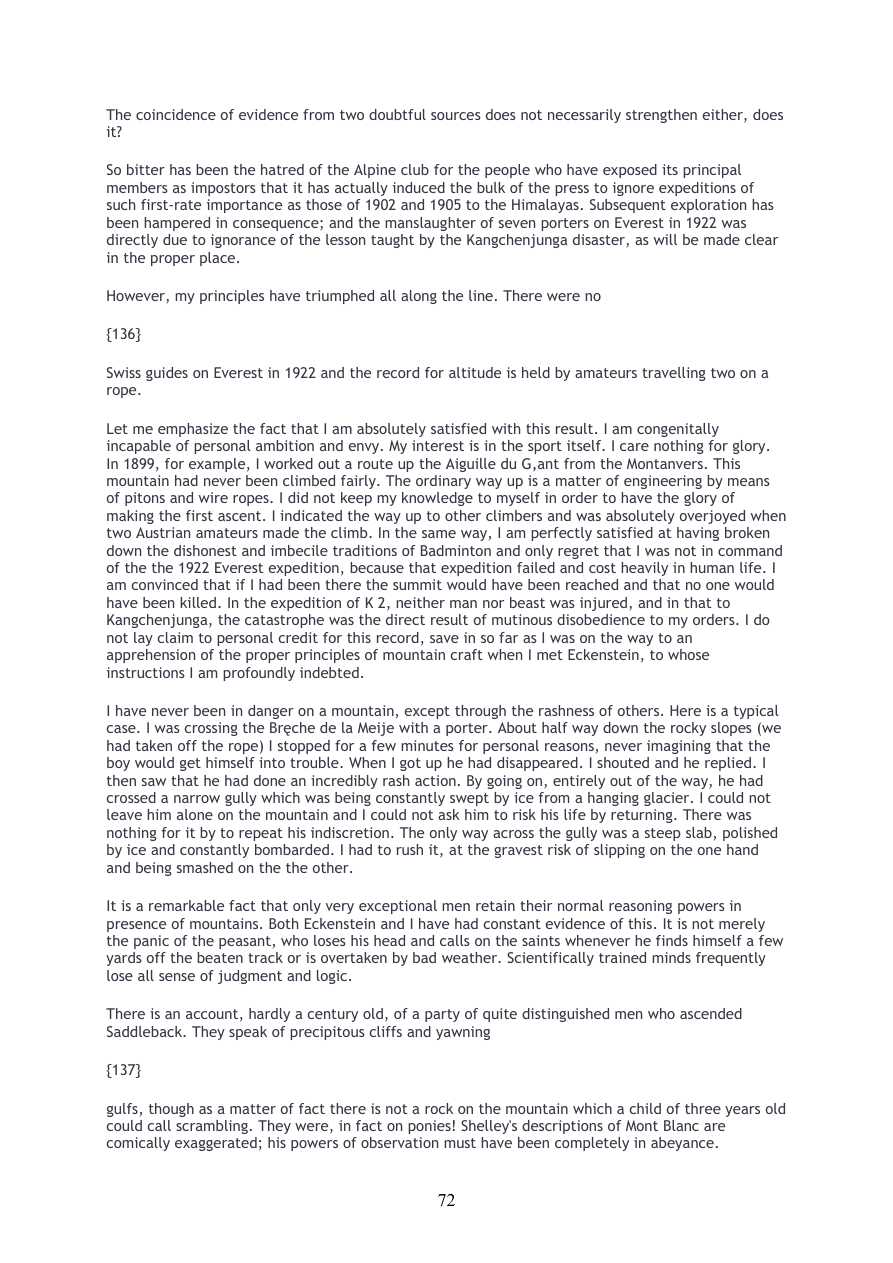
Highlights use the original PDF text layer. OCR-only matches may not be visible on the scan.
Transcription
Download text ↓raw extractionoriginal embedded textReview: unreviewed
72
The coincidence of evidence from two doubtful sources does not necessarily strengthen either, does
it?
So bitter has been the hatred of the Alpine club for the people who have exposed its principal
members as impostors that it has actually induced the bulk of the press to ignore expeditions of
such first-rate importance as those of 1902 and 1905 to the Himalayas. Subsequent exploration has
been hampered in consequence; and the manslaughter of seven porters on Everest in 1922 was
directly due to ignorance of the lesson taught by the Kangchenjunga disaster, as will be made clear
in the proper place.
However, my principles have triumphed all along the line. There were no
{136}
Swiss guides on Everest in 1922 and the record for altitude is held by amateurs travelling two on a
rope.
Let me emphasize the fact that I am absolutely satisfied with this result. I am congenitally
incapable of personal ambition and envy. My interest is in the sport itself. I care nothing for glory.
In 1899, for example, I worked out a route up the Aiguille du Gant from the Montanvers. This
mountain had never been climbed fairly. The ordinary way up is a matter of engineering by means
of pitons and wire ropes. I did not keep my knowledge to myself in order to have the glory of
making the first ascent. I indicated the way up to other climbers and was absolutely overjoyed when
two Austrian amateurs made the climb. In the same way, I am perfectly satisfied at having broken
down the dishonest and imbecile traditions of Badminton and only regret that I was not in command
of the the 1922 Everest expedition, because that expedition failed and cost heavily in human life. I
am convinced that if I had been there the summit would have been reached and that no one would
have been killed. In the expedition of K 2, neither man nor beast was injured, and in that to
Kangchenjunga, the catastrophe was the direct result of mutinous disobedience to my orders. I do
not lay claim to personal credit for this record, save in so far as I was on the way to an
apprehension of the proper principles of mountain craft when I met Eckenstein, to whose
instructions I am profoundly indebted.
I have never been in danger on a mountain, except through the rashness of others. Here is a typical
case. I was crossing the Bręche de la Meije with a porter. About half way down the rocky slopes (we
had taken off the rope) I stopped for a few minutes for personal reasons, never imagining that the
boy would get himself into trouble. When I got up he had disappeared. I shouted and he replied. I
then saw that he had done an incredibly rash action. By going on, entirely out of the way, he had
crossed a narrow gully which was being constantly swept by ice from a hanging glacier. I could not
leave him alone on the mountain and I could not ask him to risk his life by returning. There was
nothing for it by to repeat his indiscretion. The only way across the gully was a steep slab, polished
by ice and constantly bombarded. I had to rush it, at the gravest risk of slipping on the one hand
and being smashed on the the other.
It is a remarkable fact that only very exceptional men retain their normal reasoning powers in
presence of mountains. Both Eckenstein and I have had constant evidence of this. It is not merely
the panic of the peasant, who loses his head and calls on the saints whenever he finds himself a few
yards off the beaten track or is overtaken by bad weather. Scientifically trained minds frequently
lose all sense of judgment and logic.
There is an account, hardly a century old, of a party of quite distinguished men who ascended
Saddleback. They speak of precipitous cliffs and yawning
{137}
gulfs, though as a matter of fact there is not a rock on the mountain which a child of three years old
could call scrambling. They were, in fact on ponies! Shelley's descriptions of Mont Blanc are
comically exaggerated; his powers of observation must have been completely in abeyance.
Page provenance & review flags
Stable page ID: 5ef44b98d8f9c4af5f6f86e1:p00072
Line breaks are preserved. Reading order and OCR accuracy may need review.
Printed page label has not been verified.
- No automated review flags. This does not establish transcription accuracy.