1929 · CLOSE READING
Confessions of Aleister Crowley
Confessions of Aleister Crowley (1929), PDF p. 76
Original page
Enlarge ↗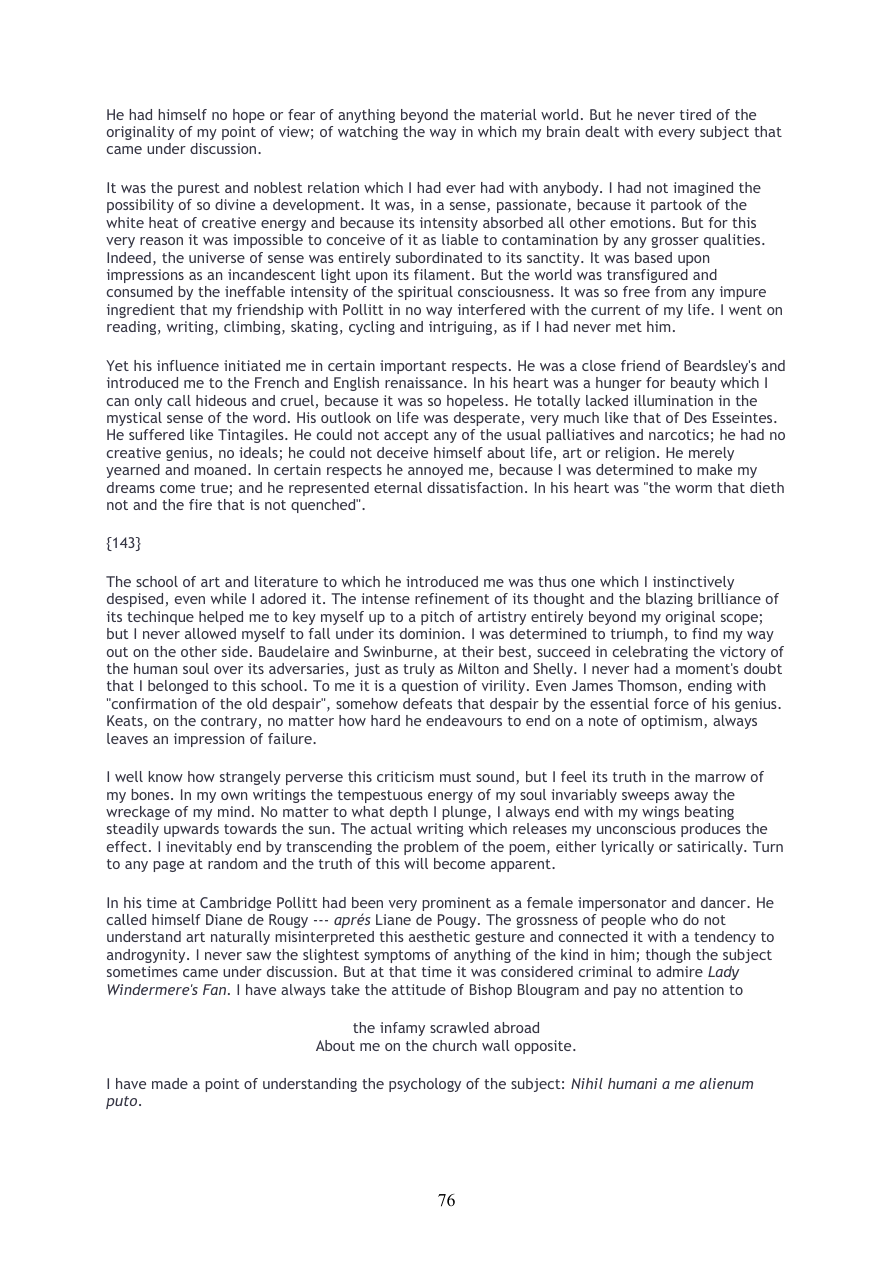
Highlights use the original PDF text layer. OCR-only matches may not be visible on the scan.
Transcription
Download text ↓raw extractionoriginal embedded textReview: unreviewed
76
He had himself no hope or fear of anything beyond the material world. But he never tired of the
originality of my point of view; of watching the way in which my brain dealt with every subject that
came under discussion.
It was the purest and noblest relation which I had ever had with anybody. I had not imagined the
possibility of so divine a development. It was, in a sense, passionate, because it partook of the
white heat of creative energy and because its intensity absorbed all other emotions. But for this
very reason it was impossible to conceive of it as liable to contamination by any grosser qualities.
Indeed, the universe of sense was entirely subordinated to its sanctity. It was based upon
impressions as an incandescent light upon its filament. But the world was transfigured and
consumed by the ineffable intensity of the spiritual consciousness. It was so free from any impure
ingredient that my friendship with Pollitt in no way interfered with the current of my life. I went on
reading, writing, climbing, skating, cycling and intriguing, as if I had never met him.
Yet his influence initiated me in certain important respects. He was a close friend of Beardsley's and
introduced me to the French and English renaissance. In his heart was a hunger for beauty which I
can only call hideous and cruel, because it was so hopeless. He totally lacked illumination in the
mystical sense of the word. His outlook on life was desperate, very much like that of Des Esseintes.
He suffered like Tintagiles. He could not accept any of the usual palliatives and narcotics; he had no
creative genius, no ideals; he could not deceive himself about life, art or religion. He merely
yearned and moaned. In certain respects he annoyed me, because I was determined to make my
dreams come true; and he represented eternal dissatisfaction. In his heart was "the worm that dieth
not and the fire that is not quenched".
{143}
The school of art and literature to which he introduced me was thus one which I instinctively
despised, even while I adored it. The intense refinement of its thought and the blazing brilliance of
its techinque helped me to key myself up to a pitch of artistry entirely beyond my original scope;
but I never allowed myself to fall under its dominion. I was determined to triumph, to find my way
out on the other side. Baudelaire and Swinburne, at their best, succeed in celebrating the victory of
the human soul over its adversaries, just as truly as Milton and Shelly. I never had a moment's doubt
that I belonged to this school. To me it is a question of virility. Even James Thomson, ending with
"confirmation of the old despair", somehow defeats that despair by the essential force of his genius.
Keats, on the contrary, no matter how hard he endeavours to end on a note of optimism, always
leaves an impression of failure.
I well know how strangely perverse this criticism must sound, but I feel its truth in the marrow of
my bones. In my own writings the tempestuous energy of my soul invariably sweeps away the
wreckage of my mind. No matter to what depth I plunge, I always end with my wings beating
steadily upwards towards the sun. The actual writing which releases my unconscious produces the
effect. I inevitably end by transcending the problem of the poem, either lyrically or satirically. Turn
to any page at random and the truth of this will become apparent.
In his time at Cambridge Pollitt had been very prominent as a female impersonator and dancer. He
called himself Diane de Rougy --- aprés Liane de Pougy. The grossness of people who do not
understand art naturally misinterpreted this aesthetic gesture and connected it with a tendency to
androgynity. I never saw the slightest symptoms of anything of the kind in him; though the subject
sometimes came under discussion. But at that time it was considered criminal to admire Lady
Windermere's Fan. I have always take the attitude of Bishop Blougram and pay no attention to
the infamy scrawled abroad
About me on the church wall opposite.
I have made a point of understanding the psychology of the subject: Nihil humani a me alienum
puto.
Page provenance & review flags
Stable page ID: 5ef44b98d8f9c4af5f6f86e1:p00076
Line breaks are preserved. Reading order and OCR accuracy may need review.
Printed page label has not been verified.
- No automated review flags. This does not establish transcription accuracy.