1929 · CLOSE READING
Confessions of Aleister Crowley
Confessions of Aleister Crowley (1929), PDF p. 78
Original page
Enlarge ↗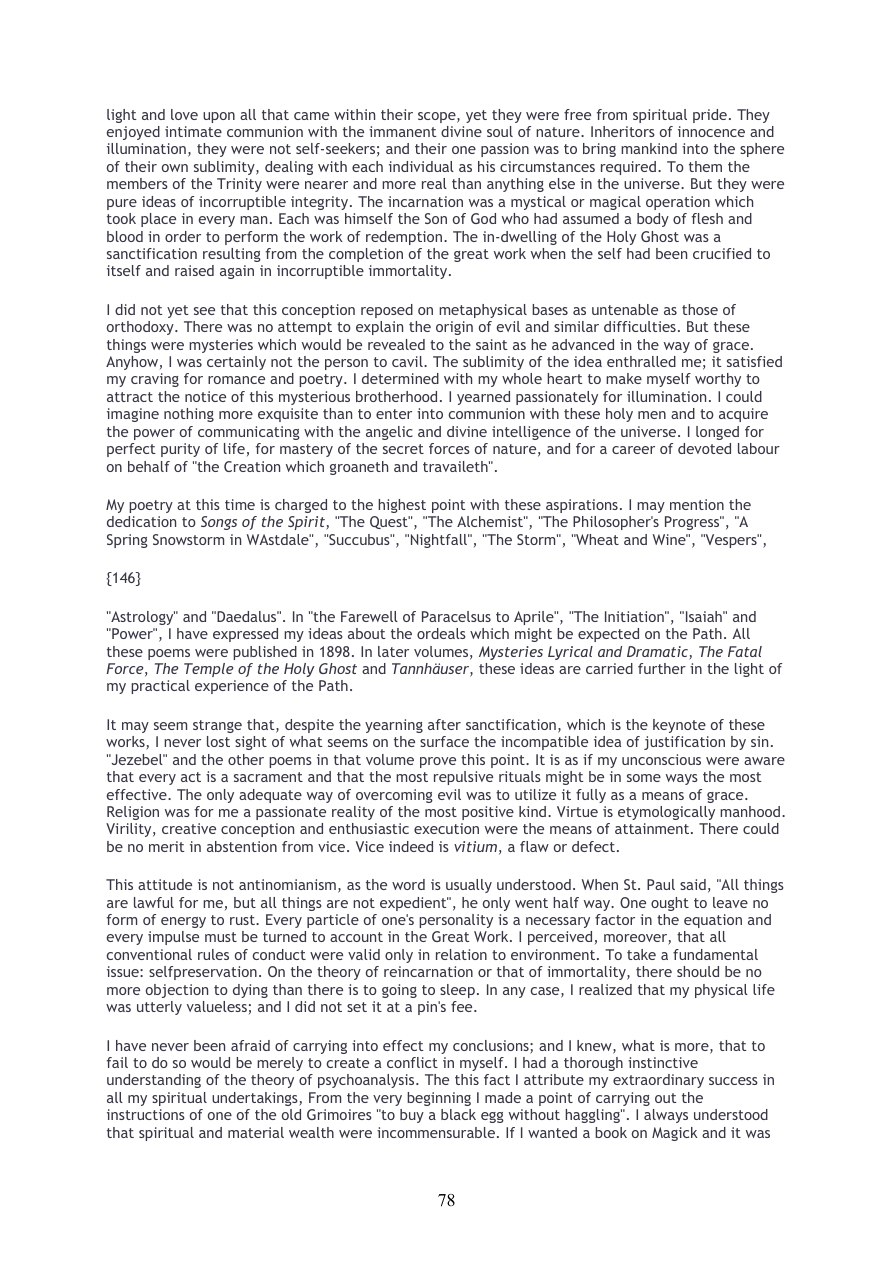
Highlights use the original PDF text layer. OCR-only matches may not be visible on the scan.
Transcription
Download text ↓raw extractionoriginal embedded textReview: unreviewed
78
light and love upon all that came within their scope, yet they were free from spiritual pride. They
enjoyed intimate communion with the immanent divine soul of nature. Inheritors of innocence and
illumination, they were not self-seekers; and their one passion was to bring mankind into the sphere
of their own sublimity, dealing with each individual as his circumstances required. To them the
members of the Trinity were nearer and more real than anything else in the universe. But they were
pure ideas of incorruptible integrity. The incarnation was a mystical or magical operation which
took place in every man. Each was himself the Son of God who had assumed a body of flesh and
blood in order to perform the work of redemption. The in-dwelling of the Holy Ghost was a
sanctification resulting from the completion of the great work when the self had been crucified to
itself and raised again in incorruptible immortality.
I did not yet see that this conception reposed on metaphysical bases as untenable as those of
orthodoxy. There was no attempt to explain the origin of evil and similar difficulties. But these
things were mysteries which would be revealed to the saint as he advanced in the way of grace.
Anyhow, I was certainly not the person to cavil. The sublimity of the idea enthralled me; it satisfied
my craving for romance and poetry. I determined with my whole heart to make myself worthy to
attract the notice of this mysterious brotherhood. I yearned passionately for illumination. I could
imagine nothing more exquisite than to enter into communion with these holy men and to acquire
the power of communicating with the angelic and divine intelligence of the universe. I longed for
perfect purity of life, for mastery of the secret forces of nature, and for a career of devoted labour
on behalf of "the Creation which groaneth and travaileth".
My poetry at this time is charged to the highest point with these aspirations. I may mention the
dedication to Songs of the Spirit, "The Quest", "The Alchemist", "The Philosopher's Progress", "A
Spring Snowstorm in WAstdale", "Succubus", "Nightfall", "The Storm", "Wheat and Wine", "Vespers",
{146}
"Astrology" and "Daedalus". In "the Farewell of Paracelsus to Aprile", "The Initiation", "Isaiah" and
"Power", I have expressed my ideas about the ordeals which might be expected on the Path. All
these poems were published in 1898. In later volumes, Mysteries Lyrical and Dramatic, The Fatal
Force, The Temple of the Holy Ghost and Tannhäuser, these ideas are carried further in the light of
my practical experience of the Path.
It may seem strange that, despite the yearning after sanctification, which is the keynote of these
works, I never lost sight of what seems on the surface the incompatible idea of justification by sin.
"Jezebel" and the other poems in that volume prove this point. It is as if my unconscious were aware
that every act is a sacrament and that the most repulsive rituals might be in some ways the most
effective. The only adequate way of overcoming evil was to utilize it fully as a means of grace.
Religion was for me a passionate reality of the most positive kind. Virtue is etymologically manhood.
Virility, creative conception and enthusiastic execution were the means of attainment. There could
be no merit in abstention from vice. Vice indeed is vitium, a flaw or defect.
This attitude is not antinomianism, as the word is usually understood. When St. Paul said, "All things
are lawful for me, but all things are not expedient", he only went half way. One ought to leave no
form of energy to rust. Every particle of one's personality is a necessary factor in the equation and
every impulse must be turned to account in the Great Work. I perceived, moreover, that all
conventional rules of conduct were valid only in relation to environment. To take a fundamental
issue: selfpreservation. On the theory of reincarnation or that of immortality, there should be no
more objection to dying than there is to going to sleep. In any case, I realized that my physical life
was utterly valueless; and I did not set it at a pin's fee.
I have never been afraid of carrying into effect my conclusions; and I knew, what is more, that to
fail to do so would be merely to create a conflict in myself. I had a thorough instinctive
understanding of the theory of psychoanalysis. The this fact I attribute my extraordinary success in
all my spiritual undertakings, From the very beginning I made a point of carrying out the
instructions of one of the old Grimoires "to buy a black egg without haggling". I always understood
that spiritual and material wealth were incommensurable. If I wanted a book on Magick and it was
Page provenance & review flags
Stable page ID: 5ef44b98d8f9c4af5f6f86e1:p00078
Line breaks are preserved. Reading order and OCR accuracy may need review.
Printed page label has not been verified.
- No automated review flags. This does not establish transcription accuracy.