1929 · CLOSE READING
Confessions of Aleister Crowley
Confessions of Aleister Crowley (1929), PDF p. 87
Original page
Enlarge ↗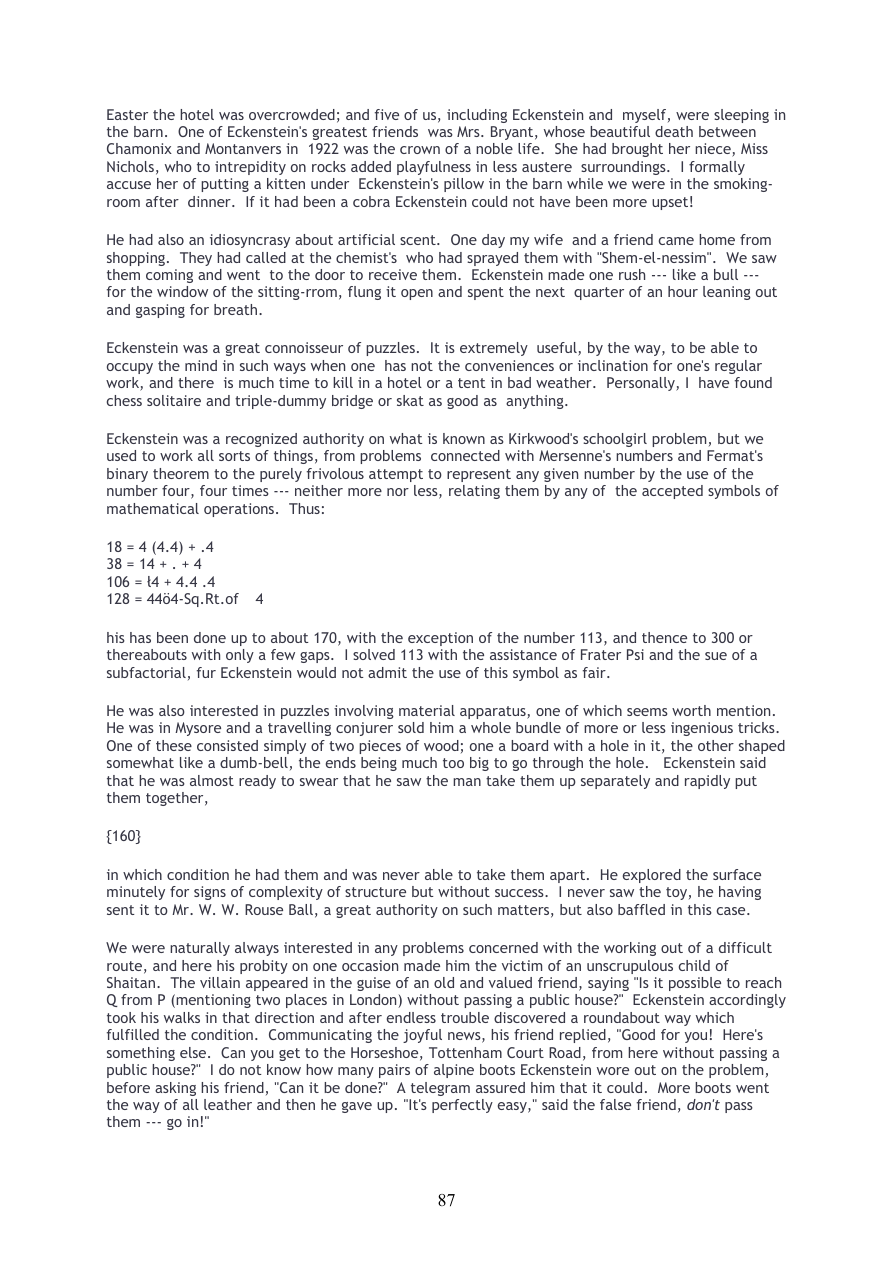
Highlights use the original PDF text layer. OCR-only matches may not be visible on the scan.
Transcription
Download text ↓raw extractionoriginal embedded textReview: unreviewed
87
Easter the hotel was overcrowded; and five of us, including Eckenstein and myself, were sleeping in
the barn. One of Eckenstein's greatest friends was Mrs. Bryant, whose beautiful death between
Chamonix and Montanvers in 1922 was the crown of a noble life. She had brought her niece, Miss
Nichols, who to intrepidity on rocks added playfulness in less austere surroundings. I formally
accuse her of putting a kitten under Eckenstein's pillow in the barn while we were in the smoking-
room after dinner. If it had been a cobra Eckenstein could not have been more upset!
He had also an idiosyncrasy about artificial scent. One day my wife and a friend came home from
shopping. They had called at the chemist's who had sprayed them with "Shem-el-nessim". We saw
them coming and went to the door to receive them. Eckenstein made one rush --- like a bull ---
for the window of the sitting-rrom, flung it open and spent the next quarter of an hour leaning out
and gasping for breath.
Eckenstein was a great connoisseur of puzzles. It is extremely useful, by the way, to be able to
occupy the mind in such ways when one has not the conveniences or inclination for one's regular
work, and there is much time to kill in a hotel or a tent in bad weather. Personally, I have found
chess solitaire and triple-dummy bridge or skat as good as anything.
Eckenstein was a recognized authority on what is known as Kirkwood's schoolgirl problem, but we
used to work all sorts of things, from problems connected with Mersenne's numbers and Fermat's
binary theorem to the purely frivolous attempt to represent any given number by the use of the
number four, four times --- neither more nor less, relating them by any of the accepted symbols of
mathematical operations. Thus:
18 = 4 (4.4) + .4
38 = 14 + . + 4
106 = ł4 + 4.4 .4
128 = 44ö4-Sq.Rt.of 4
his has been done up to about 170, with the exception of the number 113, and thence to 300 or
thereabouts with only a few gaps. I solved 113 with the assistance of Frater Psi and the sue of a
subfactorial, fur Eckenstein would not admit the use of this symbol as fair.
He was also interested in puzzles involving material apparatus, one of which seems worth mention.
He was in Mysore and a travelling conjurer sold him a whole bundle of more or less ingenious tricks.
One of these consisted simply of two pieces of wood; one a board with a hole in it, the other shaped
somewhat like a dumb-bell, the ends being much too big to go through the hole. Eckenstein said
that he was almost ready to swear that he saw the man take them up separately and rapidly put
them together,
{160}
in which condition he had them and was never able to take them apart. He explored the surface
minutely for signs of complexity of structure but without success. I never saw the toy, he having
sent it to Mr. W. W. Rouse Ball, a great authority on such matters, but also baffled in this case.
We were naturally always interested in any problems concerned with the working out of a difficult
route, and here his probity on one occasion made him the victim of an unscrupulous child of
Shaitan. The villain appeared in the guise of an old and valued friend, saying "Is it possible to reach
Q from P (mentioning two places in London) without passing a public house?" Eckenstein accordingly
took his walks in that direction and after endless trouble discovered a roundabout way which
fulfilled the condition. Communicating the joyful news, his friend replied, "Good for you! Here's
something else. Can you get to the Horseshoe, Tottenham Court Road, from here without passing a
public house?" I do not know how many pairs of alpine boots Eckenstein wore out on the problem,
before asking his friend, "Can it be done?" A telegram assured him that it could. More boots went
the way of all leather and then he gave up. "It's perfectly easy," said the false friend, don't pass
them --- go in!"
Page provenance & review flags
Stable page ID: 5ef44b98d8f9c4af5f6f86e1:p00087
Line breaks are preserved. Reading order and OCR accuracy may need review.
Printed page label has not been verified.
- No automated review flags. This does not establish transcription accuracy.