1929 · CLOSE READING
Confessions of Aleister Crowley
Confessions of Aleister Crowley (1929), PDF p. 93
Original page
Enlarge ↗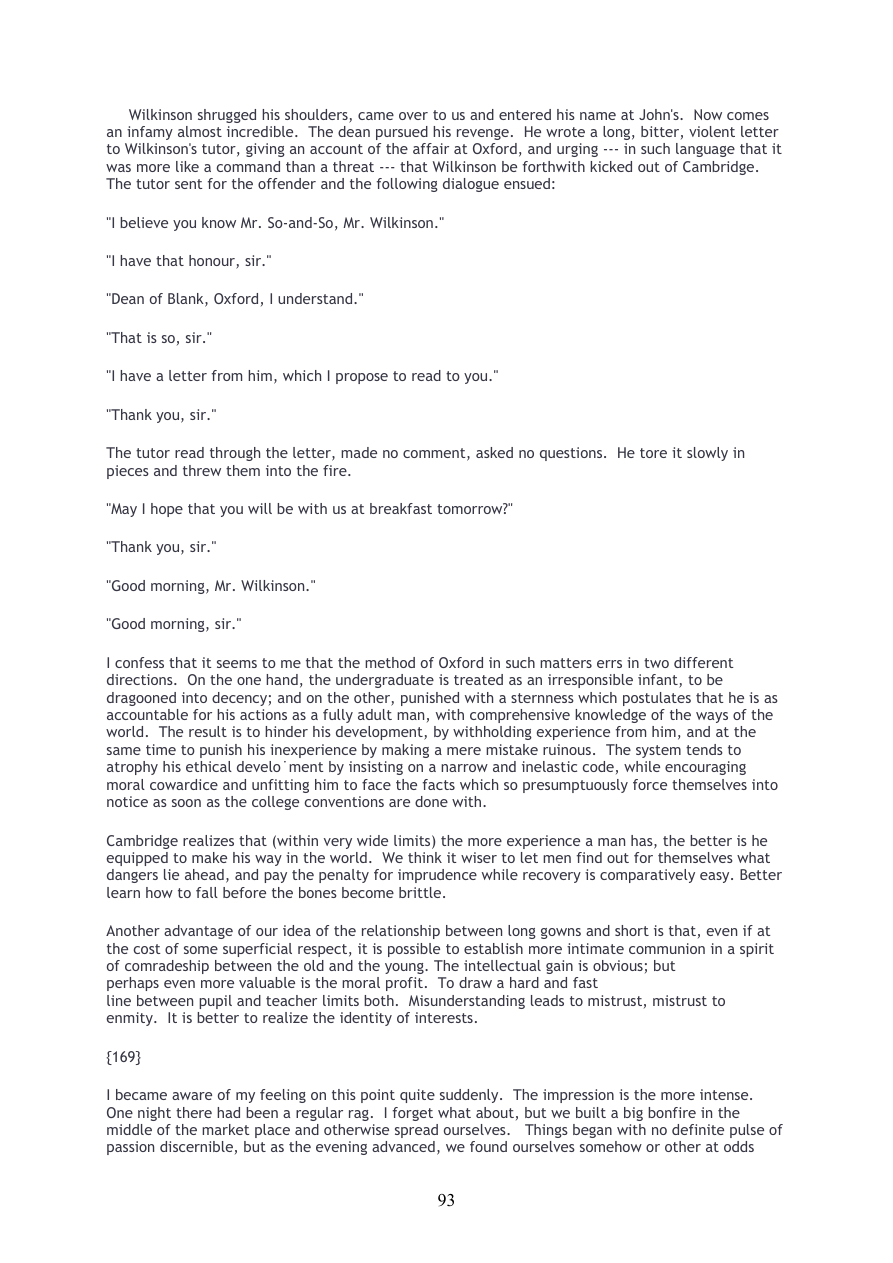
Highlights use the original PDF text layer. OCR-only matches may not be visible on the scan.
Transcription
Download text ↓raw extractionoriginal embedded textReview: unreviewed
93
Wilkinson shrugged his shoulders, came over to us and entered his name at John's. Now comes
an infamy almost incredible. The dean pursued his revenge. He wrote a long, bitter, violent letter
to Wilkinson's tutor, giving an account of the affair at Oxford, and urging --- in such language that it
was more like a command than a threat --- that Wilkinson be forthwith kicked out of Cambridge.
The tutor sent for the offender and the following dialogue ensued:
"I believe you know Mr. So-and-So, Mr. Wilkinson."
"I have that honour, sir."
"Dean of Blank, Oxford, I understand."
"That is so, sir."
"I have a letter from him, which I propose to read to you."
"Thank you, sir."
The tutor read through the letter, made no comment, asked no questions. He tore it slowly in
pieces and threw them into the fire.
"May I hope that you will be with us at breakfast tomorrow?"
"Thank you, sir."
"Good morning, Mr. Wilkinson."
"Good morning, sir."
I confess that it seems to me that the method of Oxford in such matters errs in two different
directions. On the one hand, the undergraduate is treated as an irresponsible infant, to be
dragooned into decency; and on the other, punished with a sternness which postulates that he is as
accountable for his actions as a fully adult man, with comprehensive knowledge of the ways of the
world. The result is to hinder his development, by withholding experience from him, and at the
same time to punish his inexperience by making a mere mistake ruinous. The system tends to
atrophy his ethical develoúment by insisting on a narrow and inelastic code, while encouraging
moral cowardice and unfitting him to face the facts which so presumptuously force themselves into
notice as soon as the college conventions are done with.
Cambridge realizes that (within very wide limits) the more experience a man has, the better is he
equipped to make his way in the world. We think it wiser to let men find out for themselves what
dangers lie ahead, and pay the penalty for imprudence while recovery is comparatively easy. Better
learn how to fall before the bones become brittle.
Another advantage of our idea of the relationship between long gowns and short is that, even if at
the cost of some superficial respect, it is possible to establish more intimate communion in a spirit
of comradeship between the old and the young. The intellectual gain is obvious; but
perhaps even more valuable is the moral profit. To draw a hard and fast
line between pupil and teacher limits both. Misunderstanding leads to mistrust, mistrust to
enmity. It is better to realize the identity of interests.
{169}
I became aware of my feeling on this point quite suddenly. The impression is the more intense.
One night there had been a regular rag. I forget what about, but we built a big bonfire in the
middle of the market place and otherwise spread ourselves. Things began with no definite pulse of
passion discernible, but as the evening advanced, we found ourselves somehow or other at odds
Page provenance & review flags
Stable page ID: 5ef44b98d8f9c4af5f6f86e1:p00093
Line breaks are preserved. Reading order and OCR accuracy may need review.
Printed page label has not been verified.
- No automated review flags. This does not establish transcription accuracy.