1929 · CLOSE READING
Confessions of Aleister Crowley
Confessions of Aleister Crowley (1929), PDF p. 94
Original page
Enlarge ↗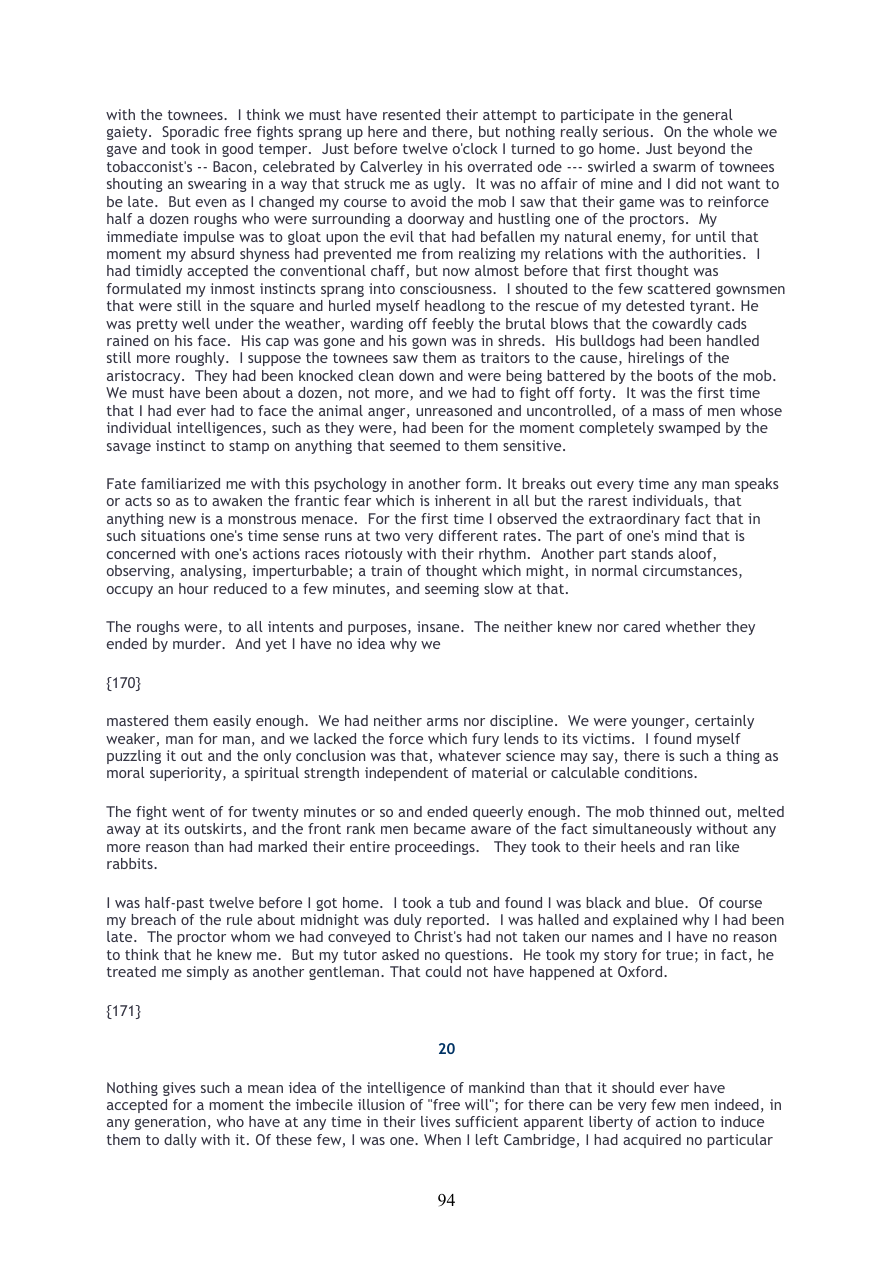
Highlights use the original PDF text layer. OCR-only matches may not be visible on the scan.
Transcription
Download text ↓raw extractionoriginal embedded textReview: unreviewed
94
with the townees. I think we must have resented their attempt to participate in the general
gaiety. Sporadic free fights sprang up here and there, but nothing really serious. On the whole we
gave and took in good temper. Just before twelve o'clock I turned to go home. Just beyond the
tobacconist's -- Bacon, celebrated by Calverley in his overrated ode --- swirled a swarm of townees
shouting an swearing in a way that struck me as ugly. It was no affair of mine and I did not want to
be late. But even as I changed my course to avoid the mob I saw that their game was to reinforce
half a dozen roughs who were surrounding a doorway and hustling one of the proctors. My
immediate impulse was to gloat upon the evil that had befallen my natural enemy, for until that
moment my absurd shyness had prevented me from realizing my relations with the authorities. I
had timidly accepted the conventional chaff, but now almost before that first thought was
formulated my inmost instincts sprang into consciousness. I shouted to the few scattered gownsmen
that were still in the square and hurled myself headlong to the rescue of my detested tyrant. He
was pretty well under the weather, warding off feebly the brutal blows that the cowardly cads
rained on his face. His cap was gone and his gown was in shreds. His bulldogs had been handled
still more roughly. I suppose the townees saw them as traitors to the cause, hirelings of the
aristocracy. They had been knocked clean down and were being battered by the boots of the mob.
We must have been about a dozen, not more, and we had to fight off forty. It was the first time
that I had ever had to face the animal anger, unreasoned and uncontrolled, of a mass of men whose
individual intelligences, such as they were, had been for the moment completely swamped by the
savage instinct to stamp on anything that seemed to them sensitive.
Fate familiarized me with this psychology in another form. It breaks out every time any man speaks
or acts so as to awaken the frantic fear which is inherent in all but the rarest individuals, that
anything new is a monstrous menace. For the first time I observed the extraordinary fact that in
such situations one's time sense runs at two very different rates. The part of one's mind that is
concerned with one's actions races riotously with their rhythm. Another part stands aloof,
observing, analysing, imperturbable; a train of thought which might, in normal circumstances,
occupy an hour reduced to a few minutes, and seeming slow at that.
The roughs were, to all intents and purposes, insane. The neither knew nor cared whether they
ended by murder. And yet I have no idea why we
{170}
mastered them easily enough. We had neither arms nor discipline. We were younger, certainly
weaker, man for man, and we lacked the force which fury lends to its victims. I found myself
puzzling it out and the only conclusion was that, whatever science may say, there is such a thing as
moral superiority, a spiritual strength independent of material or calculable conditions.
The fight went of for twenty minutes or so and ended queerly enough. The mob thinned out, melted
away at its outskirts, and the front rank men became aware of the fact simultaneously without any
more reason than had marked their entire proceedings. They took to their heels and ran like
rabbits.
I was half-past twelve before I got home. I took a tub and found I was black and blue. Of course
my breach of the rule about midnight was duly reported. I was halled and explained why I had been
late. The proctor whom we had conveyed to Christ's had not taken our names and I have no reason
to think that he knew me. But my tutor asked no questions. He took my story for true; in fact, he
treated me simply as another gentleman. That could not have happened at Oxford.
{171}
20
Nothing gives such a mean idea of the intelligence of mankind than that it should ever have
accepted for a moment the imbecile illusion of "free will"; for there can be very few men indeed, in
any generation, who have at any time in their lives sufficient apparent liberty of action to induce
them to dally with it. Of these few, I was one. When I left Cambridge, I had acquired no particular
Page provenance & review flags
Stable page ID: 5ef44b98d8f9c4af5f6f86e1:p00094
Line breaks are preserved. Reading order and OCR accuracy may need review.
Printed page label has not been verified.
- No automated review flags. This does not establish transcription accuracy.