1996 · CLOSE READING
The Law is for All
The Law is for All (1996), PDF p. 103
Original page
Enlarge ↗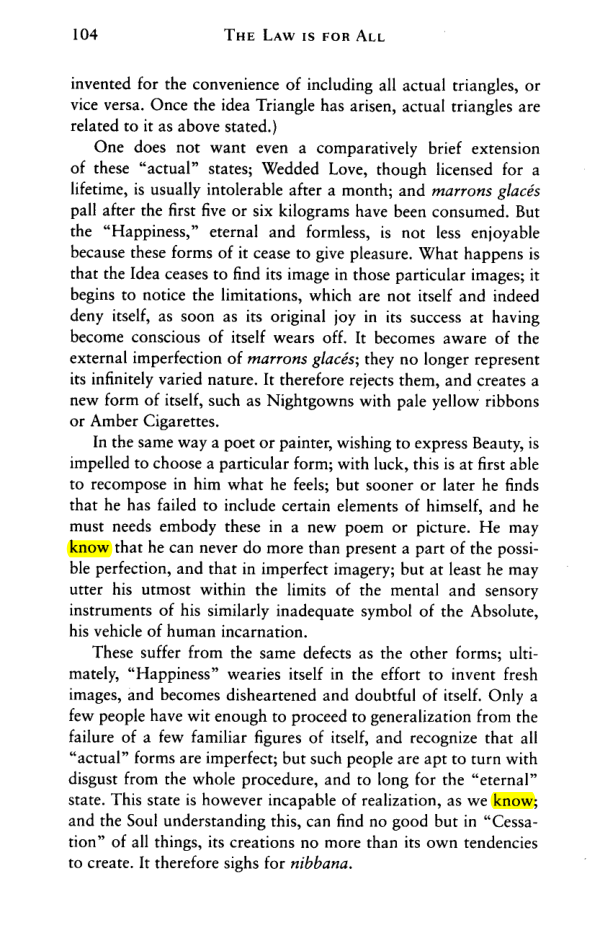
Highlights use the original PDF text layer. OCR-only matches may not be visible on the scan.
Transcription
Download text ↓raw extractionoriginal embedded textReview: unreviewed
104
The Law is for All
invented for the convenience of including all actual triangles, or
vice versa. Once the idea Triangle has arisen, actual triangles are
related to it as above stated.)
One does not want even a comparatively brief extension
of these “actual” states; Wedded Love, though licensed for a
lifetime, is usually intolerable after a month; and marrons glacés
pall after the first five or six kilograms have been consumed. But
the “Happiness,” eternal and formless, is not less enjoyable
because these forms of it cease to give pleasure. What happens is
that the Idea ceases to find its image in those particular images; it
begins to notice the limitations, which are not itself and indeed
deny itself, as soon as its original joy in its success at having
become conscious of itself wears off. It becomes aware of the
external imperfection of marrons glacés; they no longer represent
its infinitely varied nature. It therefore rejects them, and creates a
new form of itself, such as Nightgowns with pale yellow ribbons
or Amber Cigarettes.
In the same way a poet or painter, wishing to express Beauty, is
impelled to choose a particular form; with luck, this is at first able
to recompose in him what he feels; but sooner or later he finds
that he has failed to include certain elements of himself, and he
must needs embody these in a new poem or picture. He may
know that he can never do more than present a part of the possi
ble perfection, and that in imperfect imagery; but at least he may
utter his utmost within the limits of the mental and sensory
instruments of his similarly inadequate symbol of the Absolute,
his vehicle of human incarnation.
These suffer from the same defects as the other forms; ulti
mately, “Happiness” wearies itself in the effort to invent fresh
images, and becomes disheartened and doubtful of itself. Only a
few people have wit enough to proceed to generalization from the
failure of a few familiar figures of itself, and recognize that all
“actual” forms are imperfect; but such people are apt to turn with
disgust from the whole procedure, and to long for the “eternal”
state. This state is however incapable of realization, as we know;
and the Soul understanding this, can find no good but in “Cessa
tion” of all things, its creations no more than its own tendencies
to create. It therefore sighs for nibbana.
Page provenance & review flags
Stable page ID: 6528ce4d28e01eb80a128d9c:p00103
Line breaks are preserved. Reading order and OCR accuracy may need review.
Printed page label has not been verified.
- No automated review flags. This does not establish transcription accuracy.