1996 · CLOSE READING
The Law is for All
The Law is for All (1996), PDF p. 111
Original page
Enlarge ↗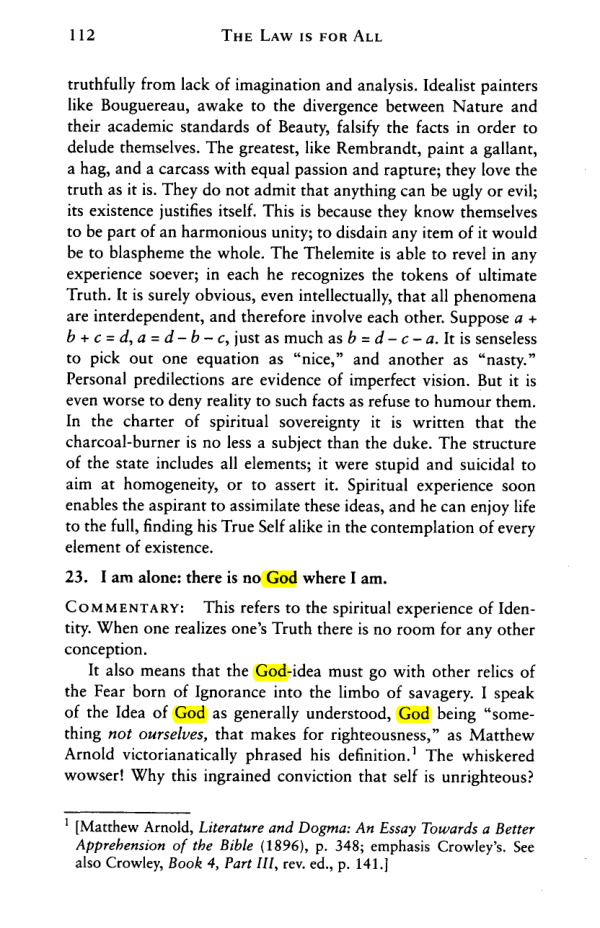
Highlights use the original PDF text layer. OCR-only matches may not be visible on the scan.
Transcription
Download text ↓raw extractionoriginal embedded textReview: unreviewed
112
The Law is for All
truthfully from lack of imagination and analysis. Idealist painters
like Bouguereau, awake to the divergence between Nature and
their academic standards of Beauty, falsify the facts in order to
delude themselves. The greatest, like Rembrandt, paint a gallant,
a hag, and a carcass with equal passion and rapture; they love the
truth as it is. They do not admit that anything can be ugly or evil;
its existence justifies itself. This is because they know themselves
to be part of an harmonious unity; to disdain any item of it would
be to blaspheme the whole. The Thelemite is able to revel in any
experience soever; in each he recognizes the tokens of ultimate
Truth. It is surely obvious, even intellectually, that all phenomena
are interdependent, and therefore involve each other. Suppose a +
b + c = d, a = d - b - c, just as much as b = d - c - a. It is senseless
to pick out one equation as “nice,” and another as “nasty.”
Personal predilections are evidence of imperfect vision. But it is
even worse to deny reality to such facts as refuse to humour them.
In the charter of spiritual sovereignty it is written that the
charcoal-burner is no less a subject than the duke. The structure
of the state includes all elements; it were stupid and suicidal to
aim at homogeneity, or to assert it. Spiritual experience soon
enables the aspirant to assimilate these ideas, and he can enjoy life
to the full, finding his True Self alike in the contemplation of every
element of existence.
23. I am alone: there is no God where I am.
Commentary: This refers to the spiritual experience of Iden
tity. When one realizes one’s Truth there is no room for any other
conception.
It also means that the God-idea must go with other relics of
the Fear born of Ignorance into the limbo of savagery. I speak
of the Idea of God as generally understood, God being “some
thing not ourselves, that makes for righteousness,” as Matthew
Arnold victorianatically phrased his definition.1 The whiskered
wowser! Why this ingrained conviction that self is unrighteous?
1 [Matthew Arnold, Literature and Dogma: An Essay Towards a Better
Apprehension of the Bible (1896), p. 348; emphasis Crowley’s. See
also Crowley, Book 4, Part III, rev. ed., p. 141.]
Page provenance & review flags
Stable page ID: 6528ce4d28e01eb80a128d9c:p00111
Line breaks are preserved. Reading order and OCR accuracy may need review.
Printed page label has not been verified.
- No automated review flags. This does not establish transcription accuracy.