1996 · CLOSE READING
The Law is for All
The Law is for All (1996), PDF p. 113
Original page
Enlarge ↗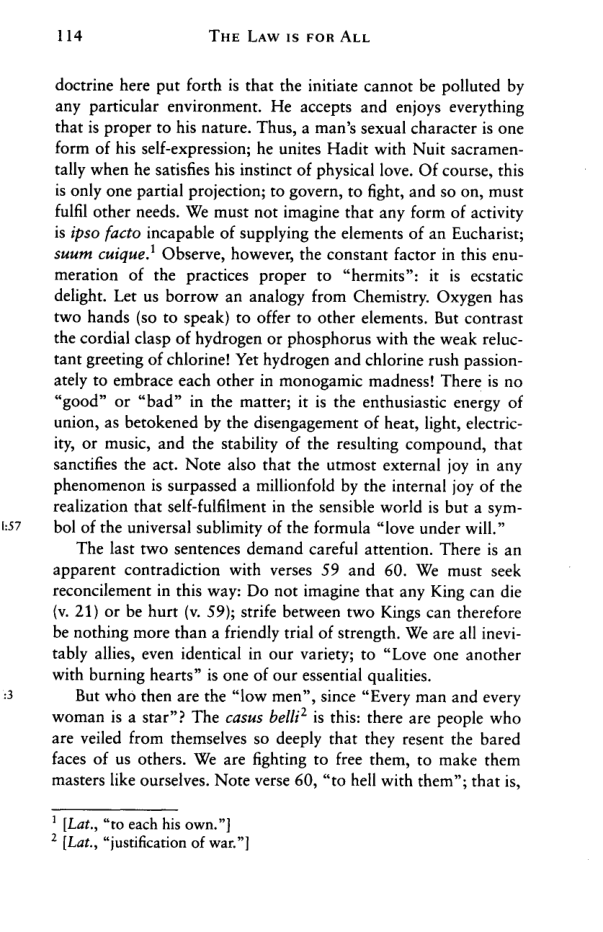
Highlights use the original PDF text layer. OCR-only matches may not be visible on the scan.
Transcription
Download text ↓raw extractionoriginal embedded textReview: unreviewed
114
The Law is for All
doctrine here put forth is that the initiate cannot be polluted by
any particular environment. He accepts and enjoys everything
that is proper to his nature. Thus, a man’s sexual character is one
form of his self-expression; he unites Hadit with Nuit sacramen
tally when he satisfies his instinct of physical love. Of course, this
is only one partial projection; to govern, to fight, and so on, must
fulfil other needs. We must not imagine that any form of activity
is ipso facto incapable of supplying the elements of an Eucharist;
suum cuique) Observe, however, the constant factor in this enu
meration of the practices proper to “hermits”: it is ecstatic
delight. Let us borrow an analogy from Chemistry. Oxygen has
two hands (so to speak) to offer to other elements. But contrast
the cordial clasp of hydrogen or phosphorus with the weak reluc
tant greeting of chlorine! Yet hydrogen and chlorine rush passion
ately to embrace each other in monogamic madness! There is no
“good” or “bad” in the matter; it is the enthusiastic energy of
union, as betokened by the disengagement of heat, light, electric
ity, or music, and the stability of the resulting compound, that
sanctifies the act. Note also that the utmost external joy in any
phenomenon is surpassed a millionfold by the internal joy of the
realization that self-fulfilment in the sensible world is but a sym-
1:57 bol of the universal sublimity of the formula “love under will.”
The last two sentences demand careful attention. There is an
apparent contradiction with verses 59 and 60. We must seek
reconcilement in this way: Do not imagine that any King can die
(v. 21) or be hurt (v. 59); strife between two Kings can therefore
be nothing more than a friendly trial of strength. We are all inevi
tably allies, even identical in our variety; to “Love one another
with burning hearts” is one of our essential qualities.
:3
But who then are the “low men”, since “Every man and every
woman is a star”? The casus belli1 2 is this: there are people who
are veiled from themselves so deeply that they resent the bared
faces of us others. We are fighting to free them, to make them
masters like ourselves. Note verse 60, “to hell with them”; that is,
1 [Lat., “to each his own.”]
2 [Lat., “justification of war.”]
Page provenance & review flags
Stable page ID: 6528ce4d28e01eb80a128d9c:p00113
Line breaks are preserved. Reading order and OCR accuracy may need review.
Printed page label has not been verified.
- No automated review flags. This does not establish transcription accuracy.