1996 · CLOSE READING
The Law is for All
The Law is for All (1996), PDF p. 121
Original page
Enlarge ↗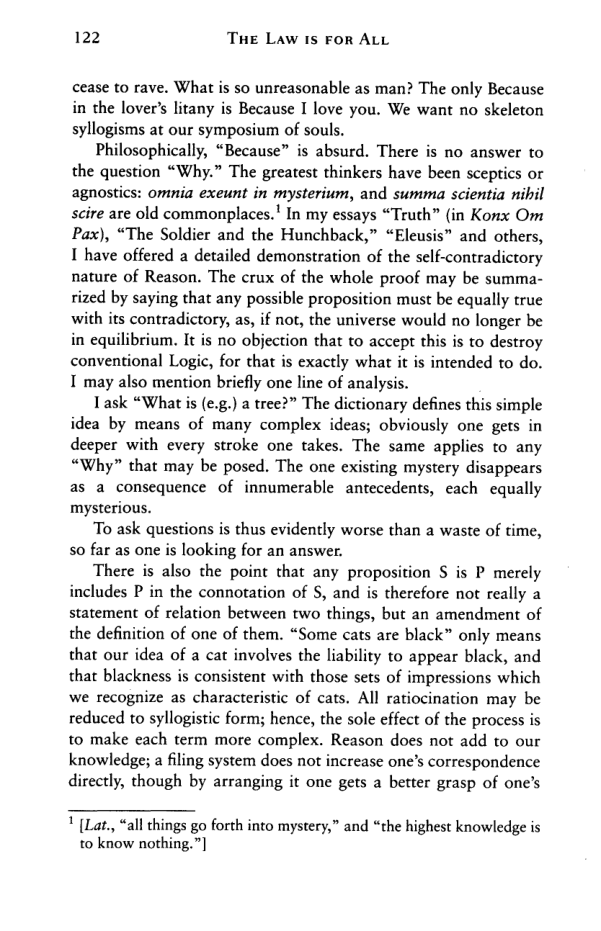
Highlights use the original PDF text layer. OCR-only matches may not be visible on the scan.
Transcription
Download text ↓raw extractionoriginal embedded textReview: unreviewed
122
The Law is for All
cease to rave. What is so unreasonable as man? The only Because
in the lover’s litany is Because I love you. We want no skeleton
syllogisms at our symposium of souls.
Philosophically, “Because” is absurd. There is no answer to
the question “Why.” The greatest thinkers have been sceptics or
agnostics: omnia exeunt in mysterium, and summa scientia nihil
scire are old commonplaces.1 In my essays “Truth” (in Konx Om
Pax), “The Soldier and the Hunchback,” “Eleusis” and others,
I have offered a detailed demonstration of the self-contradictory
nature of Reason. The crux of the whole proof may be summa
rized by saying that any possible proposition must be equally true
with its contradictory, as, if not, the universe would no longer be
in equilibrium. It is no objection that to accept this is to destroy
conventional Logic, for that is exactly what it is intended to do.
I may also mention briefly one line of analysis.
1 [Lat., “all things go forth into mystery,” and “the highest knowledge is
to know nothing.”]
I ask “What is (e.g.) a tree?” The dictionary defines this simple
idea by means of many complex ideas; obviously one gets in
deeper with every stroke one takes. The same applies to any
“Why” that may be posed. The one existing mystery disappears
as a consequence of innumerable antecedents, each equally
mysterious.
To ask questions is thus evidently worse than a waste of time,
so far as one is looking for an answer.
There is also the point that any proposition S is P merely
includes P in the connotation of S, and is therefore not really a
statement of relation between two things, but an amendment of
the definition of one of them. “Some cats are black” only means
that our idea of a cat involves the liability to appear black, and
that blackness is consistent with those sets of impressions which
we recognize as characteristic of cats. All ratiocination may be
reduced to syllogistic form; hence, the sole effect of the process is
to make each term more complex. Reason does not add to our
knowledge; a filing system does not increase one’s correspondence
directly, though by arranging it one gets a better grasp of one’s
Page provenance & review flags
Stable page ID: 6528ce4d28e01eb80a128d9c:p00121
Line breaks are preserved. Reading order and OCR accuracy may need review.
Printed page label has not been verified.
- No automated review flags. This does not establish transcription accuracy.