1996 · CLOSE READING
The Law is for All
The Law is for All (1996), PDF p. 136
Original page
Enlarge ↗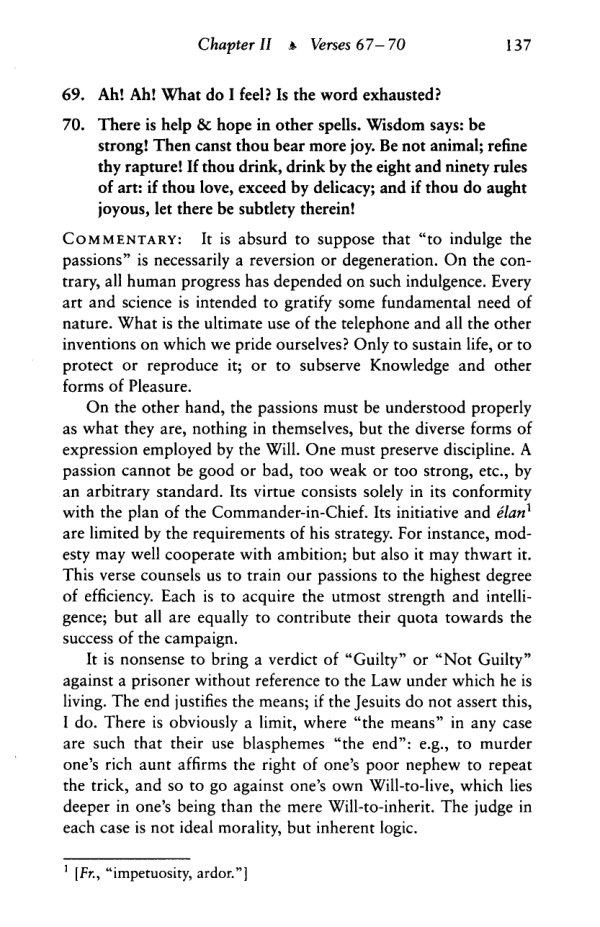
Highlights use the original PDF text layer. OCR-only matches may not be visible on the scan.
Transcription
Download text ↓raw extractionoriginal embedded textReview: unreviewed
Chapter II * Verses 67-70
137
69. Ah’ Ah! What do I feel? Is the word exhausted?
70. There is help & hope in other spells. Wisdom says: be
strong! Then canst thou bear more joy. Be not animal; refine
thy rapture! If thou drink, drink by the eight and ninety rules
of art: if thou love, exceed by delicacy; and if thou do aught
joyous, let there be subtlety therein!
Commentary: It is absurd to suppose that “to indulge the
passions” is necessarily a reversion or degeneration. On the con
trary, all human progress has depended on such indulgence. Every
art and science is intended to gratify some fundamental need of
nature. What is the ultimate use of the telephone and all the other
inventions on which we pride ourselves? Only to sustain life, or to
protect or reproduce it; or to subserve Knowledge and other
forms of Pleasure.
On the other hand, the passions must be understood properly
as what they are, nothing in themselves, but the diverse forms of
expression employed by the Will. One must preserve discipline. A
passion cannot be good or bad, too weak or too strong, etc., by
an arbitrary standard. Its virtue consists solely in its conformity
with the plan of the Commander-in-Chief. Its initiative and elanx
are limited by the requirements of his strategy. For instance, mod
esty may well cooperate with ambition; but also it may thwart it.
This verse counsels us to train our passions to the highest degree
of efficiency. Each is to acquire the utmost strength and intelli
gence; but all are equally to contribute their quota towards the
success of the campaign.
It is nonsense to bring a verdict of “Guilty” or “Not Guilty”
against a prisoner without reference to the Law under which he is
living. The end justifies the means; if the Jesuits do not assert this,
1 do. There is obviously a limit, where “the means” in any case
are such that their use blasphemes “the end”: e.g., to murder
one’s rich aunt affirms the right of one’s poor nephew to repeat
the trick, and so to go against one’s own Will-to-live, which lies
deeper in one’s being than the mere Will-to-inherit. The judge in
each case is not ideal morality, but inherent logic.
1 [Fr., “impetuosity, ardor.”]
Page provenance & review flags
Stable page ID: 6528ce4d28e01eb80a128d9c:p00136
Line breaks are preserved. Reading order and OCR accuracy may need review.
Printed page label has not been verified.
- No automated review flags. This does not establish transcription accuracy.