1996 · CLOSE READING
The Law is for All
The Law is for All (1996), PDF p. 90
Original page
Enlarge ↗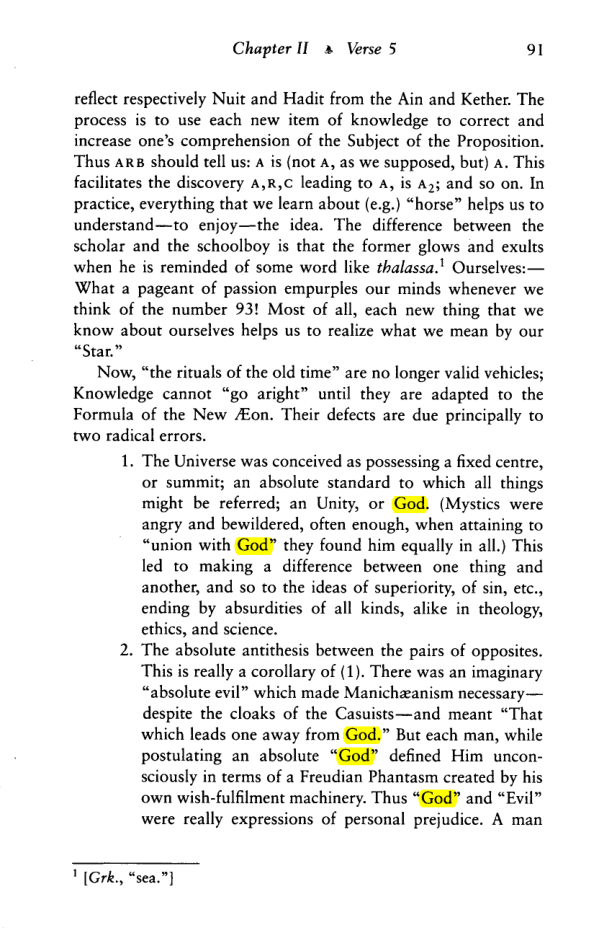
Highlights use the original PDF text layer. OCR-only matches may not be visible on the scan.
Transcription
Download text ↓raw extractionoriginal embedded textReview: unreviewed
Chapter II * Verse 5
91
reflect respectively Nuit and Hadit from the Ain and Kether. The
process is to use each new item of knowledge to correct and
increase one’s comprehension of the Subject of the Proposition.
Thus arb should tell us: A is (not A, as we supposed, but) A. This
facilitates the discovery a,r,c leading to a, is a2; and so on. In
practice, everything that we learn about (e.g.) “horse” helps us to
understand—to enjoy—the idea. The difference between the
scholar and the schoolboy is that the former glows and exults
when he is reminded of some word like thalassa.1 Ourselves:—
What a pageant of passion empurples our minds whenever we
think of the number 93! Most of all, each new thing that we
know about ourselves helps us to realize what we mean by our
“Star.”
1 [Grk., “sea.”]
Now, “the rituals of the old time” are no longer valid vehicles;
Knowledge cannot “go aright” until they are adapted to the
Formula of the New /Eon. Their defects are due principally to
two radical errors.
1. The Universe was conceived as possessing a fixed centre,
or summit; an absolute standard to which all things
might be referred; an Unity, or God. (Mystics were
angry and bewildered, often enough, when attaining to
“union with God” they found him equally in all.) This
led to making a difference between one thing and
another, and so to the ideas of superiority, of sin, etc.,
ending by absurdities of all kinds, alike in theology,
ethics, and science.
2. The absolute antithesis between the pairs of opposites.
This is really a corollary of (1). There was an imaginary
“absolute evil” which made Manichieanism necessary—
despite the cloaks of the Casuists—and meant “That
which leads one away from God.” But each man, while
postulating an absolute “God” defined Him uncon
sciously in terms of a Freudian Phantasm created by his
own wish-fulfilment machinery. Thus “God” and “Evil”
were really expressions of personal prejudice. A man
Page provenance & review flags
Stable page ID: 6528ce4d28e01eb80a128d9c:p00090
Line breaks are preserved. Reading order and OCR accuracy may need review.
Printed page label has not been verified.
- No automated review flags. This does not establish transcription accuracy.