1996 · CLOSE READING
The Law is for All
The Law is for All (1996), PDF p. 98
Original page
Enlarge ↗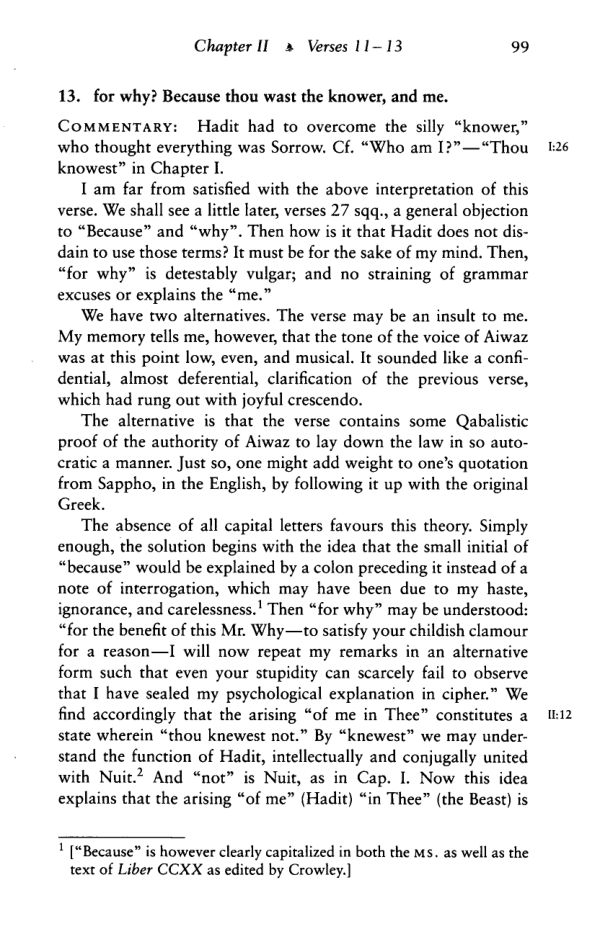
Highlights use the original PDF text layer. OCR-only matches may not be visible on the scan.
Transcription
Download text ↓raw extractionoriginal embedded textReview: unreviewed
Chapter II A Verses 11 — 13
99
13. for why? Because thou wast the knower, and me.
Commentary: Hadit had to overcome the silly “knower,”
who thought everything was Sorrow. Cf. “Who am I?”—“Thou
knowest” in Chapter I.
I am far from satisfied with the above interpretation of this
verse. We shall see a little later, verses 27 sqq., a general objection
to “Because” and “why”. Then how is it that Hadit does not dis
dain to use those terms? It must be for the sake of my mind. Then,
“for why” is detestably vulgar; and no straining of grammar
excuses or explains the “me.”
We have two alternatives. The verse may be an insult to me.
My memory tells me, however, that the tone of the voice of Aiwaz
was at this point low, even, and musical. It sounded like a confi
dential, almost deferential, clarification of the previous verse,
which had rung out with joyful crescendo.
The alternative is that the verse contains some Qabalistic
proof of the authority of Aiwaz to lay down the law in so auto
cratic a manner. Just so, one might add weight to one’s quotation
from Sappho, in the English, by following it up with the original
Greek.
The absence of all capital letters favours this theory. Simply
enough, the solution begins with the idea that the small initial of
“because” would be explained by a colon preceding it instead of a
note of interrogation, which may have been due to my haste,
ignorance, and carelessness.1 Then “for why” may be understood:
“for the benefit of this Mr. Why—to satisfy your childish clamour
for a reason—I will now repeat my remarks in an alternative
form such that even your stupidity can scarcely fail to observe
that I have sealed my psychological explanation in cipher.” We
find accordingly that the arising “of me in Thee” constitutes a
state wherein “thou knewest not.” By “knewest” we may under
stand the function of Hadit, intellectually and conjugally united
with Nuit.2 And “not” is Nuit, as in Cap. I. Now this idea
explains that the arising “of me” (Hadit) “in Thee” (the Beast) is
1 [“Because” is however clearly capitalized in both the ms. as well as the
text of Liber CCXX as edited by Crowley.]
1:26
11:12
Page provenance & review flags
Stable page ID: 6528ce4d28e01eb80a128d9c:p00098
Line breaks are preserved. Reading order and OCR accuracy may need review.
Printed page label has not been verified.
- No automated review flags. This does not establish transcription accuracy.