1930 · CLOSE READING
Magick in Theory and Practice (Section 2)
Magick in Theory and Practice (Section 2) (1930), PDF p. 33
Original page
Enlarge ↗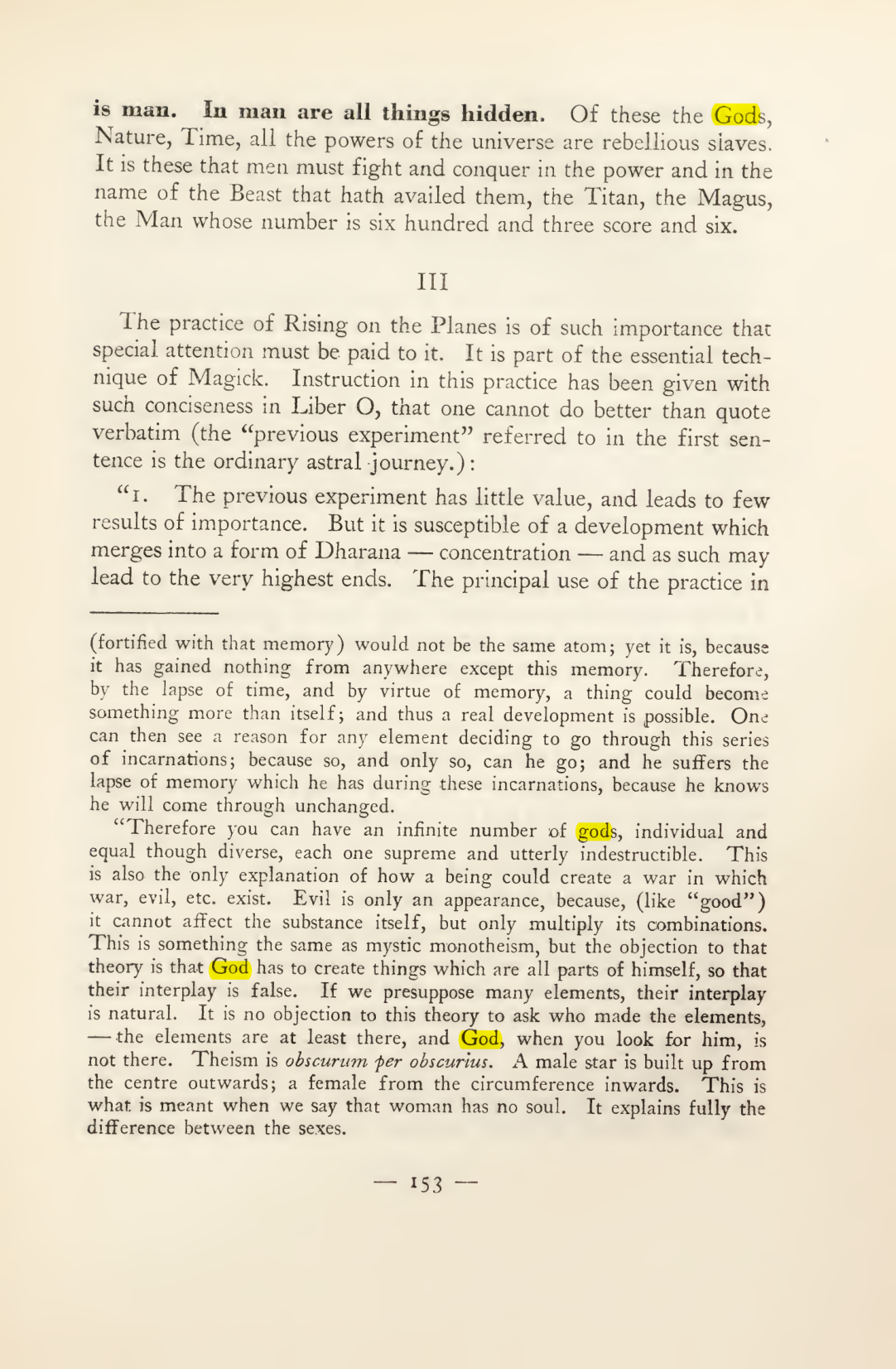
Highlights use the original PDF text layer. OCR-only matches may not be visible on the scan.
Transcription
Download text ↓raw extractionoriginal embedded textReview: unreviewed
is man. In man are ail things hidden, Of these the Gods,
Nature, Time, ail the powers of the universe are rebellions slaves.
It is these that men must fight and conquer in the power and in the
name of the Beast that hath availed them, the Titan, the Magus,
the Man whose number is six hundred and three score and six.
III
Ihe practice of Rising on the Planes is of such importance that
spécial attention must be paid to it. It is part of the essential tech¬
nique of Magick. Instruction in this practice has been given with
such conciseness in Liber O, that one cannot do better than quote
Verbatim (the “previous experiment” referred to in the first sen¬
tence is the ordinary astral journey.) :
“i. The previous experiment has little value, and leads to few
results of importance. But it is susceptible of a development which
merges into a form of Dharana — concentration — and as such may
lead to the very highest ends. The principal use of the practice in
(fortiheci with that memory) would not be the same atom; yet it is, because
it has gained nothing from anywhere except this memory. Therefore,
by the lapse of time, and by virtue of memory, a thing could become
something more than itself; and thus a real development is possible. One
can then see a reason for any element deciding to go through this sériés
of incarnations; because so, and only so, can he go; and he suffers the
lapse of memory which he has during these incarnations, because he knows
he will corne through unchanged.
“Therefore you can hâve an infinité number of gods, individual and
equal though diverse, each one suprême and utterly indestructible. This
is also the only explanation of how a being could create a war in which
war, evil, etc. exist. Evil is only an appearance, because, (like “good”)
it cannot affect the substance itself, but only multiply its combinations.
This is something the same as mystic monotheism, but the objection to that
theory is that God has to create things which are ail parts of himself, so that
their interplay is false. If we présupposé many éléments, their interplay
is natural. It is no objection to this theory to ask who made the éléments,
— the éléments are at least there, and God, when you look for him, is
not there. Theism is obscurum per obscurius. A male star is built up from
the centre outwards; a female from the circumference inwards. This is
what is meant when we say that woman has no soûl. It explains fully the
différence between the sexes.
— 153
Page provenance & review flags
Stable page ID: 7225bbab6d2ac2a8268d8bdd:p00033
Line breaks are preserved. Reading order and OCR accuracy may need review.
Printed page label has not been verified.
- No automated review flags. This does not establish transcription accuracy.