1930 · CLOSE READING
Magick in Theory and Practice (Section 2)
Magick in Theory and Practice (Section 2) (1930), PDF p. 51
Original page
Enlarge ↗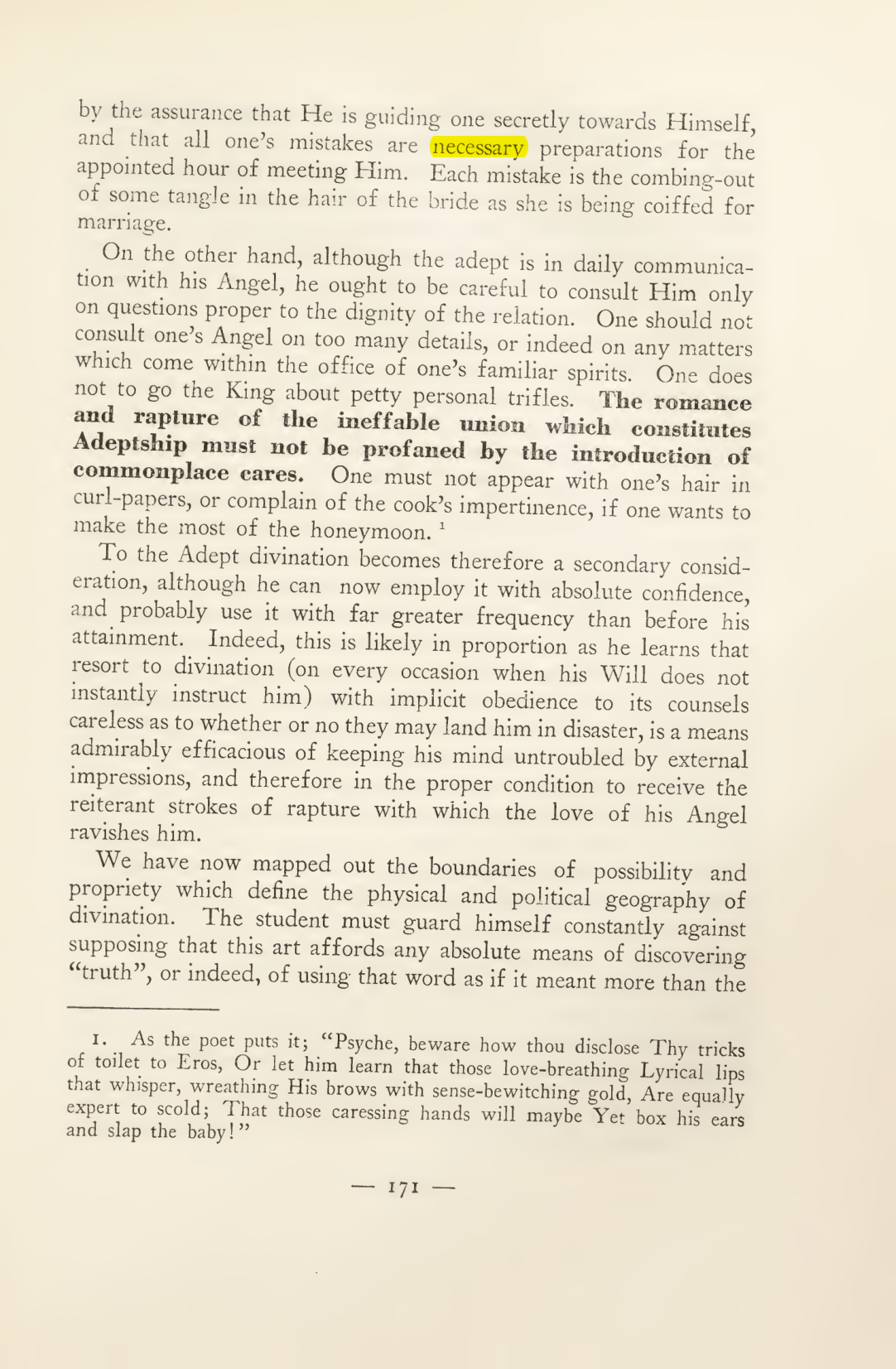
Highlights use the original PDF text layer. OCR-only matches may not be visible on the scan.
Transcription
Download text ↓raw extractionoriginal embedded textReview: unreviewed
y te assurance that He is guiding one secretly towards Himself,
and ihat ail one’s mistakes are necessary préparations for the
appointed hour of meeting Him. Each mistake is the combing-out
oi some tangle in the hair of the bride as she is being coiffed for
marriage.
On the other hand, although the adept is in daily communica¬
tion with his Angel, he ought to be careful to consult Him only
on questions proper to the dignity of the relation. One should not
consult one s Angel on too many details, or indeed on any matters
vvhich corne within the office of one’s familiar spirits. One does
not to go the King about petty personal trifles. The romance
and rapture of the ineffable union which consentes
Adeptship must not be profaned by the introduction of
eommonplace cares. One must not appear with one’s hair in
curl-papers, or complain of the cook’s impertinence, if one wants to
make the most of the honeymoon. 1
To the Adept divination becomes therefore a secondary consid¬
ération, although he can now employ it with absolute confidence,
and probably use it with far greater frequency than before his
attainment. Indeed, this is likely in proportion as he learns that
resort to divination (on every occasion when his Will does not
mstantly instruct him) with implicit obedience to its counsels
careless as to whether or no they may land him in disaster, is a means
admirably efficacious of keeping his mind untroubled by external
impressions, and therefore in the proper condition to receive the
réitérant strokes of rapture with which the love of his Angel
ravishes him.
We hâve now mapped out the boundaries of possibility and
propnety which define the physical and political geography of
divination. The student must guard himself constantly against
supposing that this art affords any absolute means of discovering
“truth”, or indeed, of using that Word as if it meant more than the
i. As the poet puts it; “Psyché, beware how thou disclose Thy tricks
of toilet to Eros, Or let him learn that those love-breathing Lyrical lins
that whisper, wreathing His brows with sense-bewitching gold, Are equally
expert to scold; 1 hat those caressing hands will maybe Yet box his ears
and slap the baby ! ”
Page provenance & review flags
Stable page ID: 7225bbab6d2ac2a8268d8bdd:p00051
Line breaks are preserved. Reading order and OCR accuracy may need review.
Printed page label has not been verified.
- No automated review flags. This does not establish transcription accuracy.