1930 · CLOSE READING
Magick in Theory and Practice (Section 2)
Magick in Theory and Practice (Section 2) (1930), PDF p. 54
Original page
Enlarge ↗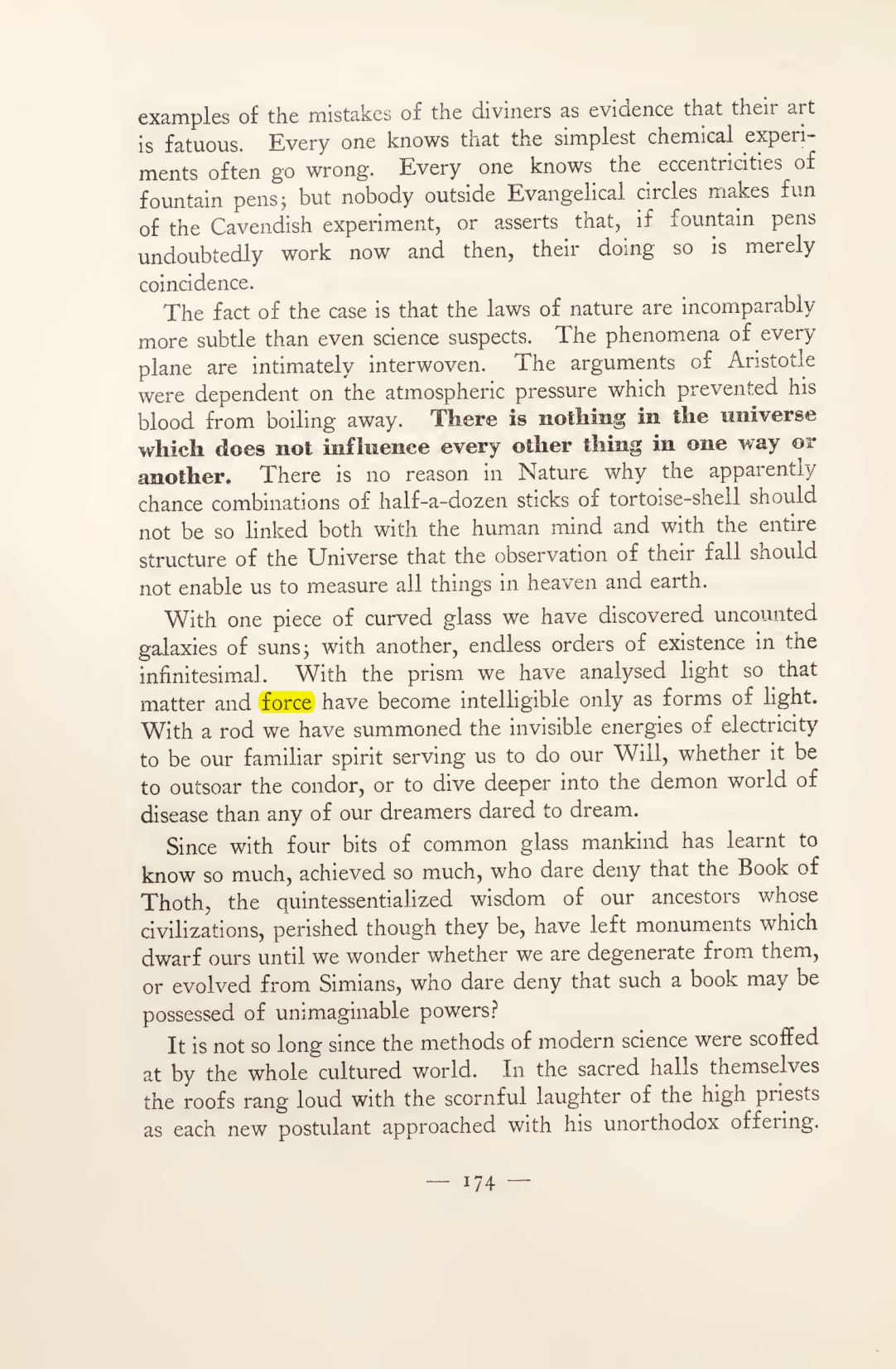
Highlights use the original PDF text layer. OCR-only matches may not be visible on the scan.
Transcription
Download text ↓raw extractionoriginal embedded textReview: unreviewed
examples of the mistakes of the diviners as evicience tîiat their ait
is fatuous. Every one knows that the simplest Chemical experi-
ments often go wrong. Every one knows the eccentricities of
fountain pensj but nobody outside Evangelical circles makes fun
of the Cavendish experiment, or asserts that, if fountain pens
undoubtedly work now and then, their doing so is mer ely
coincidence.
The fact of the case is that the laws of nature are incomparably
more subtle than even science suspects. The phenomena of every
plane are intimately interwoven. The arguments of Aristotle
were dépendent on the atmospheric pressure which prevented his
blood from boiling away. Tliere is notiiing in the universe
wliicli does not influence every otlier thing in one way or
another. There is no reason in Nature why the apparently
chance combinations of half-a-dozen sticks oï tortoise-shell should
not be so linked both with the human mind and with the entire
structure of the Universe that the observation of their fall should
not enable us to rneasure ail things in heaven and earth.
With one piece of curved glass we hâve discovered uncounted
galaxies of suns; with another, endless orders of existence in the
infinitésimal. With the prism we hâve analysed light so that
matter and force hâve become intelligible only as forms of light.
With a rod we hâve summoned the invisible energies of electricity
to be our familiar spirit serving us to do our Will, whether it be
to outsoar the condor, or to dive deeper into the démon world of
disease than any of our dreamers dared to dream.
Since with four bits of common glass mankind has learnt to
know so much, achieved so much, who dare deny that the Book of
Thoth, the quintessentialized wisdom of our ancestors whose
civilizations, penshed though they be, hâve left monuments which
dwarf ours until we wonder whether we are degenerate from them,
or evolved from Simians, who dare deny that such a book may be
possessed of unimaginable powers?
It is not so long since the methods of modem science were scoffed
at by the whole cultured world. In the sacred halls themselves
the roofs rang loud with the scornful laughter of the high pnests
as each new postulant approached with his unorthodox offeiing.
174 —
Page provenance & review flags
Stable page ID: 7225bbab6d2ac2a8268d8bdd:p00054
Line breaks are preserved. Reading order and OCR accuracy may need review.
Printed page label has not been verified.
- No automated review flags. This does not establish transcription accuracy.