1930 · CLOSE READING
Magick in Theory and Practice (Section 2)
Magick in Theory and Practice (Section 2) (1930), PDF p. 55
Original page
Enlarge ↗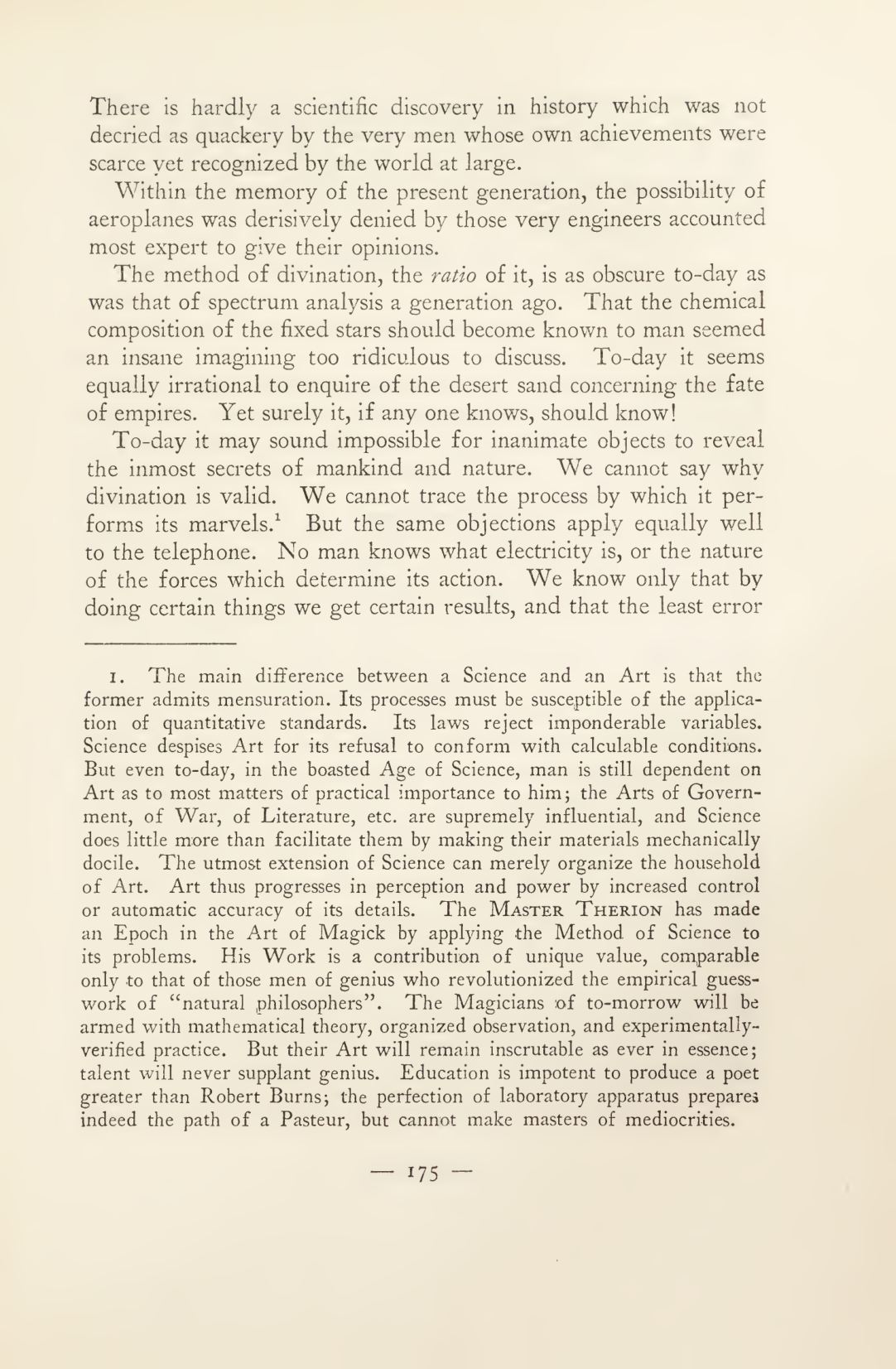
Highlights use the original PDF text layer. OCR-only matches may not be visible on the scan.
Transcription
Download text ↓raw extractionoriginal embedded textReview: unreviewed
There is hardly a scientific discovery in history which was not
decried as quackery by the very men whose own achievements were
scarce vet recognized by the world at large.
Within the memory of the présent génération, the possibility of
aéroplanes was derisively denied by those very engineers accounted
most expert to give their opinions.
The method of divination, the ratio of it, is as obscure to-day as
was that of spectrum analysis a génération ago. That the Chemical
composition of the fixed stars should become known to man seemed
an insane imagining too ridiculous to discuss. To-day it seems
equally irrational to enquire of the desert sand concerning the fate
of empires. Yet surely it, if any one knows, should know!
To-day it may Sound impossible for inanimate objects to reveal
the inmost secrets of mankind and nature. We cannot say whv
divination is valid. We cannot trace the process by which it per-
forms its marvels.1 But the same objections apply equally well
to the téléphoné. No man knows what electricity is, or the nature
of the forces which détermine its action. We know only that by
doing certain things we get certain results, and that the least error
I. The main différence between a Science and an Art is that the
former admits mensuration. Its processes must be susceptible of the applica¬
tion of quantitative standards. Its laws reject impondérable variables.
Science despises Art for its refusai to conform with calculable conditions.
But even to-day, in the boasted Age of Science, man is still dépendent on
Art as to most matters of practical importance to him; the Arts of Govern¬
ment, of War, of Literature, etc. are supremely influential, and Science
does little more than facilitate them by making their materials mechanically
docile. The utmost extension of Science can merely organize the household
of Art. Art thus progresses in perception and power by increased control
or automatic accuracy of its details. The Master Therion has made
an Epoch in the Art of Magick by applying the Method of Science to
its problems. His Work is a contribution of unique value, comparable
only to that of those men of genius who revolutionized the empirical guess-
work of “natural philosophers”. The Magicians of to-morrow will be
armed with mathematical theory, organized observation, and experimentally-
verified practice. But their Art will remain inscrutable as ever in essence;
talent will never supplant genius. Education is impotent to produce a poet
greater than Robert Burns; the perfection of laboratory apparatus préparé»
indeed the path of a Pasteur, but cannot make masters of mediocrities.
175 “
Page provenance & review flags
Stable page ID: 7225bbab6d2ac2a8268d8bdd:p00055
Line breaks are preserved. Reading order and OCR accuracy may need review.
Printed page label has not been verified.
- No automated review flags. This does not establish transcription accuracy.