1930 · CLOSE READING
Magick in Theory and Practice (Section 2)
Magick in Theory and Practice (Section 2) (1930), PDF p. 77
Original page
Enlarge ↗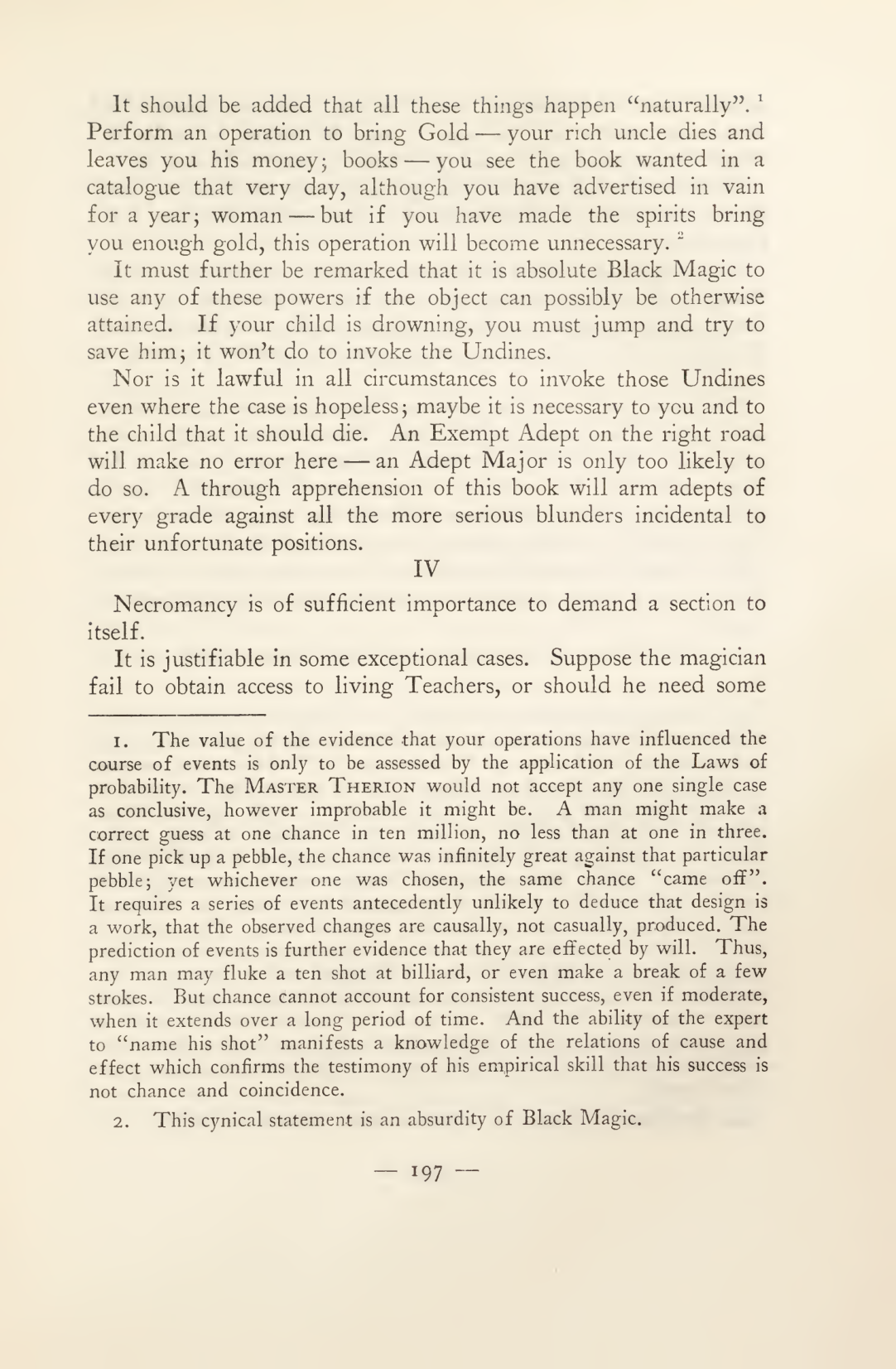
Highlights use the original PDF text layer. OCR-only matches may not be visible on the scan.
Transcription
Download text ↓raw extractionoriginal embedded textReview: unreviewed
lt should be added that ail these things happen “naturally”. 1
Perform an operation to bring Gold — your rich uncle dies and
leaves you his moneyj books — you see the book wanted in a
catalogue that very day, although you hâve advertised in vain
for a year; woman — but if you hâve made the spirits bring
you enough gold, this operation will become unnecessary. 2
It must further be remarked that it is absolute Black Magic to
use any of these powers if the object can possibly be otherwise
attained. If your child is drowning, you must jump and try to
save him; it won’t do to invoke the Undines.
Nor is it lawful in ail circumstances to invoke those Undines
even where the case is hopeless; maybe it is necessary to ycu and to
the child that it should die. An Exempt Adept on the right road
will make no error here — an Adept Major is only too likely to
do so. A through appréhension of this book will arm adepts of
every grade against ail the more serious blunders incidental to
their unfortunate positions.
IV
Necromancy is of sufficient importance to demand a section to
itself.
It is justifiable in some exceptional cases. Suppose the magician
fail to obtain. access to living Teachers, or should he need some
1. The value of the evidence that your operations hâve influenced the
course of events is only to be assessed by the application of the Laws of
probability. The Master Therion would not accept any one single case
as conclusive, however improbable it might be. A man might make a
correct guess at one chance in ten million, no less than at one in three.
If one pick up a pebble, the chance was infinitely great against that particular
pebble; yet whichever one was chosen, the same chance “came off”.
It requires a sériés of events antecedently unlikely to deduce that design is
a work, that the observed changes are causally, not casually, produced. The
prédiction of events is further evidence that they are effected by will. Thus,
any man may fluke a ten shot at billiard, or even make a break of a few
strokes. But chance cannot account for consistent success, even if moderate,
when it extends over a long period of time. And the ability of the expert
to “name his shot” manifests a knowledge of the relations of cause and
effect which confirms the testimony of his empirical skill that his success is
not chance and coincidence.
2. This cynical statement is an absurdity of Black Magic.
ï97 —
Page provenance & review flags
Stable page ID: 7225bbab6d2ac2a8268d8bdd:p00077
Line breaks are preserved. Reading order and OCR accuracy may need review.
Printed page label has not been verified.
- No automated review flags. This does not establish transcription accuracy.