1902 · CLOSE READING
Tannhäuser
Tannhäuser (1902), PDF p. 13
Original page
Enlarge ↗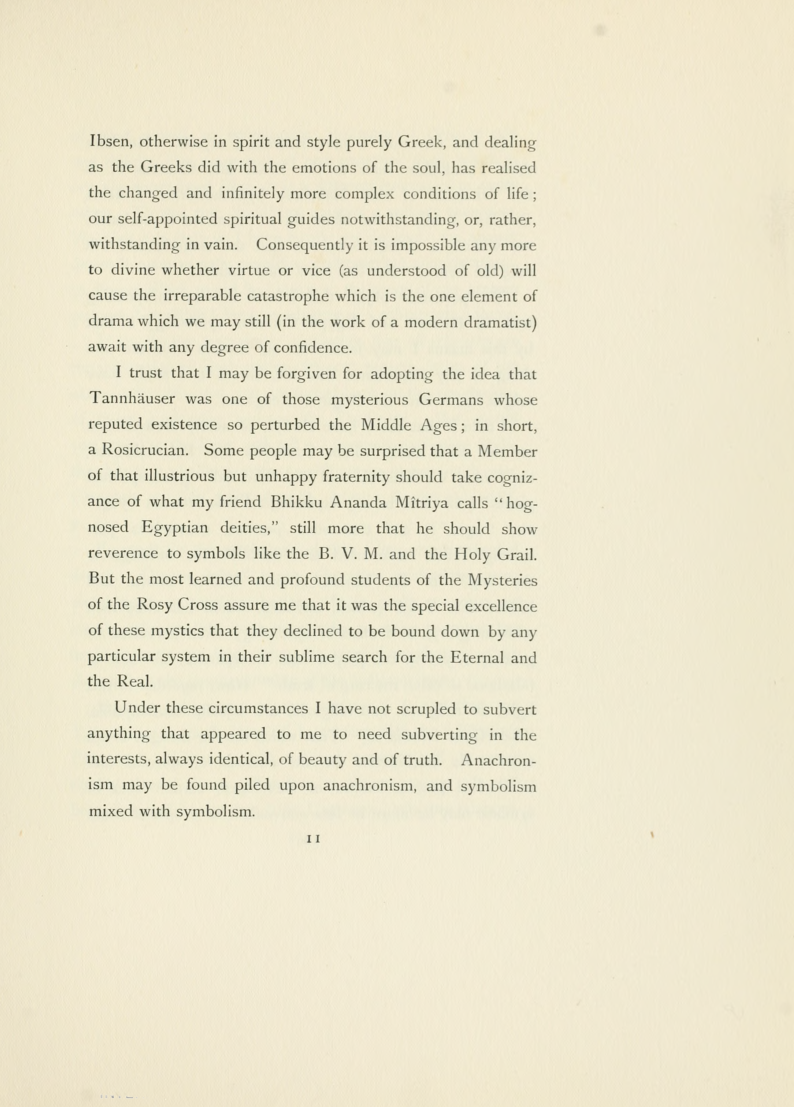
Highlights use the original PDF text layer. OCR-only matches may not be visible on the scan.
Transcription
Download text ↓raw extractionoriginal embedded textReview: unreviewed
Ibsen, otherwise in spirit and style purely Greek,
and dealing
as
the Greeks did with the emotions of the soul,
has realised
the
changed
and
infinitely
more
complex
conditions
of life ;
our self-appointed spiritual guides notwithstanding, or, rather,
withstanding
in vain.
Consequently it is impossible any more
to
divine whether
virtue or vice
(as
understood of old)
will
cause
the irreparable catastrophe which
is the one element
of
drama which we may still (in the work of a modern dramatist)
await with any degree of confidence.
I trust
that
I may be forgiven for adopting
the idea
that
Tannhauser
was
one
of
those
mysterious
Germans
whose
reputed existence
so perturbed
the
Middle
Ages
;
in
short,
a Rosicrucian.
Some people may be surprised that a Member
of that illustrious
but
unhappy fraternity should take cogniz-
ance of what my friend
Bhikku
Ananda
Mitriya
calls "hog-
nosed
Egyptian
deities,"
still
more
that
he
should
show
reverence
to symbols
like the B. V. M. and
the Holy Grail.
But the most learned and profound students of the Mysteries
of the Rosy Cross assure
me that it was the special excellence
of these mystics that they declined to be bound down
by any
particular system
in their sublime
search
for the Eternal
and
the Real.
Under
these circumstances I have not scrupled to subvert
anything
that
appeared
to
me
to
need
subverting
in
the
interests,
always identical, of beauty and of truth.
Anachron-
ism
may
be
found
piled
upon anachronism,
and symbolism
mixed with symbolism.
II
Page provenance & review flags
Stable page ID: 7646d0b2ad39d4a05a1a3694:p00013
Line breaks are preserved. Reading order and OCR accuracy may need review.
Printed page label has not been verified.
- No automated review flags. This does not establish transcription accuracy.