1930 · CLOSE READING
Magick in Theory and Practice (Section 4)
Magick in Theory and Practice (Section 4) (1930), PDF p. 106
Original page
Enlarge ↗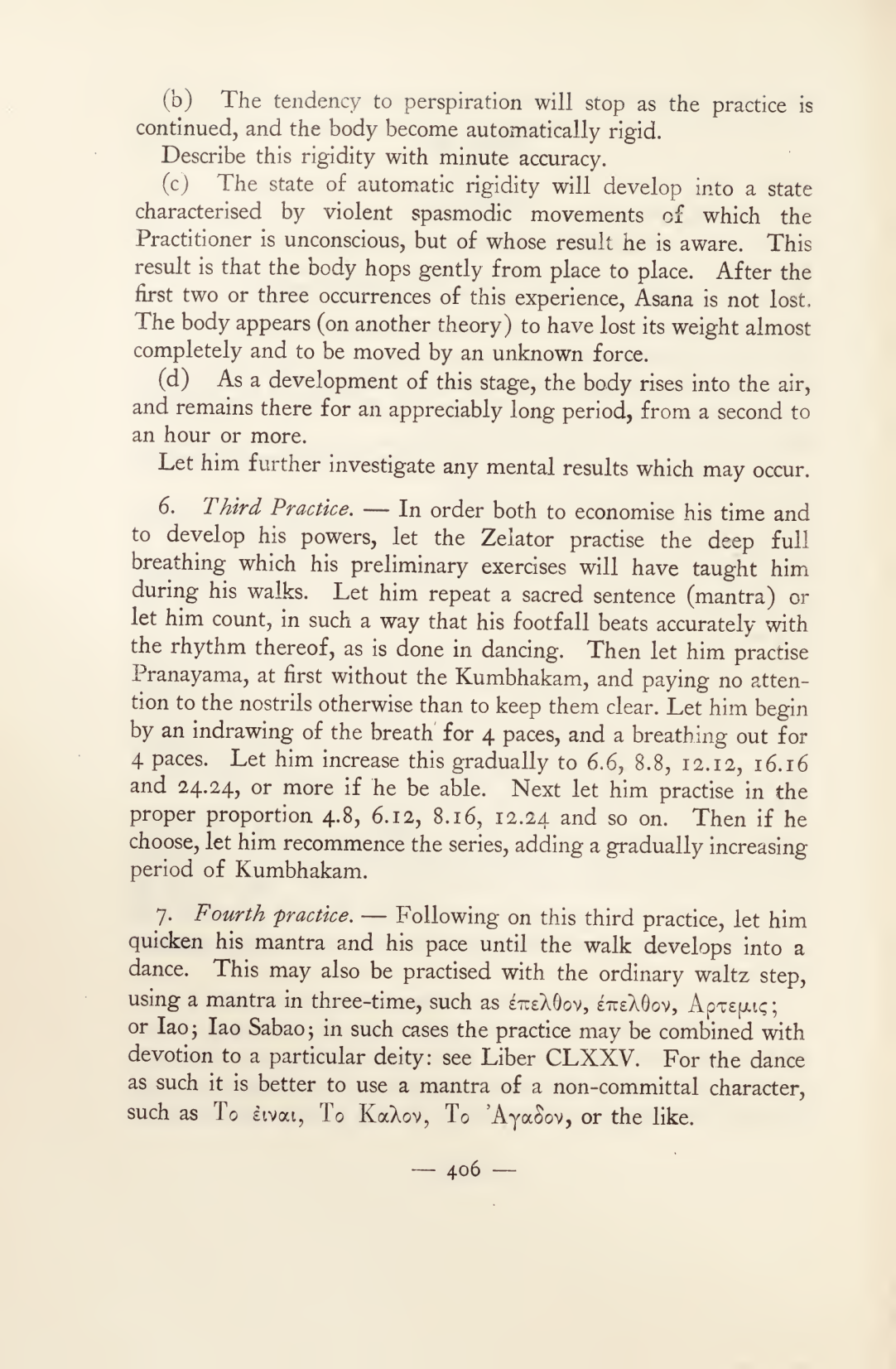
Highlights use the original PDF text layer. OCR-only matches may not be visible on the scan.
Transcription
Download text ↓raw extractionoriginal embedded textReview: unreviewed
(b) The tendency to perspiration will stop as the practice is
continue^ and the body become automatically rigid.
Describe this rigidity with minute accuracy.
(c) The State of automatic rigidity will develop into a State
characterised by violent spasmodic movements of which the
Practitioner is unconscious, but of whose resuit he is aware. This
resuit is that the body hops gently from place to place. After the
first two or three occurrences of this expérience, Asana is not lost.
The body appears (on another theory) to hâve lost its weight almost
completely and to be moved by an unknown force.
(d) As a development of this stage, the body rises into the air,
and remains there for an appreciably long period, from a second to
an hour or more.
Let him further investigate any mental results w’hich may occur.
6. Third Practice. — In order both to économisé his time and
to develop his powers, let the Zelator practise the deep full
breathing which his preliminary exercises will hâve taught him
during his walks. Let him repeat a sacred sentence (mantra) or
let him count, in such a way that his footfall beats accurately with
the rhythm thereof, as is done in dancing. Then let him practise
Pranayama, at first without the Kumbhakam, and paying no atten¬
tion to the nostrils otherwise than to keep them clear. Let him begin
by an indrawing of the breath for 4 paces, and a breathing out for
4 paces. Let him increase this gradually to 6.6, 8.8, 12.12, 16.16
and 24.24, or more if he be able. Next let him practise in the
proper proportion 4.8, 6.12, 8.16, 12.24 and so on. Then if he
choose, let him recommence the sériés, adding a gradually increasing
period of Kumbhakam.
7. Fourth fractice. — Following on this third practice, let him
quicken his mantra and his pace until the walk develops into a
dance. This may also be practised with the ordinary waltz step,
using a mantra in three-time, such as iizzküov, étusAÔov, ApTspaç;
or Iaoj Iao Sabao; in such cases the practice may be combined with
dévotion to a particular deity: see Liber CLXXV. For the dance
as such it is better to use a mantra of a non-committal character,
such as J 0 aval, lo KaAov, To Ayaôov, or the like.
— 406
Page provenance & review flags
Stable page ID: 7753951376af2a884c0b63fa:p00106
Line breaks are preserved. Reading order and OCR accuracy may need review.
Printed page label has not been verified.
- No automated review flags. This does not establish transcription accuracy.