1930 · CLOSE READING
Magick in Theory and Practice (Section 4)
Magick in Theory and Practice (Section 4) (1930), PDF p. 92
Original page
Enlarge ↗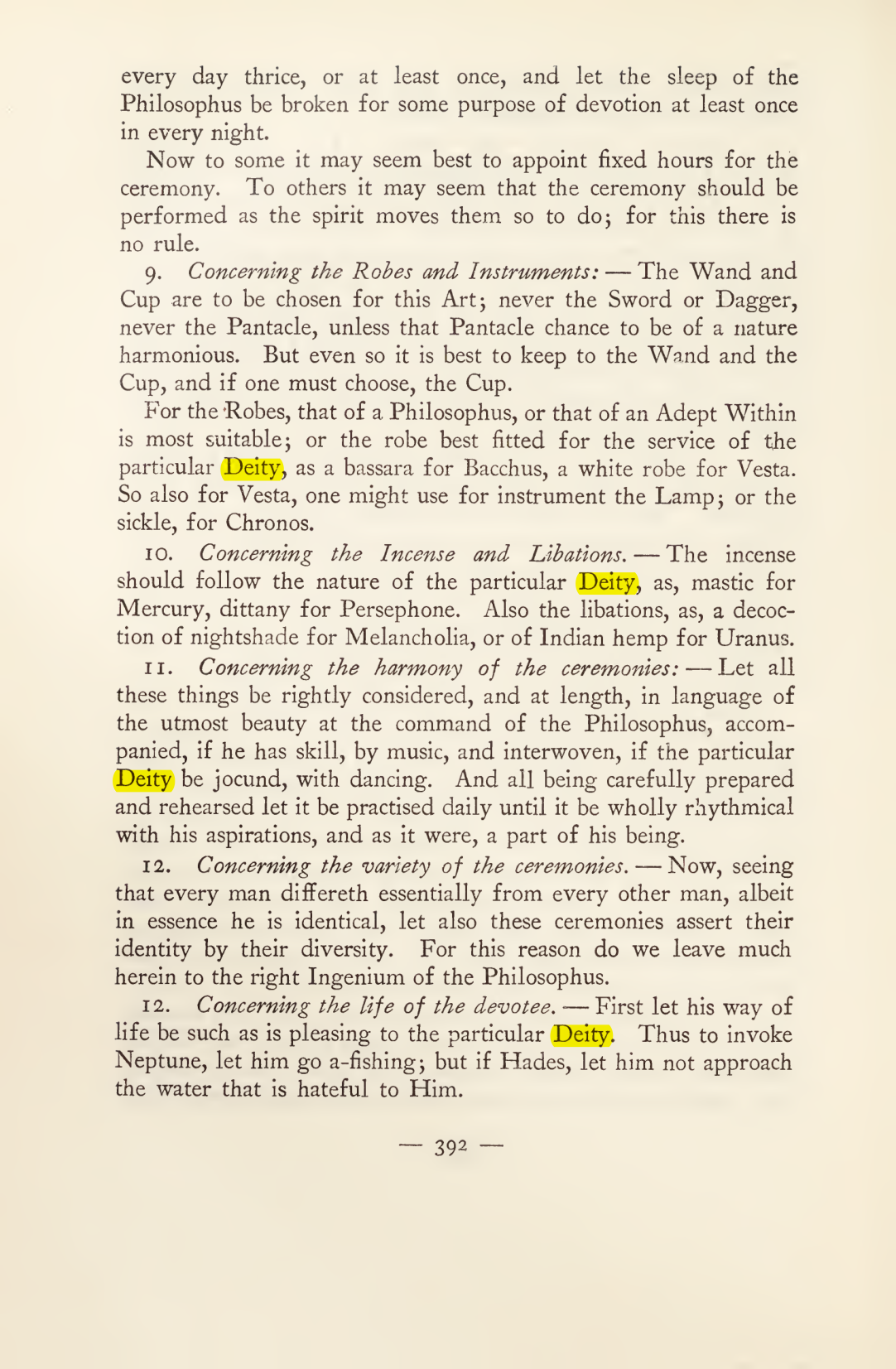
Highlights use the original PDF text layer. OCR-only matches may not be visible on the scan.
Transcription
Download text ↓raw extractionoriginal embedded textReview: unreviewed
every day thrice, or at least once, and let the sleep of the
Philosophus be broken for some purpose of dévotion at least once
in every night.
Now to some it may seem best to appoint fixed hours for the
ceremony. To others it may seem that the ceremony should be
performed as the spirit moves them so to do 3 for this there is
no rule.
9. Concernlng the Robes and Instruments : — The Wand and
Cup are to be chosen for this Art 3 never the Sword or Dagger,
never the Pantacle, unless that Pantacle chance to be of a nature
harmonious. But even so it is best to keep to the Wand and the
Cup, and if one must choose, the Cup.
For the'Robes, that of a Philosophus, or that of an Adept Within
is most suitable3 or the robe best fitted for the service of the
particular Deity, as a bassara for Bacchus, a white robe for Vesta.
So also for Vesta, one might use for instrument the Lampj or the
sickle, for Chronos.
10. Concernlng the Incense and Libations. — The incense
should follow the nature of the particular Deity, as, mastic for
Mercury, dittany for Persephone. Also the libations, as, a décoc¬
tion of nightshade for Melancholia, or of Indian hemp for Uranus.
11. Concernlng the harmony of the ceremonies: — Let ail
these things be rightly considered, and at length, in language of
the utmost beauty at the command of the Philosophus, accom-
panied, if he has skill, by music, and interwoven, if the particular
Deity be jocund, with dancing. And ail being carefully prepared
and rehearsed let it be practised daily until it be wholly rhythmical
with his aspirations, and as it were, a part of his being.
12. Concernlng the variety of the ceremonies. — Now, seeing
that every man differeth essentially from every other man, albeit
in essence he is identical, let also these ceremonies assert their
identity by their diversity. For this reason do we leave much
herein to the right Ingenium of the Philosophus.
12. Concernlng the life of the devotee. -— First let his way of
life be such as is pleasing to the particular Deity. Thus to invoke
Neptune, let him go a-fishing3 but if Hades, let him not approach
the water that is hateful to Him.
392
Page provenance & review flags
Stable page ID: 7753951376af2a884c0b63fa:p00092
Line breaks are preserved. Reading order and OCR accuracy may need review.
Printed page label has not been verified.
- No automated review flags. This does not establish transcription accuracy.