1909 · CLOSE READING
The Equinox (Volume I, Number I)
The Equinox (Volume I, Number I) (1909), PDF p. 409
Original page
Enlarge ↗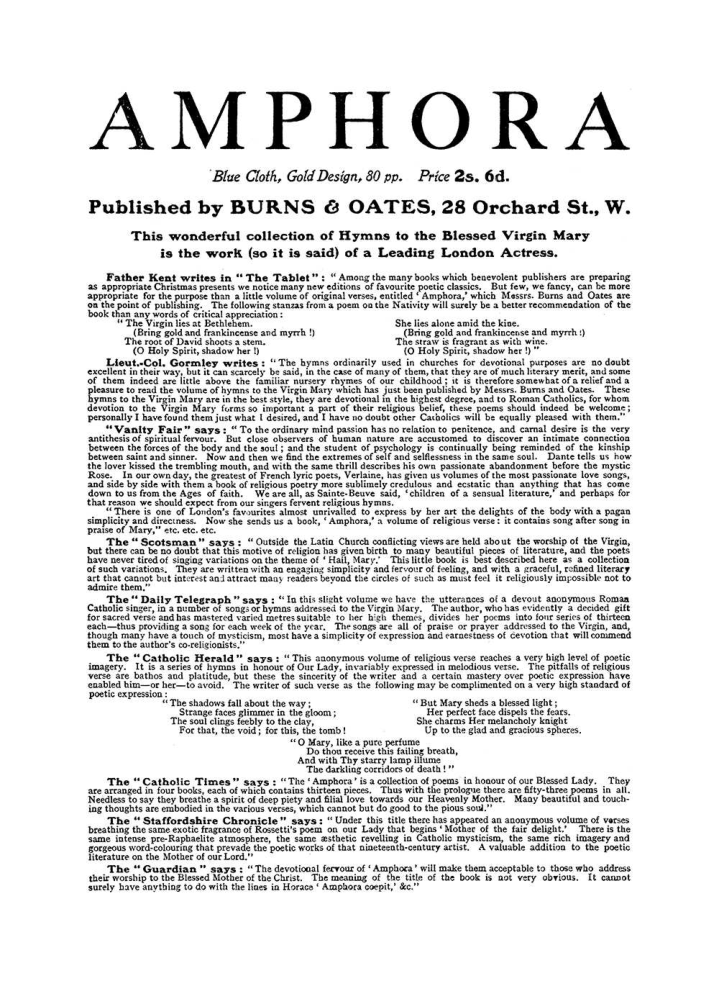
Highlights use the original PDF text layer. OCR-only matches may not be visible on the scan.
Transcription
Download text ↓raw extractionoriginal embedded textReview: unreviewed
AMPHORA
“Blue Cloth, Gold Design, 80 pp. Price 2s. 6d.
Published by BURNS & OATES, 28 Orchard St., W.
This wonderful collection of Hymns to the Blessed Virgin Mary
is the work (so it is said) of a Leading London Actress.
Father Kent writes in “The Tablet” : “ Among the many books which benevolent publishers are preparing
as appropriate Christmas presents we notice many new editions of favourite poetic classics. But few, we fancy, can be more
appropriate for the purpose than a little volume of original verses, entitled “ Amphora,’ which Massrs. Burns and Oates are
‘a the point of publishing. The following stanzas from a poem on the Nativity will surely be a better recommendation of the
book than any words of critical appreciation:
“The Virgin lies at Bethlehem. She lies alone amid the kine.
(Bring gold and frankincense and myrrh !) (Bring gold and frankincense and myrth :)
‘The root of David shootsa stem. ‘The straw is fragrant as with wine.
(O Holy Spirit, shadow her !) (0 Holy Spirit, shadow her !) "
Lieut..Col. Gormley writes : “The bymns ordinarily used in churches for devotional purposes are no doubt
excellent in their way, but it can scarcely be said, in the case of many of them, that they are of much literary merit, and some
of them indeed are little above the familiar nursery rhymes of our childhood; it is therefore somewhat of a relief
and a
plessure to read the volume of hymns to the Virgin Mary which has just been published by Messrs, Bums and Oates, These
yymns to the Virgin Mary are in the best style, they are devotional in the highest degree, and to Roman Catholics, for whom
devotion to the Virgin Mary forms so important a part of their religious belief, these poems should indeed be welcome;
personallyI have found them just what I desired, and I have no doubt other Cacadlics will be equally pleased with them."
“Vanity Fair” says: “To the ordinary mind passion has no relation to penitence, and carnal desire is the very
antithesis of spiritual fervour. But close observers of human nature are accustomed to discover an intimate connection
between the forces of the body and the soul; and the student of psychology is continually being reminded of the Kinship
between saint and sinner. Now and then we find the extremes of self and selflessness in the same soul. Dante tells us how
the lover kissed the trembling mouth, and with the same thrill describes his own passionate abandonment before the mystic
Rose. In our own day, the greatest of French lyric poets, Verlaine, has given us volumes of the most passionate love songs,
and side by side with them a book of religious poetry more sublimely credulous and ecstatic than anything that has come
down to us from the Ages of faith. We are all, as Sainte-Beuve said, ‘children of a sensual literature,” and perhaps for
that reason we should expect from our singers fervent religious hymns.
“There is one of London’s favourites almost unrivalled to express by her art the delights of the body witha pagan
simplicity and directness. Now she sends us a book, ‘ Amphora,” a volume of religious verse: it contains song after song in
Praise of Mary,” etc, etc. etc.
The “ Scotsman” says : “ Outside the Latin Church conflicting views are held about the worship of the Virgin,
Dut there can be no doubt that this motive of religion has given birth to many beautiful pieces of literature, and the poets
have never tired
of singing variations on the theme of ‘ Hail, Mary.’ This little book is best described here as a collection
of such variations, They are written with an engasing simplicity and fervour of feeling, and with a graceful, refined literary
art that cannot but interest aa attract many readers beyond the ciecles of such as must feel it religiously itapossible not to
admire them,”
The “ Daily Telegraph” says : “In this slicht volume we have the utterances of a devout anonymous Roman
Catholic singer, ina number of songs or hymns addressed to the Virgin Mary. The author, who has evidently a decided gift
for sacred vers¢
and has mastered varied metres suitable to her high themes, divides her’ pocms into four serics of thirteca
‘each—thus providing a song for each week of the year, The songs are all of praise or prayer addressed to the Virgin, and,
though many have a touch of mysticism, most have a simplicity of expression and earnestness of cevotion that will conimend
them to the author's co-religionists.””
The “Catholic Herald” says : “This aaonymous volume of religious verse reaches a very high level of poetic
imagery. It is a series of hymas in honour of Out Lady, invariably expressed in melodious verse. The pitfalls of religious
verse are bathos and platitude, but these the sincerity of the writer and a certain mastery over poetic expression have
enabled him or her—to avoid. ' The writer of such verse as the following may be complimented on a very high standard of
Poetic expression:
“The shadows fall about the way; “But Mary sheds a blessed light;
Strange faces glimmer in the gloom; Her petfect face dispels the fears.
‘The soul clings feebly to the clay, She charms Her melancholy knight
For that, the void} for this, the tomb! Up to the glad and gracious spheres.
“O Mary, like a pure perfume
Do thou receive this failing breath,
And with Thy starry lamp illume
The darkling corridors of death !
‘The “Catholic Times” says: “The ‘Amphora’ is a collection of poems ia honour of our Blessed Lady. They
ae arranged in four books, each of which contains thirteen pieces. Thus with the prologue there are fifty-three poems in all.
Neediess to say they breathe a spirit of deep piety and filial love towards our Heavenly Mother, Many beautiful and touch-
ing thoughts are emabodied in the various verses, which cannot but do good to the pious soul.”
The ‘Staffordshire Chronicle” says: “Under, this title there has appeared an anonymous volume of varses
breathing the same exotic fragrance of Rossetti’s poem on out Lady that begins ‘Mother of the fair delight.” There
is the
same intense pre-Raphaelite atmosphere, the same asthetic revelling ia Catholic mysticism, the same rich imagery and
gorgeous word-colouring that prevade the poetic works of that nineteeath-century artist, A valuable addition to the poetic
Titetature on the Mother of our Lord.”
‘The “ Guardian” says : “The devotional fervour of ‘Amphora’ will make them acceptable to those who address
their worship to the Blessed Mother of the Christ. The meaning of the title of the book is aot very obvious. It cannot
surely bave anything to do with the lines in Horace ‘ Amphora coepit,’ &c.”
Page provenance & review flags
Stable page ID: 7a1ccfa408b1d9012e23c50d:p00409
Line breaks are preserved. Reading order and OCR accuracy may need review.
Printed page label has not been verified.
- No automated review flags. This does not establish transcription accuracy.