1930 · CLOSE READING
Magick in Theory and Practice (Section 3)
Magick in Theory and Practice (Section 3) (1930), PDF p. 56
Original page
Enlarge ↗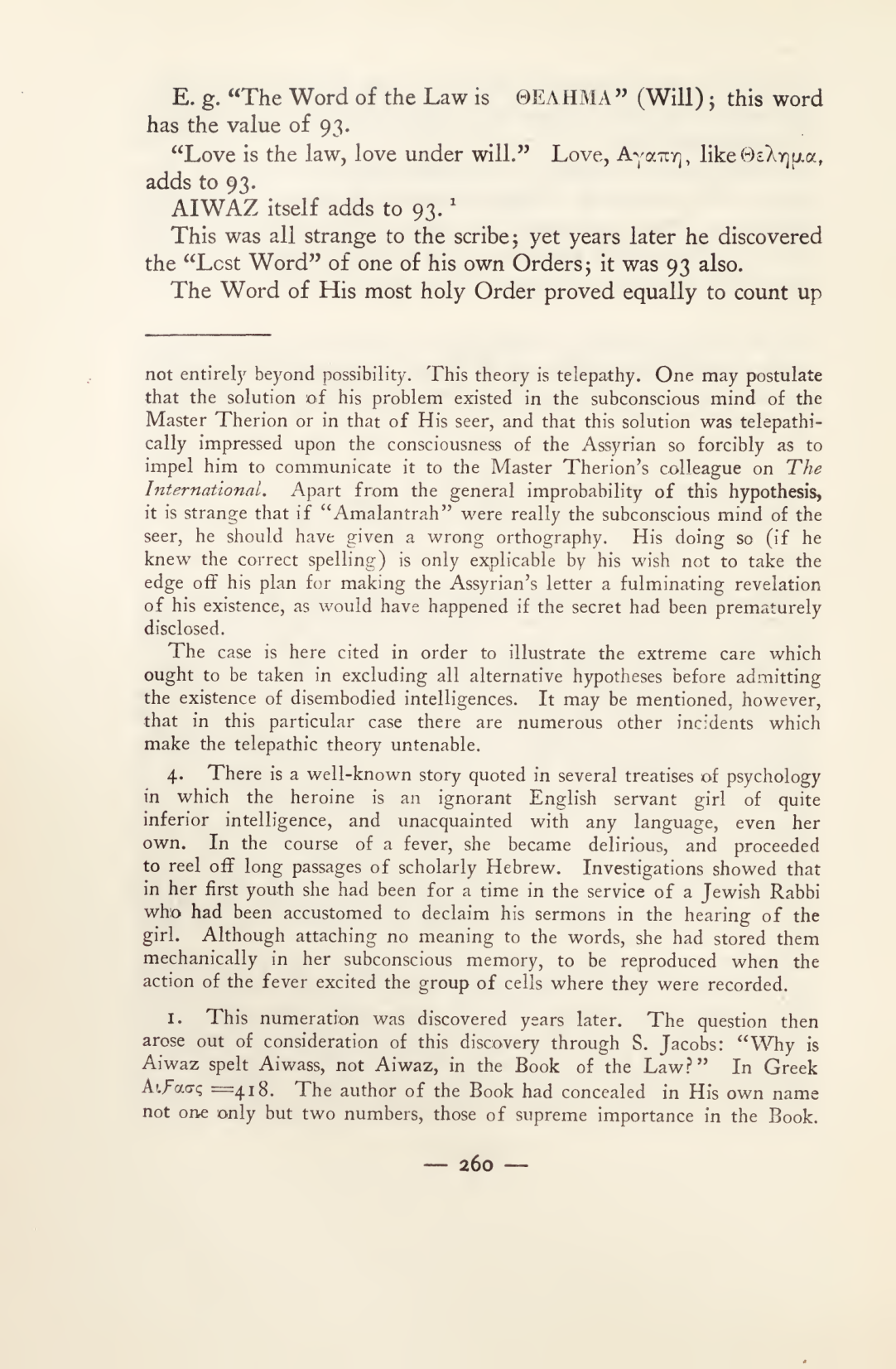
Highlights use the original PDF text layer. OCR-only matches may not be visible on the scan.
Transcription
Download text ↓raw extractionoriginal embedded textReview: unreviewed
E. g. “The Word of the Law is 0EAHMA” (Will) ; this Word
has the value of 93.
“Love is the law, love under will.” Love, Aya-ruy), likeBsXyjua,
adds to 93.
AIWAZ itself adds to 93.1
This was ail strange to the scribe; yet years later he discovered
the “Lest Word” of one of his own Orders; it was 93 also.
The Word of His most holy Order proved equally to count up
not entirely beyond possibility. This theory is telepathy. One may postulate
that the solution of his problem existed in the subconscious minci of the
Master Therion or in that of His seer, and that this solution was telepathi-
cally impressed upon the consciousness of the Assyrian so forcibly as to
impel him to communicate it to the Master Therion’s colîeague on The
International. Apart from the general improbability of this hypothesis,
it is strange that if “Amalantrah” were really the subconscious mind of the
seer, he should hâve given a wrong orthography. His doing so (if he
knew the correct spelling) is only explicable by his wish not to take the
edge off his plan for making the Assyrian’s letter a fulminating révélation
of his existence, as would hâve happened if the secret had been prematurely
disclosed.
The case is here cited in order to illustrate the extreme care which
ought to be taken in excluding ail alternative hypothèses before admitting
the existence of disembodied intelligences. It may be mentioned, however,
that in this particular case there are numerous other incidents which
make the télépathie theory untenable.
4. There is a well-known story quoted in several treatises of psychology
in which the heroine is an ignorant English servant girl of quite
inferior intelligence, and unacquainted with any language, even her
own. In the course of a fever, she became delirious, and proceeded
to reel off long passages of scholarly Hebrew. Investigations showed that
in her hrst youth she had been for a time in the service of a Jewish Rabbi
who had been accustomed to declaim his sermons in the hearing of the
girl. Although attaching no meaning to the words, she had stored them
mechanically in her subconscious memory, to be reproduced when the
action of the fever excited the group of cells where they were recorded.
I. This numération was discovered years later. The question then
arose out of considération of this discovery through S. Jacobs: “Why is
Aiwaz spelt Aiwass, not Aiwaz, in the Book of the Law?” In Greek
AiJFa<rç =418. The author of the Book had concealed in His own name
not orve only but two numbers, those of suprême importance in the Book.
— 260 —
Page provenance & review flags
Stable page ID: 8716dc3e5e58c785b9453767:p00056
Line breaks are preserved. Reading order and OCR accuracy may need review.
Printed page label has not been verified.
- No automated review flags. This does not establish transcription accuracy.