1910 · CLOSE READING
The Equinox (Volume I, Number IV)
The Equinox (Volume I, Number IV) (1910), PDF p. 148
Original page
Enlarge ↗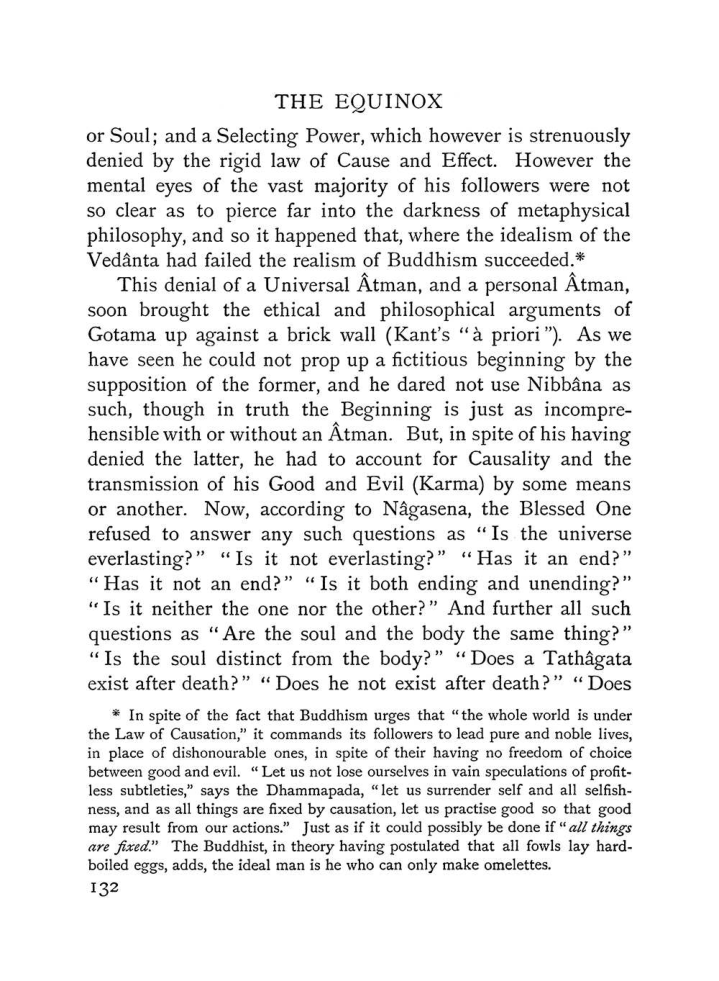
Highlights use the original PDF text layer. OCR-only matches may not be visible on the scan.
Transcription
Download text ↓raw extractionoriginal embedded textReview: unreviewed
THE EQUINOX
or Soul; and a Selecting Power, which however is strenuously
denied by the rigid law of Cause and Effect. However the
mental eyes of the vast majority of his followers were not
so clear as to pierce far into the darkness of metaphysical
philosophy, and so it happened that, where the idealism of the
Vedanta had failed the realism of Buddhism succeeded.*
This denial ofa Universal Atman, and a personal Atman,
soon brought the ethical and philosophical arguments of
Gotama up against a brick wall (Kant’s “a priori”). As we
have seen he could not prop up a fictitious beginning by the
supposition of the former, and he dared not use Nibbana as
such, though in truth the Beginning is just as incompre-
hensible with or without an Atman. But, in spite of his having
denied the latter, he had to account for Causality and the
transmission of his Good and Evil (Karma) by some means
or another. Now, according to Nagasena, the Blessed One
refused to answer any such questions as “Is the universe
everlasting?” “Is it not everlasting?” ‘‘Has it an end?”
“Has it not an end?” “Is it both ending and unending?”
“Is it neither the one nor the other?” And further all such
questions as “Are the soul and the body the same thing?”
“Is the soul distinct from the body?” ‘Does a Tathagata
exist after death?” ‘Does he not exist after death?” “Does
* In spite of the fact that Buddhism urges that “the whole world is under
the Law of Causation,” it commands its followers to lead pure and noble lives,
in place of dishonourable ones, in spite of their having no freedom of choice
between good and evil. “Let us not lose ourselves in vain speculations of profit-
less subtleties,” says the Dhammapada, “let us surrender self and all selfish-
ness, and as all things are fixed by causation, let us practise good so that good
may result from our actions.” Just as if it could possibly be done if “ all things
are fixed.” The Buddhist, in theory having postulated that all fowls lay hard-
boiled eggs, adds, the ideal man is he who can only make omelettes.
132
Page provenance & review flags
Stable page ID: 8af424f3c6f02f3b8e8db2b3:p00148
Line breaks are preserved. Reading order and OCR accuracy may need review.
Printed page label has not been verified.
- No automated review flags. This does not establish transcription accuracy.