1910 · CLOSE READING
The Equinox (Volume I, Number IV)
The Equinox (Volume I, Number IV) (1910), PDF p. 67
Original page
Enlarge ↗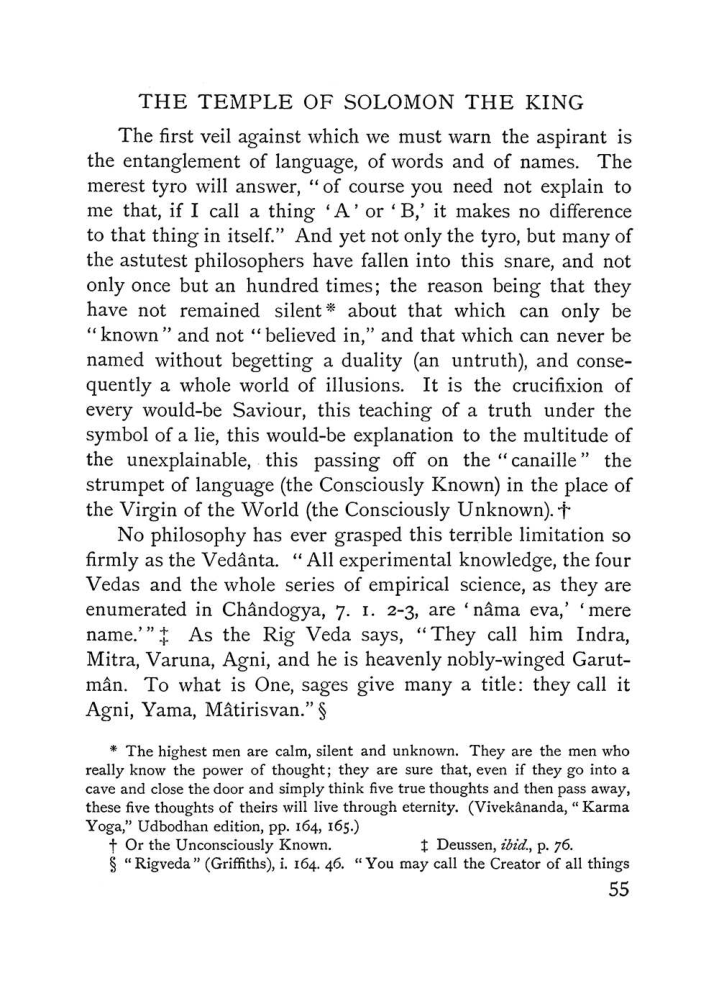
Highlights use the original PDF text layer. OCR-only matches may not be visible on the scan.
Transcription
Download text ↓raw extractionoriginal embedded textReview: unreviewed
THE TEMPLE OF SOLOMON THE KING
The first veil against which we must warn the aspirant is
the entanglement of language, of words and of names. The
merest tyro will answer, “of course you need not explain to
me that, ifI call a thing ‘A’ or ‘B,’ it makes no difference
to that thing in itself.” And yet not only the tyro, but many of
the astutest philosophers have fallen into this snare, and not
only once but an hundred times; the reason being that they
have not remained silent* about that which can only be
“known” and not “believed in,” and that which can never be
named without begetting a duality (an untruth), and conse-
quently a whole world of illusions. It is the crucifixion of
every would-be Saviour, this teaching of a truth under the
symbol of a lie, this would-be explanation to the multitude of
the unexplainable, this passing off on the “canaille” the
strumpet of language (the Consciously Known) in the place of
the Virgin of the World (the Consciously Unknown). +
No philosophy has ever grasped this terrible limitation so
firmly as the Vedanta. “ All experimental knowledge, the four
Vedas and the whole series of empirical science, as they are
enumerated in Chandogya, 7. 1. 2-3, are ‘nama eva,’ ‘mere
name.’” t+ As the Rig Veda says, ‘They call him Indra,
Mitra, Varuna, Agni, and he is heavenly nobly-winged Garut-
man. To what is One, sages give many a title: they call it
Agni, Yama, MAtirisvan.Ӥ
* The highest men are calm, silent and unknown. They are the men who
really know the power of thought; they are sure that, even if they go into a
cave and close the door and simply think five true thoughts and then pass away,
these five thoughts of theirs will live through eternity. (Vivekananda, “Karma
Yoga,” Udbodhan edition, pp. 164, 165.)
+ Or the Unconsciously Known. t Deussen, 27d, p. 76.
§ “Rigveda” (Griffiths), i. 164. 46. “You may call the Creator of all things
55
Page provenance & review flags
Stable page ID: 8af424f3c6f02f3b8e8db2b3:p00067
Line breaks are preserved. Reading order and OCR accuracy may need review.
Printed page label has not been verified.
- No automated review flags. This does not establish transcription accuracy.