1929 · CLOSE READING
Magick in Theory and Practice (Section 1)
Magick in Theory and Practice (Section 1) (1929), PDF p. 112
Original page
Enlarge ↗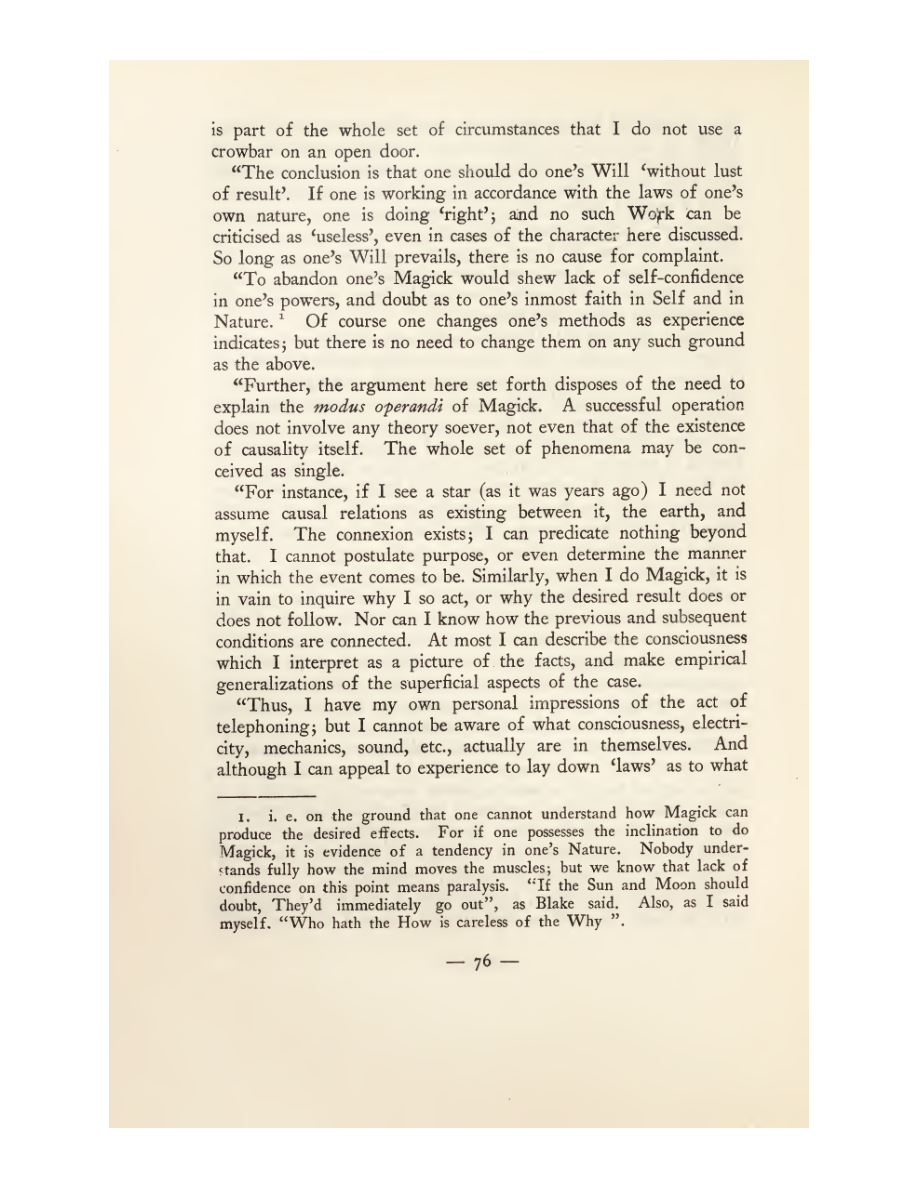
Highlights use the original PDF text layer. OCR-only matches may not be visible on the scan.
Transcription
Download text ↓raw extractionoriginal embedded textReview: unreviewed
is part of the whole set of circumstances that I do not use a
crowbar on an open door.
“The conclusion is that one should do one’s Will ‘without lust
of resuit’. If one is working in accordance with the laws of one’s
own nature, one is doing ‘right’; and no such Wo^k can be
criticised as ‘useless’, even in cases of the character here discussed.
So long as one’s Will prevails, there is no cause for complaint.
“To abandon one’s Magick would shew lack of self-confidence
in one’s powers, and doubt as to one’s inmost faith in Self and in
Nature.1 Of course one changes one’s methods as expérience
indicates; but there is no need to change them on any such ground
as the above.
“Further, the argument here set forth disposes of the need to
explain the modus operandi of Magick. A successful operation
does not involve any theory soever, not even that of the existence
of causality itself. The whole set of phenomena may be con-
ceived as single.
“For instance, if I see a star (as it was years ago) I need not
assume causal relations as existing between it, the earth, and
myself. The connexion existsj I can predicate nothing beyond
that. I cannot postulate purpose, or even détermine the manner
in which the event cornes to be. Similarly, when I do Magick, it is
in vain to inquire why I so act, or why the desired resuit does or
does not follow. Nor can I know how the previous and subséquent
conditions are connected. At most I can describe the consciousness
which I interpret as a picture of the facts, and make empirical
generalizations of the superficial aspects of the case.
“Thus, I hâve my own personal impressions of the act of
telephoning; but I cannot be aware of what consciousness, electri-
city, mechanics, sound, etc., actually are in themselves. And
although I can appeal to expérience to lay down ‘laws’ as to what
I. i. e. on the ground that one cannot understand how Magick can
produce the desired effects. For if one possesses the inclination to do
Magick, it is evidence of a tendency in one’s Nature. Nobody under-
ftands fully how the mind moves the muscles; but we know that lack of
confidence on this point means paralysis. “If the Sun and Moon should
doubt, They’d immediately go out”, as Blake said. Also, as I said
myself. “Who hath the How is careless of the Why ”.
76
Page provenance & review flags
Stable page ID: ada196c290adc6561dda8e9d:p00112
Line breaks are preserved. Reading order and OCR accuracy may need review.
Printed page label has not been verified.
- No automated review flags. This does not establish transcription accuracy.