1929 · CLOSE READING
Magick in Theory and Practice (Section 1)
Magick in Theory and Practice (Section 1) (1929), PDF p. 88
Original page
Enlarge ↗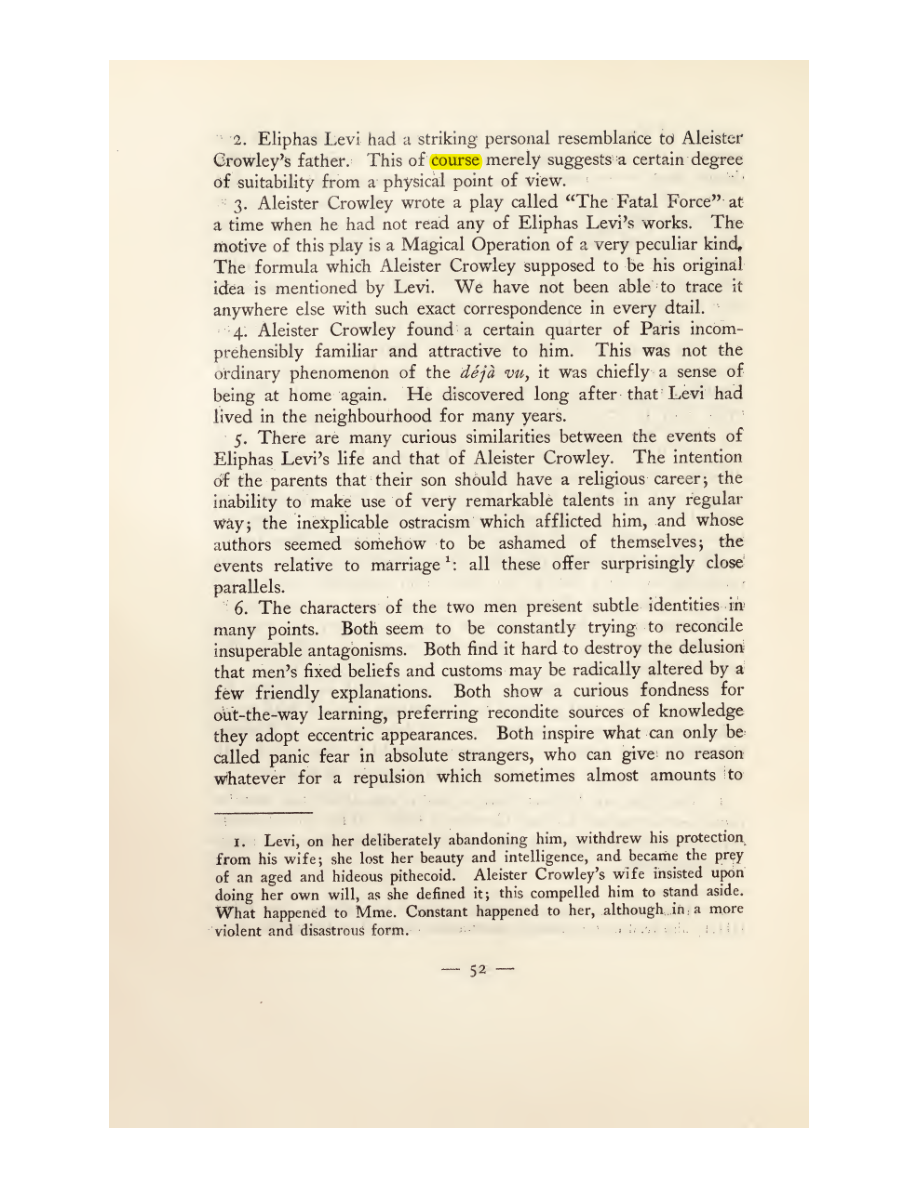
Highlights use the original PDF text layer. OCR-only matches may not be visible on the scan.
Transcription
Download text ↓raw extractionoriginal embedded textReview: unreviewed
2. Eliphas Levi had a striking personal resemblarice td Aleister
Growley’s father. This of course merely suggests a certain degree
of suitability from a physical point of view.
3. Aleister Crowley wrote a play called “The Fatal Force” at
a time when he had not read any of Eliphas Levi’s Works. The
motive of this play is a Magical Operation of a very peculiar kincl
The formula which Aleister Crowley supposed to be his original
idea is mentioned by Levi. We hâve not been able to trace it
anywhere else with such exact correspondent in every dtail.
4. Aleister Crowley found a certain quarter of Paris incom-
prehensibly familiar and attractive to him. This was not the
ordinary phenomenon of the déjà vu, it was chiefly a sense of
being at home again. He discovered long after that Levi had
lived in the neighbourhood for many years.
5. There are many curious similarities between the events of
Eliphas Levi’s life and that of Aleister Crowley. The intention
6f the parents that their son should hâve a religious career; the
inability to make use of very remarkable talents in any regular
wây; the inexplicable ostracism which afflicted him, and whose
authors seemed somehow to be ashamed of themselves; the
events relative to marriage1: ail these offer surprisingly close
parallels.
6. The characters of the two men présent subtle identities in
many points. Both seem to be constantly trying to reconcile
insuperable antagonisms. Both find it hard to destroy the delusion
that men’s fixed beliefs and customs may be radically altered by a
féw friendly explanations. Both show a curious fondness for
oüt-the-way learning, preferring recondite sources of knowledge
they adopt eccentric appearances. Both inspire what can only be
called panic fear in absolute strangers, who can give no reason
wFatever for a repulsion which sometimes almost amounts to
I. Levi, on her deliberately abandoning him, withdrew his protection
from his wife; she lost her beauty and intelligence, and became the prey
of an aged and hideous pithecoid. Aleister Crowley’s wife insisted upon
doing her own will, as she defined it; this compelled him to stand aside.
What happened to Mme. Constant happened to her, although in a more
violent and disastrous form.
52
Page provenance & review flags
Stable page ID: ada196c290adc6561dda8e9d:p00088
Line breaks are preserved. Reading order and OCR accuracy may need review.
Printed page label has not been verified.
- No automated review flags. This does not establish transcription accuracy.