1913 · CLOSE READING
The Equinox (Volume I, Number IX)
The Equinox (Volume I, Number IX) (1913), PDF p. 294
Original page
Enlarge ↗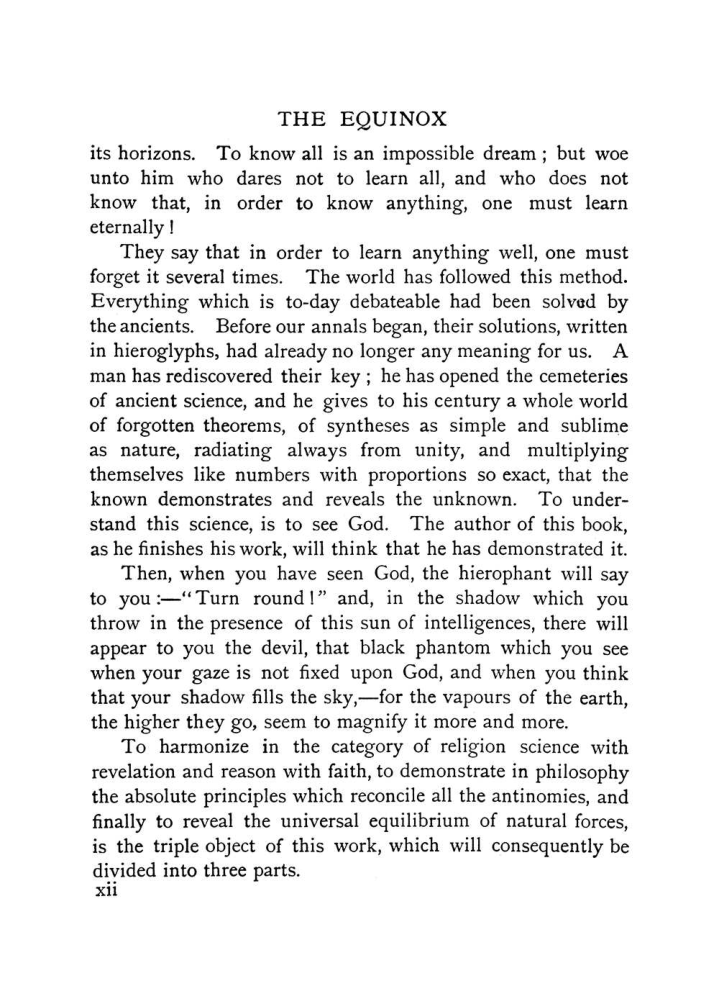
Highlights use the original PDF text layer. OCR-only matches may not be visible on the scan.
Transcription
Download text ↓raw extractionoriginal embedded textReview: unreviewed
THE EQUINOX
its horizons. To know all is an impossible dream; but woe
unto him who dares not to learn all, and who does not
know that, in order to know anything, one must learn
eternally!
They say that in order to learn anything well, one must
forget it several times. The world has followed this method.
Everything which is to-day debateable had been solved by
theancients. Before our annals began, their solutions, written
in hieroglyphs, had already no longer any meaning for us. A
man has rediscovered their key ; he has opened the cemeteries
of ancient science, and he gives to his century a whole world
of forgotten theorems, of syntheses as simple and sublime
as nature, radiating always from unity, and multiplying
themselves like numbers with proportions so exact, that the
known demonstrates and reveals the unknown. To under-
stand this science, is to see God. The author of this book,
as he finishes his work, will think that he has demonstrated it.
Then, when you have seen God, the hierophant will say
to you:—“ Turn round!” and, in the shadow which you
throw in the presence of this sun of intelligences, there will
appear to you the devil, that black phantom which you see
when your gaze is not fixed upon God, and when you think
that your shadow fills the sky,—for the vapours of the earth,
the higher they go, seem to magnify it more and more.
To harmonize in the category of religion science with
revelation and reason with faith, to demonstrate in philosophy
the absolute principles which reconcile all the antinomies, and
finally to reveal the universal equilibrium of natural forces,
is the triple object of this work, which will consequently be
divided into three parts.
xii
Page provenance & review flags
Stable page ID: b19b302fada611776d16b5bf:p00294
Line breaks are preserved. Reading order and OCR accuracy may need review.
Printed page label has not been verified.
- No automated review flags. This does not establish transcription accuracy.