1912 · CLOSE READING
Book 4 (Part I)
Book 4 (Part I) (1912), PDF p. 18
Original page
Enlarge ↗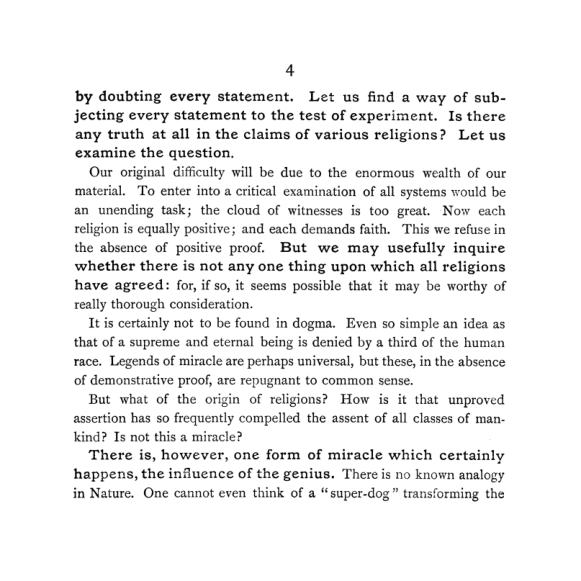
Highlights use the original PDF text layer. OCR-only matches may not be visible on the scan.
Transcription
Download text ↓raw extractionoriginal embedded textReview: unreviewed
4
by doubting every statement.
Let us find a way of sub-
jecting every statement to the test of experiment. Is there
any truth at all in the claims of various religions? Let us
examine the question.
Our original difficulty will be due to the enormous wealth of our
material.
To enter into a critical examination of all systems would be
an unending task; the cloud of witnesses
is too great.
Now each
religion is equally positive; and each demands faith. This we refuse in
the absence of positive proof.
But we may usefully inquire
whether there is not any one thing upon which all religions
have agreed: for, if so, it seems possible that it may be worthy of
really thorough consideration.
It is certainly not to be found in dogma.
Even so simple an idea as
that of a supreme and eternal being is denied by a third of the human
race. Legends of miracle are perhaps universal, but these, in the absence
of demonstrative proof, are repugnant to common sense.
But what of the origin
of religions? How is it that unproved
assertion has so frequently compelled the assent of all classes of man-
kind? Is not this a miracle?
There is, however, one form of miracle which certainly
happens, the influence of the genius. There'18 no known analogy
in Nature. One cannot even think of a “super-dog” transforming the
Page provenance & review flags
Stable page ID: b57ece87819cbb5a1ea55583:p00018
Line breaks are preserved. Reading order and OCR accuracy may need review.
Printed page label has not been verified.
- No automated review flags. This does not establish transcription accuracy.