1912 · CLOSE READING
Book 4 (Part I)
Book 4 (Part I) (1912), PDF p. 24
Original page
Enlarge ↗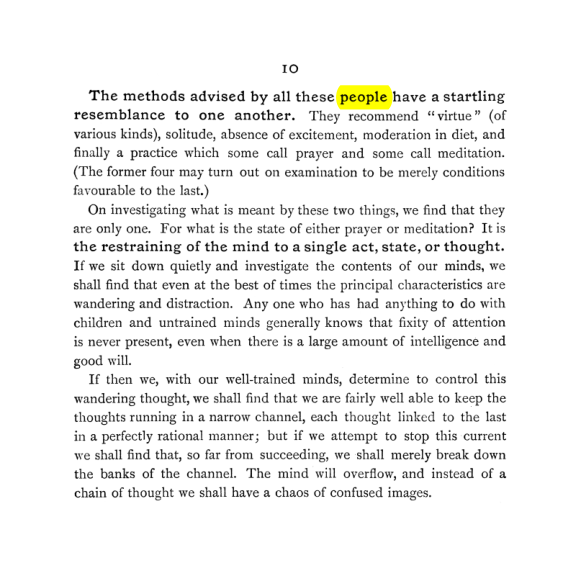
Highlights use the original PDF text layer. OCR-only matches may not be visible on the scan.
Transcription
Download text ↓raw extractionoriginal embedded textReview: unreviewed
ID
The methods advised by all these people have a startling
resemblance to one another.
They recommend “virtue” (of
various kinds), solitude, absence of excitement, moderation in diet, and
finally a practice which some call prayer and some call meditation.
(The former four may turn out on examination to be merely conditions
favourable to the last.)
On investigating what is meant by these two things, we find that they
are only one. For what is the state of either prayer or meditation? It is
the restraining of the mind to a single act, state, or thought.
If we sit down quietly and investigate the contents of our minds, we
shall find that even at the best 05 times the principal characteristics are
wandering and distraction. Any one who has had anything to do with
children and untrained minds generally knows that fixity of attention
is never present, even when there is a large amount of intelligence and
good will.
If then we, with our well-trained minds, determine to control this
wandering thought, we shall find that we are fairly well able to keep the
thoughts running in a narrow channel, each thought linked to the last
in a perfectly rational manner; but if we attempt to stop this current
we shall find that, so far from succeeding, we shall merely break down
the banks of the channel. The mind'will overflow, and instead of a
chain 05 thought we shall have a chaos of confused images.
Page provenance & review flags
Stable page ID: b57ece87819cbb5a1ea55583:p00024
Line breaks are preserved. Reading order and OCR accuracy may need review.
Printed page label has not been verified.
- No automated review flags. This does not establish transcription accuracy.